Your cart is empty
 Short Rigid Couplings
 Controlflex Couplings
 Jaw Couplings
 Oldham Couplings
 Bearing Locknuts – TCN
 Double Wide Shaft Collars
 Heavy Duty Shaft Collars
 International Series Shaft Collars
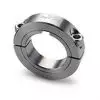 Keyed Shaft Collars
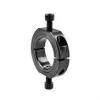 Mountable Shaft Collars
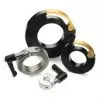 Quick Clamping Shaft Collars
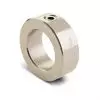 Set Screw Shaft Collars
 Thin Line Shaft Collars
 Threaded Shaft Collars – Pacific International Bearing Products
 Two-Piece Shaft Collars
 Friction Bearing Universal Joints
 Needle Bearing Universal Joints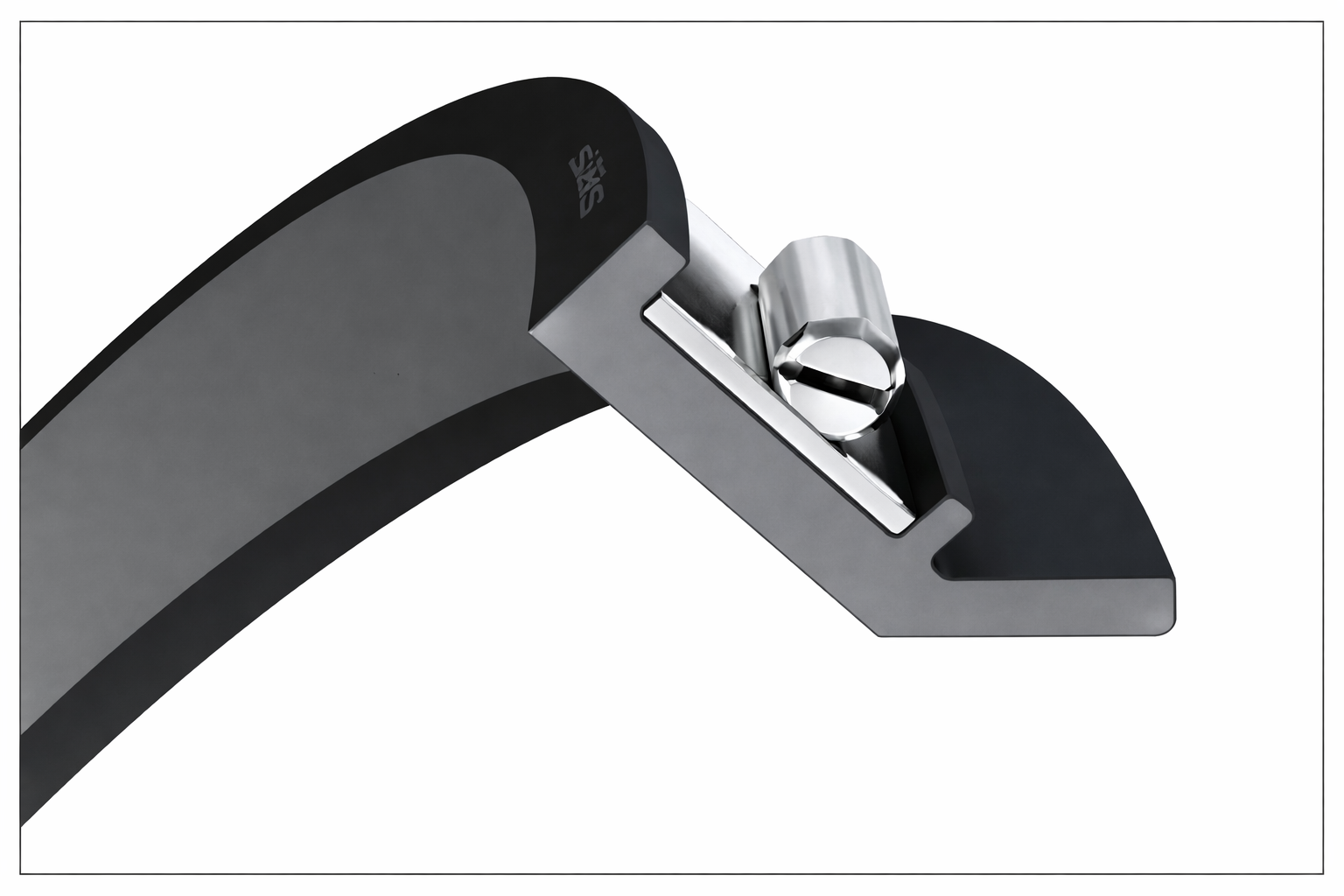
Bearings
Axial clamp seals
16 March, 2026
14 min read
Axial clamp seals are split, stationary seals that seal axially against a rotating counterface — ideal when shafts are large, contamination is heavy, and downtime is expensive. Pacific International Bearing Sales (PIB) typically recommends them when you need a robust “keep dirt out / keep uptime in” solution that installs fast, without pulling the shaft through a traditional radial seal.
Key Takeaways
- Axial clamp seals don’t rotate; they seal axially against a rotating counterface—so the counterface and alignment matter more than people expect.
- SKF makes two core designs: CT1 (one band clamp, +2.4 mm axial displacement) and CT4 (extra-wide, two band clamps, +4.8 mm axial displacement).
- Typical install uses an ~25 mm end gap positioned at 6 o’clock for drainage and easier installation; clamp screw torque should not exceed 7 Nm.
- If you treat it like a “regular lip seal,” you’ll miss the details that drive service life: seat tolerances, counterface finish, and axial movement allowance.
PIB related resources
- Browse + order via the PIB online catalog
- Explore sealing options in context
- SKF line overview (manufacturer page)
- Engineering + custom support
- Ask a question
Axial clamp seals solve a very specific (and very common) maintenance headache: sealing large or very large shaft diameters in dirty environments without turning every seal change into a teardown. SKF’s axial clamp seals are built from profiled, non‑reinforced nitrile rubber (NBR) and held in position with stainless steel band clamps, which is why they scale well into large diameters and remain service-friendly.
From an engineering standpoint, the “make or break” factors are measurable and straightforward: pick the right width/design (CT1 vs CT4), keep the seal seat dimensions within SKF’s published tolerance bands, make sure the counterface finish is in the recommended roughness range, and follow the installation sequence—especially the 6 o’clock joint position and the clamp screw torque limit.
If you already know your seat diameter and widths, the fastest next step is the PIB online catalog; if you don’t, PIB engineering support can work from a sketch/drawing and your contamination + axial movement conditions.
What an axial clamp seal is and why you’d choose one
The concept in plain language
An axial clamp seal is a split seal that installs around large rotating hardware and seals on an axial (face) interface rather than a radial one. It stays stationary and seals against a rotating counterface. That single sentence explains why these are so useful in harsh environments: large shafts plus contamination usually means frequent service and split installation makes service realistic.
SKF positions axial clamp seals as suitable for large/very large shafts and usable as primary seals or as secondary seals when primary seals are getting hammered by solid or fluid contaminants. In the field, that often looks like “protect the expensive primary seal and bearing cavity with a simpler, robust exclusion stage.”
A quick mental model: radial vs axial sealing
Below is a simple, not-to-scale diagram you can drop into a blog post to make the geometry obvious:
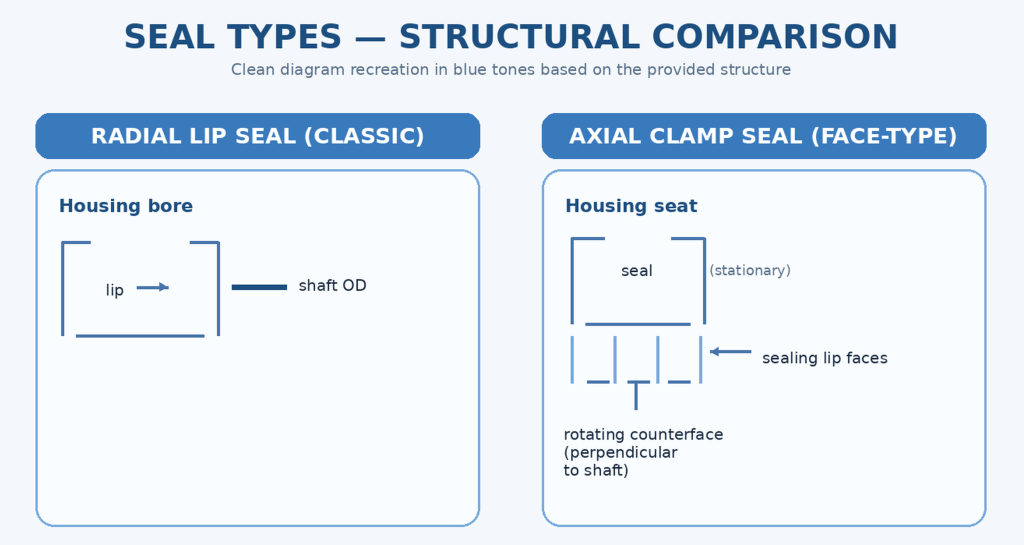
Key implication: with axial clamp seals, the counterface and axial alignment/movement are the first-order concerns — not just shaft OD like you’d do with a traditional radial seal.
When axial clamp seals are a strong fit
- Shaft diameters are large (SKF covers 150 to 4,600 mm).
- You’re dealing with contamination and need either a tough primary barrier or a secondary barrier that keeps “big grit” away from more sensitive sealing lips.
- You want installation that doesn’t require sliding a seal down the full length of a massive shaft.
PIB’s broader sealing content frames the business outcome well: seals sit between rotating shafts and stationary housings to keep lubricants in and contaminants out—so you get more reliable runtime and fewer messy failures.
CT1 vs CT4: a selection framework that actually holds up
SKF manufactures axial clamp seals in two designs. The naming is simple, but the selection logic matters.
What changes between the designs
CT1 is the “basic” design held by one band clamp; CT4 is extra-wide, uses two band clamps, and tolerates more axial displacement relative to the counterface.
The practical limits (straight from SKF):
- CT1 maximum permissible axial displacement: +2.4 mm (0.094 in.)
- CT4 maximum axial displacement: +4.8 mm (0.189 in.)
How to decide
If your interface has more axial movement (thermal growth, housing float, shaft dynamics, or real-life tolerances you can’t fully eliminate), CT4 is often the safer choice because it’s built for larger axial displacement and has the extra-wide design with two clamps.
If axial movement is controlled and small, and you want the simplest, service-friendly exclusion seal on a big diameter, CT1 is typically appropriate.
If you want a “procurement-friendly” rule of thumb for writeups: CT1 is the baseline; CT4 is the “more axial forgiveness” option. That matches the way SKF defines the two designs.
For sourcing and cross-checking availability alongside the manufacturer line – SKF
Engineering details that drive outcomes: seat, counterface, joint, torque
This is the section that prevents the “it fit, but it didn’t last” situation.
Material and retention hardware
SKF axial clamp seals are made from profiled strips of non‑reinforced NBR, held in position by stainless steel band clamps. The design intent here is clear: the seal body is resilient and serviceable, while the clamp provides the mechanical retention needed on large diameters.
Inch ranges, metric shafts, and the end gap
SKF notes the standard range is intended for inch-size shaft diameters, but because axial clamp seals are typically installed with an approximate 25 mm gap between the ends, they can also be used for metric shaft diameters. (That gap is also part of the design/installation guidance, not an accident.)
Seal seat geometry and why a shoulder helps
SKF calls out that for reliable sealing you should meet the requirements for:
- seal seat diameter d1
- seal seat width b1
- seal fitted width B1
Counterface finish
SKF’s guidance is refreshingly practical: finely turned counterfaces are adequate. Recommended roughness values are Ra 2.5 μm and Rt 12 μm.
Joint position: “6 o’clock” is a real operating detail
After installation, CT axial clamp seals typically have an ~25 mm gap between ends, and SKF recommends arranging that gap at the 6 o’clock position to facilitate installation and drainage of contaminants. That’s not cosmetic — it’s about where gravity and debris flow actually go.
Installation torque: don’t crush the clamp
SKF’s guidance is explicit: the torque applied to the clamp screws should not exceed 7 Nm. If you want one “installer-proof” value to bold in your internal work instruction, it’s that.
Specifications tables for SKF axial clamp seals
Two tables below: one for “engineering limits” (design and installation-critical numbers), and one for “seat dimension tolerance ranges” (the stuff that decides whether your housing seat is actually compatible).
Specifications summary: CT1 vs CT4
| Specification | CT1 | CT4 | Why it matters in the real world |
| Seal behavior | Stationary; seals axially against rotating counterface | Stationary; seals axially against rotating counterface | Confirms this is face-type sealing—counterface + axial alignment are key. |
| Typical role | Primary or secondary (when contaminants are heavy) | Primary or secondary (when contaminants are heavy) | Useful as an exclusion stage to protect primary seals/bearing cavity. |
| Seal material | Non‑reinforced NBR | Non‑reinforced NBR | Material baseline affects compatibility and wear behavior. |
| Clamp material / retention | Stainless steel band clamp(s) | Stainless steel band clamp(s) | Mechanical retention is how it survives large diameters. |
| Number of band clamps | 1 | 2 (extra-wide design) | Helps explain stability and why CT4 is “more forgiving.” |
| Max permissible axial displacement (relative to counterface) | +2.4 mm | +4.8 mm | This is the core CT1 vs CT4 decision point. |
| Shaft diameter availability (SKF range) | 150–4,600 mm | 150–4,600 mm | Makes the case for “big shaft” applications. |
| Typical installed end gap | ~25 mm | ~25 mm | Drives the “metric shaft possible” logic and joint placement guidance. |
| Recommended joint position | 6 o’clock | 6 o’clock | Supports drainage of contaminants; improves install repeatability. |
| Counterface finish (guidance) | Finely turned; Ra 2.5 μm; Rt 12 μm | Finely turned; Ra 2.5 μm; Rt 12 μm | One of the biggest predictors of leakage and wear. |
| Clamp screw torque limit | ≤ 7 Nm | ≤ 7 Nm | Prevents over-tightening that can distort the seal/clamp behavior. |
Seat dimension and tolerance bands (SKF application tolerances)
| Dimension (SKF notation) | Tolerance | CT1 range | CT4 range | Notes |
| Seal seat diameter (d1) | ±1.6 mm | 152.40–4,572 mm | 304.80–1,143 mm | This is the housing seat diameter the clamp seal sits in. |
| Seal fitted width (B1) | ±0.8 mm | 28.60–38.10 mm | 38.10–92.20 mm | CT4 covers much larger fitted widths (extra-wide). |
| Seal seat width (b1) | ±3.2 mm | 17.50–27 mm | 27–84 mm | Housing pocket width requirement. |
| Lip height (c1) | ±0.8 mm | 12.70 mm | 12.70 mm | Lip height is consistent across CT designs in the table. |
| Gap width (B3 max.) | (max.) 11.10 mm | 11.10 mm | 11.10 mm | Published max for gap width parameter in the tolerance table. |
FAQ table
| Question | Direct answer (PIB-style) | What to check next |
| Do axial clamp seals rotate with the shaft? | No. They stay stationary and seal axially against a rotating counterface. | Verify counterface finish and axial movement allowance. |
| Are these primary seals or “just excluders”? | They can be used as primary seals or as secondary seals when primary seals see excessive solid/fluid contamination. | Decide whether you’re protecting a primary lip seal or sealing directly. |
| CT1 vs CT4 — what’s the fastest decision rule? | Pick by axial movement: CT1 allows +2.4 mm; CT4 allows +4.8 mm and is extra-wide with two clamps. | Confirm housing space (B1 and b1 ranges) match your design. |
| Can I use them on metric shafts if the standard range is inch-based? | Often yes. SKF notes typical installation uses an ~25 mm end gap, which can make metric shaft use practical. | Confirm seat diameter and fitted width requirements; don’t “force fit.” |
| Why does SKF tell you to put the joint at 6 o’clock? | It helps installation and helps contaminants drain instead of packing into the joint. | Make it a standard work instruction for consistent installs. |
| What’s the most common install mistake? | Over-tightening the clamp screws. SKF says torque should not exceed 7 Nm. | Use a torque tool; don’t “hand-tight + feel.” |
| What counterface finish do I actually need? | Finely turned is adequate; SKF gives Ra 2.5 μm and Rt 12 μm guidance. | Confirm the counterface is perpendicular and stable under load. |
| How do I buy the right one quickly? | If you have the seat dimensions (d1, b1, B1) you can shop directly; if not, send a sketch and operating conditions and PIB can help translate them into a part choice. | Use the PIB online catalog and/or contact engineering support. |
Ready to spec and source axial clamp seals without a long back-and-forth?
Start with the PIB online catalog to match your seat diameter and width requirements:
If you want a second set of eyes on CT1 vs CT4, counterface finish, or “will this survive our contamination level?”, use PIB engineering support or send your details via [email protected].