Your cart is empty
 Short Rigid Couplings
 Controlflex Couplings
 Jaw Couplings
 Oldham Couplings
 Bearing Locknuts – TCN
 Double Wide Shaft Collars
 Heavy Duty Shaft Collars
 International Series Shaft Collars
 Keyed Shaft Collars
 Mountable Shaft Collars
 Quick Clamping Shaft Collars
 Set Screw Shaft Collars
 Thin Line Shaft Collars
 Threaded Shaft Collars – Pacific International Bearing Products
 Two-Piece Shaft Collars
 Friction Bearing Universal Joints
 Needle Bearing Universal Joints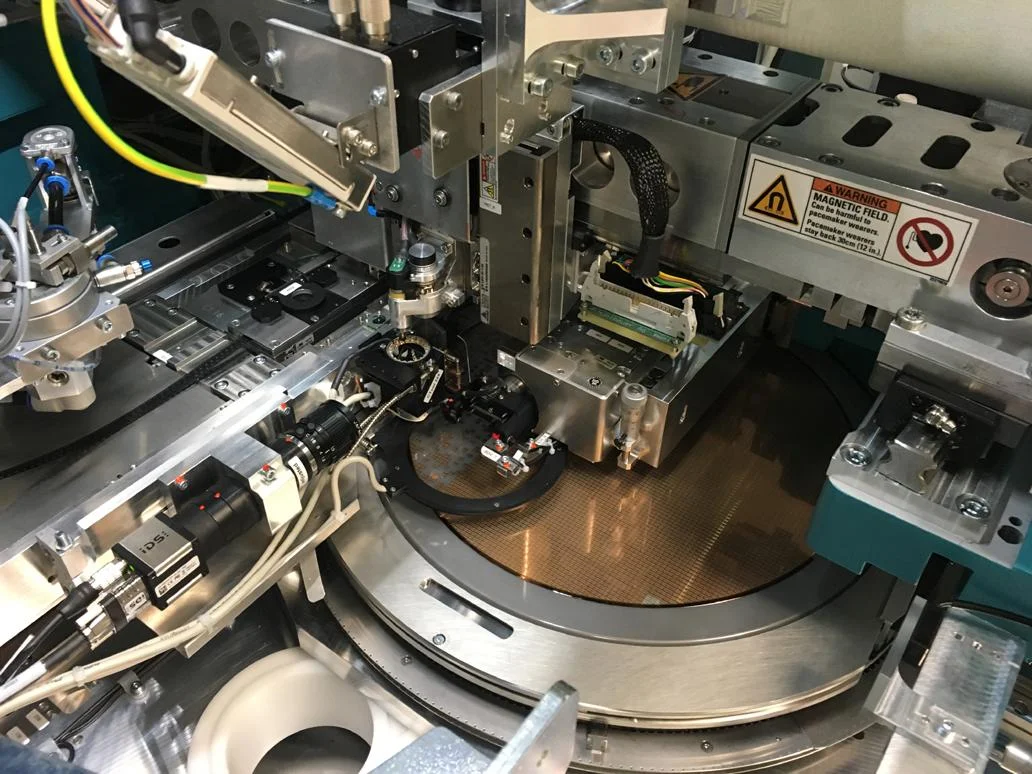
Bearings
Bearings Used in Semiconductor Pick-and-Place Machines
04 August, 2026
36 min read
Semiconductor pick-and-place machines repeat short, controlled movements at high cycle rates. The mechanism may lift a die, package, substrate, or other component, move it through several axes, correct its angular position, and place it within a tightly controlled process window.
Bearings support every part of that motion. They guide X-Y-Z positioning stages, locate rotary axes, support ball screws, carry grippers, and maintain the alignment of compact motors and inspection systems.
When the bearing arrangement is correct, the machine reaches position quickly and settles predictably. When stiffness, preload, lubrication, cleanliness, or mounting accuracy is wrong, the result may be rising torque, longer settling time, particle generation, or placement variation.
Pacific International Bearing Sales supports high-tech and high-performance bearing applications where motion quality depends on more than basic load capacity. For semiconductor pick-and-place equipment, PIB evaluates precision, friction, stiffness, contamination control, operating environment, and duty cycle together.
Motion Requirements in Semiconductor Pick-and-Place Equipment
A pick-and-place machine is not simply a positioning table. Its bearings operate as part of a coordinated motion system that may include servo motors, encoders, ball screws, linear motors, vision systems, vacuum tools, and force-control components.
The motion profile commonly includes:
1) Rapid acceleration away from the pickup position
2) Controlled movement through one or more axes
3) Deceleration near the placement point
4) A short settling period
5) Pickup or release
6) Immediate reversal toward the next cycle
These repeated moves create different bearing demands from continuous rotation at a steady speed.
Accuracy, repeatability, and resolution
These terms are related, but they are not interchangeable.
Accuracy describes how closely the mechanism reaches the commanded position.
Repeatability describes how consistently it returns to the same position.
Resolution describes the smallest movement the control and feedback system can command or detect.
A machine can have fine encoder resolution and still show poor placement repeatability if the bearings allow deflection, friction variation, or rotational play.
Bearing condition affects accuracy and repeatability through:
- Radial and axial runout
- Internal clearance
- Preload
- Friction variation
- Rail straightness
- Shaft and housing fits
- Structural deflection
- Lubricant behavior
- Thermal growth
The bearing is not the only source of positioning error. Encoders, drives, tooling, frames, calibration, and temperature also contribute. The purpose of the bearing system is to avoid adding uncontrolled motion to the total error stack.
Settling time and throughput
After a fast move, the stage or end effector may continue to vibrate briefly before it reaches a stable position.
Higher stiffness and controlled damping can reduce this motion. Excessive clearance, flexible bearing support, or unstable friction can make the control system work harder and increase settling time.
A machine may reach the commanded coordinate quickly but still be unable to pick or place until the residual movement falls within the required limit.
This is where bearing performance becomes a throughput issue. Small delays repeated across thousands of cycles can reduce output even when no bearing has technically failed.
Where Bearings Are Used
Semiconductor pick-and-place machines vary considerably. A compact die-handling machine and a large substrate-transfer system will not use identical bearing arrangements.
Common bearing positions include:
- X-Y positioning stages
- Vertical Z axes
- Theta or rotational alignment stages
- Compact servo and stepper motors
- Ball-screw support positions
- Gripper and end-effector pivots
- Vacuum pickup mechanisms
- Optical and camera positioning systems
- Index tables
- Rotary encoders
- Tool-changing mechanisms
- Transfer arms
- Wafer, tray, or carrier handling assemblies
Different positions may require miniature radial bearings, angular contact bearings, duplex arrangements, thin-section bearings, crossed-roller bearings, or linear guides.
The correct choice depends on how the position moves and what it must control.
A motor bearing may prioritize low torque and running accuracy. A rotary stage may prioritize moment stiffness. A Z axis may require controlled linear guidance and ball-screw support. A gripper bearing may make only a few degrees of oscillating movement but still need low, repeatable friction.
Miniature and Precision Ball Bearings
Miniature ball bearings are used where installation space is limited and rotational resistance must remain low.
Possible positions include:
- Compact drive motors
- Vacuum-tool mechanisms
- Gripper pivots
- Encoder shafts
- Small rotary stages
- Camera adjustments
- Tool changers
- Sensor mechanisms
Deep-groove miniature bearings can carry radial load and a limited amount of axial load in either direction. Their compact dimensions make them practical for small shafts and closely packaged mechanisms.
Precision and running behavior
A higher precision class can provide tighter control of dimensional variation and rotational runout. That can be useful where the bearing directly influences an encoder, optical path, spindle, or placement axis.
Higher precision should be selected because the mechanism requires it, not because the application is associated with semiconductor equipment.
A standard-precision bearing may be adequate in a lightly loaded auxiliary motor. A higher-precision bearing may be justified in a theta stage where angular runout affects placement.
ABEC class alone does not define:
- Bearing torque
- Noise
- Internal clearance
- Lubricant
- Preload
- Closure type
- Particle behavior
- Material
- Clean assembly condition
Two bearings with the same precision class can perform differently if these other variables are not equivalent.
Internal clearance
Internal clearance changes after the bearing is installed.
A tight shaft fit can expand the inner ring. A tight housing fit can compress the outer ring. Temperature differences can change the operating clearance further.
If clearance becomes too small, the bearing may develop:
- Higher torque
- Heat
- Lubricant stress
- Unstable speed
- Reduced life
- Increased particle generation
If clearance remains too large, the mechanism may show:
- Radial play
- Axial movement
- Runout
- Vibration
- Position variation
- Longer settling time
The goal is controlled operating clearance, not simply the tightest available bearing.
Materials and hybrid options
Chrome steel, stainless steel, and hybrid constructions may all be considered, depending on corrosion exposure, speed, electrical conditions, and cleanliness requirements.
Ceramic rolling elements may be useful in certain designs because of their mass, hardness, electrical behavior, or operating characteristics. They are not automatically required in every semiconductor machine.
Material selection should follow the actual load, speed, environment, lubricant, and reliability requirements.
Angular Contact, Duplex, and Preloaded Arrangements
Angular contact ball bearings carry combined radial and axial loads through an angled contact path.
They are useful where the shaft or stage must be located accurately in the axial direction.
Potential applications include:
- Ball-screw fixed supports
- Precision rotary stages
- Compact spindle arrangements
- Theta axes
- Motor shafts carrying thrust
- Vacuum-tool rotation mechanisms
A single angular contact bearing normally supports axial load more effectively in one direction. Bearings can be combined in pairs when the arrangement must carry thrust in both directions or provide greater moment stiffness.
Back-to-back arrangements
A back-to-back pair has pressure lines that spread outward.
This arrangement generally provides good resistance to overturning moment and can create a broad effective support span.
It may be useful where a rotary stage or screw shaft requires high angular stiffness.
Face-to-face arrangements
A face-to-face pair has pressure lines that converge inward.
It can tolerate certain alignment conditions differently but usually provides a smaller effective moment-supporting span than a comparable back-to-back pair.
The correct configuration depends on the housing, shaft, applied loads, and expected misalignment.
Tandem arrangements
A tandem arrangement places the bearings in the same load direction. It is used where greater axial-load capacity is needed in one direction.
A separate bearing arrangement may still be needed to support reverse thrust.
Preload
Preload removes internal clearance and establishes controlled contact between the rolling elements and raceways.
In precision motion systems, preload can improve:
- Axial stiffness
- Shaft location
- Reversal response
- Running accuracy
- Control-loop behavior
Too much preload increases torque and heat. Thermal expansion can raise preload further after the machine reaches operating temperature.
Too little preload may allow axial movement or variation during reversal.
There is no universal preload suitable for every semiconductor pick-and-place mechanism. The correct value depends on load, speed, bearing size, lubrication, temperature, fits, and required stiffness.
Thin-Section and Crossed-Roller Bearings
Compact rotary stages often require a large central opening for cables, vacuum lines, optics, or process access. At the same time, the bearing envelope must remain small.
Thin-section bearings provide a relatively large bore with a small radial cross-section.
They may be used in:
- Theta stages
- Index tables
- Inspection platforms
- Camera positioning assemblies
- Compact robot joints
- Wafer or substrate handling mechanisms
Thin-section bearing configurations can include radial-contact, angular-contact, and four-point-contact designs.
Radial-contact thin-section bearings
Radial-contact designs are primarily intended for radial load. Depending on the design and internal clearance, they may also support limited axial and moment loads.
Angular-contact thin-section bearings
Angular-contact versions provide stronger axial capability in one direction and may be paired for higher stiffness or bidirectional thrust.
Four-point-contact bearings
A four-point-contact bearing can support radial load, axial load in both directions, and moment load within one compact position.
That does not mean it is the best choice for every combined-load condition. High radial and axial loads acting together can affect how the balls contact the raceways.
The complete load case should be reviewed rather than selecting the design only because it can support several load directions.
Crossed-roller bearings
Crossed-roller bearings arrange adjacent rollers at alternating angles. This allows one compact bearing to resist radial, axial, and moment loads with high stiffness.
They are often considered for precision rotary and linear stages where deflection must remain low.
Their stiffness also makes them sensitive to mounting accuracy. A distorted housing or uneven mounting surface can change internal contact and increase running torque.
Before correction, a stage may show high torque or localized wear even though the bearing has sufficient catalog capacity. Once the mounting surface and fastener loading are corrected, the bearing can operate with more uniform contact.
Linear Guides and Ball-Screw Support
X-Y-Z positioning is commonly produced by linear motors, ball screws, belts, or other drive systems.
The drive creates motion. The guide bearings constrain that motion and support the carriage.
Linear guides and carriages may use recirculating balls or rollers running on profiled rails. Compact linear bushings and round-shaft systems may also be used in lighter axes.
Profiled linear guides
Profiled guides provide good stiffness and can carry loads in several directions. With suitable carriage spacing, they can also resist pitch, yaw, and roll moments.
Ball-type guides usually provide a practical balance of low friction, speed, and load capacity.
Roller-type guides generally provide greater stiffness but require more accurate mounting.
Rail spacing and carriage spacing
A stage with two closely spaced carriages may fit into a small envelope, but it may have limited moment resistance.
Increasing the distance between rails or carriages gives the bearing system more leverage against an overhung load.
This matters when the Z axis, camera, vacuum tool, or process head is offset from the guide plane.
The nominal carriage load can be modest while moment loading on one carriage remains high.
Parallelism and mounting accuracy
Parallel rails must remain aligned throughout the travel.
If one rail is twisted or mounted higher than the other, the carriage assembly may bind. Preloaded guides are particularly sensitive because they have less internal freedom to accommodate error.
A stage that feels rigid because it is difficult to move may actually be internally stressed.
Useful rigidity supports the applied load. Assembly-induced binding only increases drive force and wear.
Ball-screw supports
A ball screw requires rotary bearing support even though the output motion is linear.
The fixed end commonly uses a preloaded angular contact pair to locate the screw axially. The opposite end may use a simpler support that allows the required thermal behavior.
If the fixed support permits axial movement, the screw can shift during reversal before the carriage responds. This creates lost motion and increases settling time.
The linear guides must also keep side load away from the ball nut. A ball screw is intended to drive the axis, not correct guide misalignment.
Cleanroom Particles, Lubricants, and Closures
Cleanroom operation changes how bearings are specified, assembled, and maintained.
The objective is not only to prevent contamination from entering the bearing. The bearing must also avoid becoming a significant source of particles or lubricant migration.
Potential particle sources include:
- Raceway wear
- Cage wear
- Seal contact
- Corrosion
- Fretting at loose fits
- Lubricant degradation
- Assembly debris
- Contact between misaligned components
Grease quantity
Grease quantity matters in a compact precision bearing.
Too little grease can reduce film formation and increase wear.
Too much grease can increase churning, torque, heat, and leakage. Excess grease may also migrate toward adjacent optical, electrical, or process surfaces.
The correct fill depends on the bearing, speed, free volume, orientation, temperature, and duty cycle.
Lubricant selection
A cleanroom lubricant may be selected for:
- Low particle generation
- Low oil separation
- Controlled migration
- Stable torque
- Material compatibility
- Oxidation resistance
- Required temperature behavior
A lubricant that works in a general industrial motor may not provide the same results in a precision cleanroom stage.
Shields and seals
Metal shields create relatively little friction and help retain lubricant while limiting the entry of larger debris.
Contact seals provide stronger exclusion but add torque and can create their own wear particles.
Noncontact sealing arrangements may provide a useful balance where contamination control is needed but torque must remain low.
The closure should match the surrounding machine enclosure and operating environment. A bearing inside a protected stage may not need the same contact seal as a bearing near an open transfer mechanism.
Assembly cleanliness
A bearing specified for clean operation can still be contaminated during handling.
Lint, fingerprints, packaging debris, machining particles, or excess adhesive can enter the bearing or become trapped around the seals.
Clean assembly processes, suitable packaging, controlled tools, and careful lubrication handling are part of the bearing system.
Vacuum and Low-Outgassing Conditions
Cleanroom operation and vacuum operation are not the same.
A cleanroom controls airborne particle concentration around the equipment. A vacuum chamber operates at reduced pressure, changing lubricant behavior, heat transfer, and material outgassing.
Only machines or subsystems that operate under vacuum require a vacuum-specific bearing review.
Important factors include:
- Lubricant vapor pressure
- Outgassing
- Evaporation
- Material compatibility
- Heat dissipation
- Cage and seal materials
- Surface treatments
- Closure design
- Vacuum level and operating duration
A conventional grease may release volatile components under reduced pressure. Lubricant loss can change torque and shorten the useful operating period.
Heat is also more difficult to remove through convection in vacuum. Bearing friction that is acceptable in air may result in a different thermal condition inside a chamber.
Vacuum-compatible lubricant and material choices should be matched to the actual chamber conditions. “Low outgassing” is not a complete specification without the pressure, temperature, exposure time, and cleanliness requirements.
Stiffness, Runout, and Settling Time
The bearing system influences how quickly the mechanism reaches a stable position after a move.
Bearing deflection
Every loaded bearing deflects. The amount depends on bearing type, preload, contact geometry, load direction, and surrounding structure.
A small angular change at a rotary stage may become a larger positional error at the end of a long tool or transfer arm.
Runout
Radial and axial runout can affect:
- Theta alignment
- Camera positioning
- Encoder readings
- Tool concentricity
- Pickup alignment
- Placement height
- Vacuum-nozzle tracking
A bearing with controlled runout can still perform poorly if the shaft, housing, adapter, or mounting surface introduces additional error.
Control-loop settling
The servo system responds to motion detected by the encoder. Bearing clearance, friction variation, structural vibration, and preload all affect that response.
Before correction, the axis may overshoot, hunt around the target, or require a long dwell before placement.
After the bearing arrangement, preload, and structure are matched correctly, the mechanism can approach the commanded position with more predictable behavior.
The improvement does not come from the bearing alone. It comes from reducing uncontrolled motion within the complete mechanical loop.
Short-Stroke Cycling and Lubricant Redistribution
Many pick-and-place axes operate over short distances.
The carriage or bearing may repeatedly travel across the same small section of raceway rather than using its full available stroke.
This can create several concerns:
- Lubricant is not redistributed across the full contact
- The same rolling elements repeatedly load the same raceway region
- Small oscillations may promote fretting-type damage
- Local temperature may rise
- Wear can become concentrated
A bearing designed for long travel may require a different lubrication strategy when used in a short repetitive stroke.
Possible responses include:
- Reviewing lubricant viscosity and base oil
- Adjusting relubrication practices
- Adding periodic maintenance strokes
- Changing bearing preload
- Improving sealing and cleanliness
- Increasing carriage spacing
- Monitoring torque trends
There is no universal relubrication interval. The correct schedule depends on actual travel, speed, load, environment, and lubricant.
Common Failure Patterns
A single symptom does not prove one root cause, but it can guide inspection.
Rising axis torque
Possible causes include excessive preload, lubricant degradation, contamination, rail misalignment, housing distortion, seal drag, or thermal growth.
Longer settling time
Possible contributors include bearing clearance, loss of preload, structural looseness, increased friction variation, encoder mounting, drive tuning, or guide wear.
Particles near the stage
Inspect seals, cages, raceways, lubricant condition, corrosion, loose bearing fits, nearby cable carriers, and contacting covers. Do not assume every particle originated inside the bearing.
Repeated linear-carriage failure
Check rail parallelism, mounting flatness, moment load, carriage spacing, short-stroke operation, lubrication, contamination, and frame distortion.
Bearing noise after maintenance
Possible causes include contamination during assembly, incorrect grease quantity, installation force through the rolling elements, improper fits, damaged seals, or misalignment.
Rotary-stage wobble
Inspect bearing runout, preload, housing accuracy, shaft condition, fastener loading, structural stiffness, and the mounted tool or table.
Corrosion or surface staining
Review humidity, cleaning chemicals, material selection, lubricant coverage, storage, condensation, and process exposure.
Motor heating or electrical symptoms
Motor heat may be caused by increased bearing torque, rotor misalignment, winding issues, drive settings, or load changes. Electrical current through bearings may also require review in certain motor designs.
Selection Priorities for OEMs
Bore, outside diameter, and width are necessary parts of the bearing specification. They establish the installation envelope and interchange requirements.
The complete selection should also consider:
- Radial, axial, and moment loads
- Speed and acceleration
- Stroke length
- Start-stop frequency
- Accuracy and repeatability
- Runout
- Required stiffness
- Internal clearance
- Preload
- Operating torque
- Cleanroom requirements
- Vacuum exposure
- Particle limits
- Lubricant
- Closure type
- Material
- Temperature
- Shaft and housing fits
- Mounting accuracy
- Documentation and traceability
- Maintenance access
The correct bearing is the one that fits both the hardware and the motion requirement.
Two dimensionally similar bearings may behave differently because of lubricant, preload, cage, precision, closure, material, or internal geometry.
Before the complete specification is established, the axis may meet its load requirement but fail to settle quickly or operate cleanly. Once the mechanical and environmental requirements are matched, the bearing becomes a stable part of the motion system rather than a recurring source of variation.
Frequently Asked Questions
Do all semiconductor pick-and-place machines require ABEC 7 bearings?
No. The required precision class depends on the bearing position and its influence on runout, alignment, and repeatability. Some auxiliary positions may use standard precision, while critical rotary or encoder axes may justify a higher class.
Are ceramic bearings required in semiconductor equipment?
No. Hybrid or ceramic configurations may be useful for specific speed, electrical, corrosion, or operating requirements. Steel and stainless bearings remain appropriate in many positions when their material, lubrication, and precision match the application.
What bearings are used in X-Y-Z pick-and-place axes?
Profiled linear guides, compact linear bearings, and ball-screw support bearings are common options. The final arrangement depends on load, travel, stiffness, acceleration, moment forces, cleanliness, and how the drive system generates motion.
Why is preload used in precision pick-and-place stages?
Preload reduces internal clearance and increases stiffness, helping the axis respond more consistently during reversal. Excessive preload raises torque and temperature, so it must be balanced against speed, lubrication, thermal growth, and drive capacity.
Are cleanroom bearings the same as vacuum bearings?
No. Cleanroom specifications focus primarily on particle control and lubricant migration. Vacuum operation also introduces outgassing, lubricant evaporation, reduced convective cooling, and material compatibility requirements associated with low pressure.
When are thin-section bearings useful?
Thin-section bearings are useful when a rotary stage needs a large bore for cables, optics, or vacuum lines but has limited radial installation space. The supporting housing must be accurate and stiff enough to avoid distorting the bearing.
Why do short strokes affect linear bearing lubrication?
Short strokes repeatedly load the same section of raceway and may not redistribute lubricant effectively. This can concentrate wear and increase the risk of lubricant starvation or fretting-type damage in the active travel zone.
What causes rising torque in a semiconductor positioning stage?
Potential causes include excess preload, misaligned rails, contaminated lubricant, housing distortion, seal drag, corrosion, thermal growth, or damaged raceways. Torque trends should be evaluated together with temperature, vibration, and maintenance history.
How should bearing particle generation be controlled?
Use suitable materials, lubricant quantity, closures, fits, and assembly cleanliness. Misalignment, corrosion, loose rings, worn cages, damaged seals, and lubricant breakdown should also be controlled because each can generate debris.
Can a replacement bearing be selected by dimensions alone?
Dimensions confirm that the bearing fits the shaft and housing, but the replacement should also match precision, clearance, preload, lubricant, closure, material, torque, and environmental requirements.
Final Considerations
Bearings used in semiconductor pick-and-place machines influence more than load support. They affect positioning stiffness, runout, settling time, friction, particle control, and repeatability across high-cycle motion.
Miniature ball bearings suit compact motors and grippers. Angular contact and duplex arrangements support controlled axial location and preload. Thin-section and crossed-roller bearings provide compact rotary-stage stiffness, while linear guides control X-Y-Z movement.
The correct result depends on how these bearings are installed and operated. Mounting accuracy, lubricant, cleanliness, short-stroke behavior, temperature, and vacuum exposure can be as important as the bearing type itself.
The PIB online catalog is a practical starting point for reviewing miniature, angular contact, thin-section, and linear bearings for semiconductor motion systems. For applications involving unusual preload, cleanroom lubrication, vacuum operation, compact packaging, or repeatability requirements, PIB can help review the operating position and available sourcing options.