Your cart is empty
 Short Rigid Couplings
 Controlflex Couplings
 Jaw Couplings
 Oldham Couplings
 Bearing Locknuts – TCN
 Double Wide Shaft Collars
 Heavy Duty Shaft Collars
 International Series Shaft Collars
 Keyed Shaft Collars
 Mountable Shaft Collars
 Quick Clamping Shaft Collars
 Set Screw Shaft Collars
 Thin Line Shaft Collars
 Threaded Shaft Collars – Pacific International Bearing Products
 Two-Piece Shaft Collars
 Friction Bearing Universal Joints
 Needle Bearing Universal Joints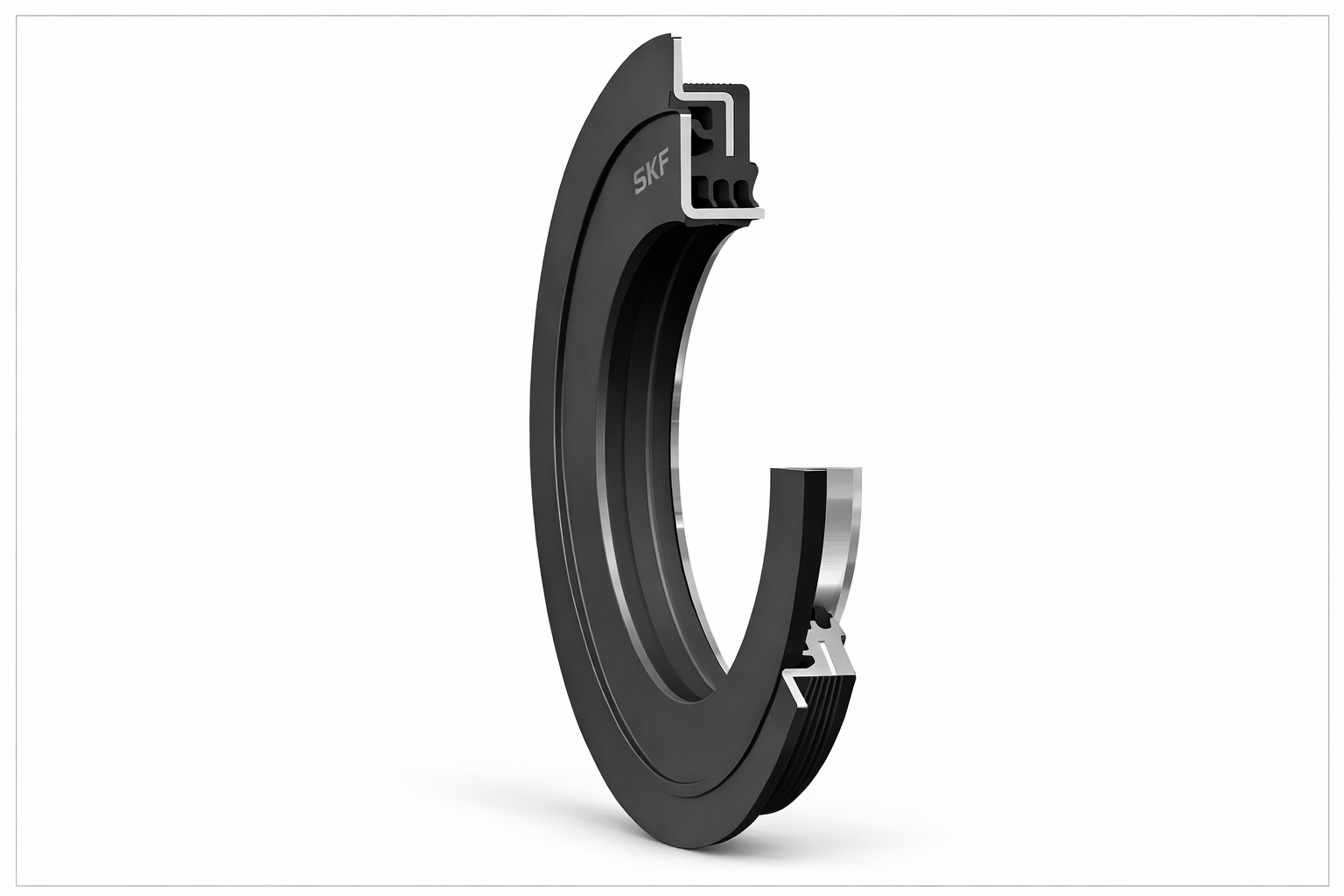
Bearings
Cassette seals
06 March, 2026
16 min read
Cassette seals are unitized, heavy-duty rotary shaft sealing solutions that combine multiple sealing lips with an integrated wear sleeve to keep lubricant in and contaminants out — especially in mud, water, dust, and slurry. For wheel-ends and off-highway equipment, they’re often the simplest way to reduce leakage, slow bearing wear, and extend service intervals.
Key Takeaways
- Cassette seals “bundle” an oil seal + wear surface + contaminant into one unit, reducing shaft finish sensitivity and simplifying retrofits.
- In lab comparisons for SKF Mudblock MUD11, results included up to 50% longer service life, up to 20% less friction, and up to 1,700 hours longer in mud-slurry tests versus competitor designs (results vary by application).
- “Oil vs. grease” matters: SKF positions MUD11 for oil/grease heavy-duty use and MUD6 specifically for grease-lubricated heavy-duty environments.
- Installation quality is a performance multiplier—shaft/housing finish and fit targets (example guidance: h8/H8 with Ra 1.6–3.2 μm) help prevent leaks and premature lip wear.
- Pacific International Bearing Sales stocks and supports cassette seals as part of its CR Seals from SKF portfolio; PIB also provides engineering support when the application needs it.
Cassette seals are built for the exact situations where traditional single-lip radial shaft seals struggle: contaminated environments, wheel-end exposures, and duty cycles where a little leakage becomes a lot of downtime. Their unitized architecture puts multiple sealing interfaces and an internal wear surface into one handled part, helping protect both the seal lips and the shaft from grooving.
A concrete example is SKF’s Mudblock cassette seals. SKF describes MUD11 as a new-generation, bidirectional cassette seal for harsh heavy-duty applications (oil and grease), emphasizing contaminant exclusion and oil retention. SKF also reports comparative lab tests showing meaningful improvements in service life and friction versus competitor cassette seal designs, important because friction is one of the hidden drivers of lip wear and heat.
For maintenance and engineering teams, the “win” is rarely the seal alone; it’s the knock-on effect: cleaner lubricant, fewer bearing failures, longer wheel-end life, and fewer emergency tear-downs in the middle of a season or project. That’s why PIB typically frames cassette seals as a reliability upgrade, not just a replacement part.
Cassette Seals
What a cassette seal is :
A cassette seal is a unitized rotary seal assembly. Instead of installing a separate oil seal and then worrying about the shaft wear surface (or adding a sleeve later), cassette seals integrate multiple sealing/excluding elements and an internal wear sleeve/counterface into one piece. Manufacturers highlight that the sealing elements ride on a self-contained internal surface, which reduces shaft finishing requirements and helps prevent shaft grooving.
Trelleborg describes the concept similarly: an “all-in-one” solution combining oil retention, wear sleeve function, and dust protection—targeted at low pressure, moderate speed rotary applications.
Why cassette seals outperform “standard” seals in harsh duty
Traditional radial shaft seals can work well—until they don’t. In wheel-ends and slurry exposure, the combination of abrasive ingress + lubricant loss + lip wear can accelerate bearing damage. SKF’s Mudblock brochure explicitly connects harsh conditions with seal failure mechanisms that can lead to contaminant ingress, lubricant loss, and premature bearing failures.
Comparison with other seal types
Cassette seals aren’t “better than everything”—they’re better for the right job:
- Standard radial shaft seals: compact and cost-effective, but often more sensitive to shaft condition and contamination when used alone in severe environments.
- V-rings (axial excluders): great as a contaminant barrier on rotating shafts and often used as a secondary defense, but they’re typically part of a sealing system rather than a full oil-retention solution by themselves.
- Metal face seals / mechanical face seals: excellent in certain slow-speed, heavily contaminated environments, but different envelope, cost, and mating-surface requirements than cassette seals. (Selection is application-specific.)
- Cassette seals: strongest fit when you need oil/grease retention + contaminant exclusion + a controlled wear surface in one handled assembly.
Before-and-after
| Scenario | “Before” (common setup) | “After” (cassette seal approach) | Outcome you usually feel first |
| Wheel-end in mud/washdown | Single-lip seal + separate wear sleeve (or none) + frequent inspection | Unitized cassette seal with integrated counterface + multiple exclusion lips | Less leakage, fewer lip failures from contamination, less shaft damage risk |
How Cassette Seals Are Built
Manufacturers tend to describe cassette seals as “multi-lip, unitized” designs—those words matter because each feature targets a specific failure mode.
A representative design breakdown (example: SKF Mudblock MUD11) includes:
- Half metal / half rubber outside diameter to improve static sealing, heat dissipation, and retention in the housing.
- Spring-loaded main lip to maintain sealing force and reduce leakage; SKF notes it supports sealing regardless of rotation direction.
- Multiple auxiliary sealing lips (often pre-greased) to exclude contaminants and support the main lip.
- Integrated counterface (wear sleeve) so the seal runs on a controlled surface and can reduce or eliminate shaft machining requirements.
- Curl / closed unitized geometry to protect components during handling and installation while keeping the assembly together.
Materials and why they are chosen
“Rubber is rubber” is a fast path to repeat work. Cassette seal materials matter because they control wear, heat, oil compatibility, and low-temperature behavior.
In SKF’s Mudblock MUD11 example, SKF highlights an SKF-developed nitrile rubber compound formulated to reduce wear and ageing and compatible with most synthetic oils.
You’ll also see material variants by duty:
- Example SKF MUD11 “R” variants use nitrile rubber (NBR) for the sealing lip material, with published operating temperature ranges like -40 °C to +80 °C on specific sizes.
- Example SKF MUD11 “VV” variants use fluoro rubber (FKM) and show higher max temperatures like +120 °C on certain sizes.
- Parker’s cassette seal bulletin (industry reference) lists typical ranges for standard designs: NBR -29 to 121 °C, FKM -40 to 204 °C (design-dependent).
Performance Advantages and Common Applications
Performance benefits (what matters to maintenance and operating cost)
SKF positions cassette seals for wheel-end protection and backs that with comparative testing for MUD11 versus competitor cassette seal designs. Reported results include:
- Up to 50% longer seal service life (rounded comparisons; results vary by application).
- Up to 20% less friction in friction torque tests, attributed to geometry + nitrile rubber material composition (again, application-dependent).
- Up to 1,700 hours longer to failure in mud slurry tests compared to a competitor seal in the reported test setup.
Where cassette seals are commonly used
SKF notes cassette seals (Mudblock) are widely used in wheel-end applications such as front and rear axles of tractors, agricultural machinery, construction equipment, forestry equipment, and off-highway trucks.
Parker’s overview also emphasizes severe operating conditions—washdown spray, debris, mining/agriculture/power generation environments—where exclusion and reliability are the core goals.
ROI / benefit case
Here’s the realistic economics: seals are cheap; downtime isn’t.
Before: A wheel-end leak forces an unscheduled stop. The seal swap is quick, but contamination has already started working against the bearing set—so you’re back soon, usually with bigger labor and parts. SKF explicitly links seal failures in harsh conditions to contaminant ingress, lubricant loss, and premature bearing failures.
After: A cassette seal upgrade can reduce that chain reaction by improving both oil retention and contaminant exclusion, while also reducing friction (heat) and protecting the running surface with the integrated counterface. SKF’s MUD11 testing claims and design description align directly to these failure modes.
Practical KPI targets to track after switching (typical maintenance view): leak-related work orders, lubricant condition/consumption, wheel-end temperature trend, and bearing replacement interval. (Exact results vary by duty cycle and installation quality.)
Selection, Installation, and Troubleshooting
Selection: a fast decision path that avoids wrong fits
Cassette seals are not “one-size-fits-all.” Use a selection flow that forces the right questions early:
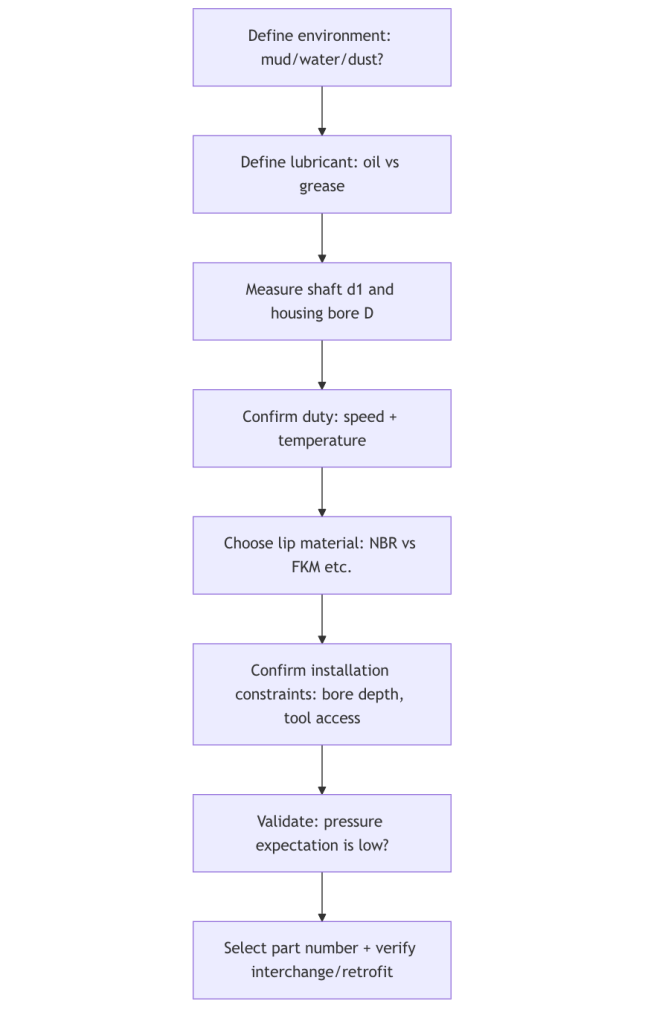
Why this flow works: SKF separates Mudblock designs by lubrication focus (e.g., MUD11 for heavy-duty, oil/grease; MUD6 developed for grease-lubricated heavy duty), and published product pages show temperature/speed limits changing with material/design variant.
High-speed note: SKF specifically mentions a MUD11 HS (high speed) design for higher-speed needs — if your shaft speed is above the standard design limits, treat this as an engineering conversation, not a quick swap.
Installation tips
A cassette seal is unitized, but it still depends on correct fits, surface finish, and clean handling.
SKF’s Mudblock brochure provides example installation guidance including:
- Install the seal into the housing bore with a proper tool, then introduce the shaft.
- Recommended surface roughness values: shaft h8 with Ra 1.6–3.2 μm, and housing bore H8 with Ra 1.6–3.2 μm.
- Example for a specific size (48×75 MUD11 R): bore depth clearance c min. 1 mm and installation tool dimensions are called out in the product spec excerpt.
Maintenance and troubleshooting
Most cassette seal “failures” in the field come down to a small set of causes:
If you see leakage shortly after installation, check (1) shaft/bore finish and fit, (2) installation damage to lips, (3) incorrect seal orientation or bottoming during press-in, and (4) pressure expectation mismatch (cassette seals are typically for low pressure—design dependent).
If you see heat or accelerated lip wear, check shaft surface speed against the published limit for that specific part number and compound. Example SKF MUD11 R sizes show a standard shaft speed limit of 200 r/min and include surface speed maxima by size (e.g., 0.5 m/s for 48×75; 1.15 m/s for 110×140).
If you see contaminant ingress, review whether the application needs a more aggressive exclusion geometry (or an additional external excluder). The point of the cassette architecture is multiple sealing/excluding interfaces, but the environment still matters.
Specifications, FAQs, and Buying from PIB
Typical cassette seal specifications and representative part numbers
Below is a representative specification table using published examples (SKF part-specific excerpts and an industry “typical range” reference). Always verify final selection against the exact application and the exact product spec for the part number you’re buying.
| Example / family | Lubrication focus | Lip material | Shaft d1 (mm) | Housing bore D (mm) | Width B / b (mm) | Operating temp (°C) | Max speed | Pressure capability |
| SKF MUD11 R (example) 48×75 MUD11 R | Oil-lubricated heavy duty (also targets grease/oil retention) | NBR | 48 | 75 | 13.5 / 14 | -40 to +80 | 200 r/min; 0.5 m/s surface speed | Low (design-dependent); see typical range row |
| SKF MUD11 R (example) 110×140 MUD11 R | Heavy-duty wheel-end sealing | NBR (70A) | 110 | 140 | 15 / 16 | -40 to +80 | 200 r/min; 1.15 m/s surface speed | Low (design-dependent); see typical range row |
| SKF MUD11 VV (example) 90×125 MUD11 VV | Heavy-duty wheel-end sealing | FKM | 90 | 125 | (varies by size; confirm per spec) | -20 to +120 | 200 r/min | Low (design-dependent); see typical range row |
| Typical cassette seal range (industry reference) | Severe contamination / harsh duty | NBR or FKM | ~10–350 (size range reference) | — | — | NBR: -29 to 121; FKM: -40 to 204 | Up to 16.3 m/s surface speed (design-dependent) | 0–0.34 bar (0–5 psi), design & speed dependent |
Common SKF cassette seal part-number patterns (examples):
- 48×75 MUD11 R
- 55×80 MUD11 R
- 110×140 MUD11 R
- 90×125 MUD11 VV
FAQ
Are cassette seals directional (do I need to worry about rotation direction)?
Many are designed to be bidirectional; for example, SKF describes MUD11 as a bidirectional cassette seal concept and also notes sealing support regardless of rotation direction in its design explanation.
What’s the biggest installation mistake with cassette seals?
Damaging lips during press-in or forcing the assembly without the right tool/clearance is common. SKF’s guidance emphasizes proper tooling, bore depth clearance, and controlling the shaft/housing surface condition.
Do cassette seals eliminate the need for shaft machining or wear sleeves?
Often, yes — because the design can include an integrated counterface (wear sleeve) that the seal runs on, which SKF notes can eliminate costly shaft machining requirements.
When should I choose FKM over NBR?
If your operating temperature is higher or the media is more chemically aggressive, FKM variants can offer higher temperature capability. SKF product examples show higher maximum temperature for FKM variants (e.g., 120 °C) than NBR examples (e.g., 80 °C) on the cited sizes, and industry references show typical ranges following that same trend.
Does PIB help with selection, cross-references, and troubleshooting?
Yes. PIB states it stocks CR Seals from SKF including cassette seals and works with customers to match the right sealing solution; PIB also highlights engineering support for selection and troubleshooting.
If you’re upgrading from “good enough” sealing to something that survives real-world contamination, PIB can help you size, cross-reference, and source the right cassette seal for your wheel-end or rotating equipment. Browse the PIB online catalog or contact us at [email protected]