Your cart is empty
 Short Rigid Couplings
 Controlflex Couplings
 Jaw Couplings
 Oldham Couplings
 Bearing Locknuts – TCN
 Double Wide Shaft Collars
 Heavy Duty Shaft Collars
 International Series Shaft Collars
 Keyed Shaft Collars
 Mountable Shaft Collars
 Quick Clamping Shaft Collars
 Set Screw Shaft Collars
 Thin Line Shaft Collars
 Threaded Shaft Collars – Pacific International Bearing Products
 Two-Piece Shaft Collars
 Friction Bearing Universal Joints
 Needle Bearing Universal Joints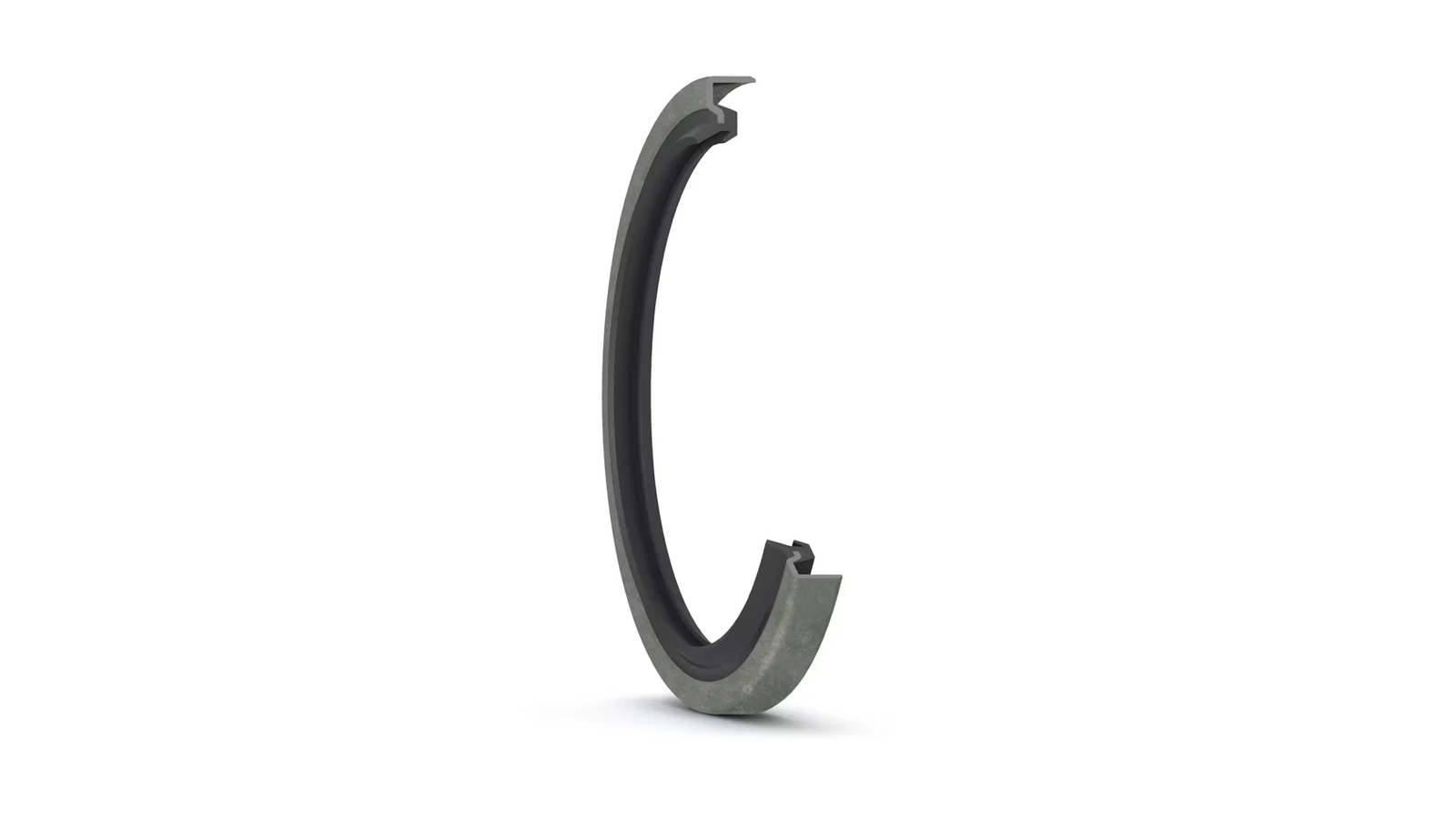
Bearings
Kingpin Seals: How They Work, Why They Fail, and How to Specify the Right Fix
17 April, 2026
11 min read
Kingpin seals sit at the ends of a steering axle’s kingpin and do two jobs: keep grease where the kingpin bearings/bushings need it, and keep water and grit out. Pacific International Bearing Sales (PIB) helps you match the seal-and-bearing stack to duty cycle, contamination, and service interval.
Key Notes
- Kingpin seals control grease retention, purge, and contamination exclusion so the kingpin joint stays tight and predictable.
- SKF positions its kingpin seal approach as a system: a special kingpin seal + an angular contact spherical plain bearing to reduce frequent lubrication and keep contaminants out.
- If steering systems use positioning sensors, SKF highlights a real constraint: sensors should not be sitting in grease, so sealing and lubrication strategy must be planned together.
- Many installation failures come down to: seal orientation and someOEM instructions do not include lip direction or visible orientation marks.
- Inquiries should include the axle/knuckle, kingpin dimensions, contamination level, lubrication strategy ( synthetic vs. conventional grease), and service interval goals then confirm the seal+bearing stack works as a unit.
What a kingpin seal actually protects
A steer axle kingpin is the pivot point between the axle beam and the steering knuckle/wheel end, accommodating loads, shock, steering cycles, and whatever water/dust/salt.
Kingpin seals are typically “grease seals” in the steering knuckle area. OEM-style service instructions treat them as a normal wear item during kingpin service: remove old grease seals from the knuckle kingpin bores, clean the bores, and install new seals with the correct lip orientation.
From a reliability standpoint, a kingpin seal is a small part that influences big outcomes:
- When grease stays clean and where it belongs, the kingpin joint stays smoother and longer-lived. When grease is washed out or contaminated, wear accelerates and steering feel degrades.
- Improper lubrication is a known driver of kingpin wear; common symptoms can show up as alignment problems, uneven tire wear, and rough handling.
The SKF approach: why kingpin seals are often a system decision
SKF describes kingpin sealing as a combined solution — a special kingpin seal working with an angular contact spherical plain bearing — to improve grease retention and contamination exclusion, with the goal of eliminating frequent lubrication of the steering axle kingpin.
- A kingpin joint isn’t a high-RPM rotating shaft seal problem. It’s typically oscillating/steering motion in a harsh environment. SKF’s engineering messaging repeatedly frames off-highway axles and kingpins as maintenance challenges because they’re low to the ground and constantly exposed to abrasive contaminants and water.
- SKF also highlights sensor integration: in electronic steering systems, kingpin position sensors need accurate, stable conditions and should not be submerged in grease; SKF presents a bearing + PTFE-coated seal approach designed to exclude contaminants without relying on grease/oil in the sensor environment.
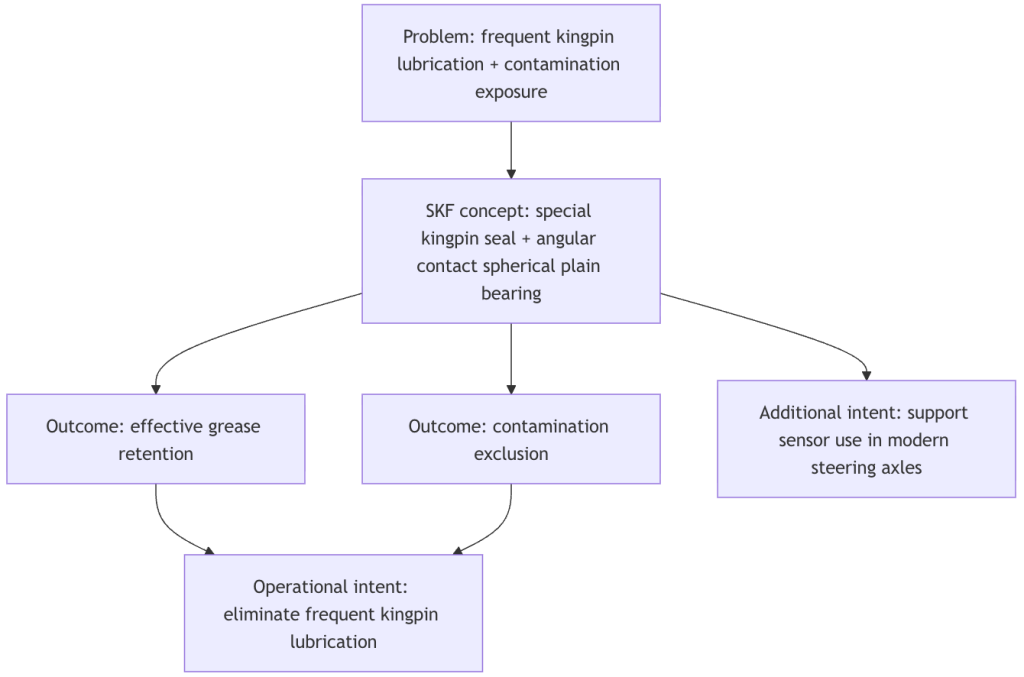
SKF’s “system” logic in one view — seal + bearing pairing → grease retention + exclusion → fewer lubrication events (where applicable).
Specifications table: what to include in a kingpin seal RFQ
Kingpin seals don’t live in a vacuum. OEM bulletins and installation instructions show how many pieces sit around the kingpin — thrust bearings, shims/spacers, sealing plugs, and grease seals — so your RFQ should describe the whole interface, not just a part number.
Kingpin seal specification checklist
| Specification item | What it controls | What to provide (practical detail) |
| Vehicle / axle / knuckle identification | Fit, geometry, and service procedure compatibility | Axle model, knuckle casting/part IDs, model year range, or the current kingpin kit reference. |
| Seal locations needed | Upper vs. lower designs can differ | Confirm if you need upper, lower, or both seals; note any cap/plug design constraints. |
| Kingpin & bore dimensions | Basic fit | Kingpin diameter, knuckle bore dimensions, and any depth/shoulder constraints (even small changes matter). |
| Lubrication strategy | Whether the seal should retain grease, allow purge, or avoid lubrication entirely | Grease-lubricated with periodic service, or “reduced/frequent lubrication eliminated” target using a system approach (seal + bearing). |
| Grease type (especially synthetic) | Compatibility and seal swell risk | Conventional vs. synthetic grease; note OEM warnings that some seals can expand with some synthetic greases. |
| Contamination exposure | Required exclusion performance | Road salt/water spray, mud slurry, dust/grit, washdown, etc. (Think “what actually hits the knuckle.”) |
| Sensor requirements | Whether grease is acceptable in the sensor zone | Any steering angle sensing / electronic steering requirements where grease intrusion is undesirable. |
| Temperature range and duty cycle | Material and bearing system constraints | Ambient + operating temps; low-speed oscillation frequency; shock load expectation (especially off-highway). |
| Service interval goal | Defines “success” | Target lubrication interval (or elimination of frequent lubrication), inspection cadence, and life-to-overhaul objective. |
A quick system note if you’re pairing with angular contact spherical plain bearings
SKF documentation on angular contact spherical plain bearing arrangements describes paired configurations (back-to-back or face-to-face) and the role of preload/adjustment after mounting.
If you’re moving toward a maintenance-free bearing option that uses a PTFE-based sliding layer, pay attention to allowable temperatures and any load reductions at elevated temperature — SKF’s catalog notes an operating range for certain steel/PTFE FRP designs and flags reduced load capacity at higher temperatures.
Common failure patterns and what to check first
A worn kingpin joint rarely fails quietly. You typically see it in driver feedback (pull, shimmy, steering effort changes) and in tire wear patterns long before it becomes a “we’re down today” breakdown.
The practical troubleshooting flow is usually:
- verify lubrication is actually reaching the joint,
- verify seals are installed correctly and still functional,
- measure play/wear per OEM procedure,
- then decide: seal-only service vs. full kit vs. system redesign.
Troubleshooting table
| Symptom you see | Likely driver | What to check immediately |
| Uneven tire wear / alignment drift feel | Kingpin/bushing wear can manifest as alignment issues | Inspect kingpin/bushing wear and confirm lubrication discipline; Graco explicitly connects improper lubrication to wear and tire/handling symptoms. |
| Grease purges oddly, leaks constantly, or never purges | Seal orientation/installation mismatch, or grease path blocked | OEM bulletins and kit instructions stress correct seal direction; some seals have visible orientation marks and are designed to allow discharge/purge. |
| “We grease it, but it still feels rough” | Grease contaminated, joint already worn, or grease not reaching surfaces | Follow OEM lubrication procedure: grease until fresh grease is seen at the purge points (Freightliner procedure describes pumping until new grease flows at specific interfaces). |
| Hard steering / binding | Lack of lubrication or damaged interface surfaces | Fleet service guidance emphasizes lubrication as critical preventive maintenance for kingpins; confirm grease type, interval, and flow. |
| Sensor issues in steering/position feedback systems | Grease contamination in sensor area | SKF’s sensor-related guidance for kingpin solutions focuses on keeping the environment free of contaminants and lubricants for accurate performance. |
Seal orientation is not “close enough”
Two examples from authoritative service literature:
- Dana/Spicer kingpin seal installation instructions explicitly say the seal lip should point toward the center of the knuckle (and illustrate lip direction for top vs. bottom).
- An Isuzu service bulletin notes kingpin grease seals must be installed in the proper direction to allow grease discharge, using white marks on the downward side of the seal as the cue.
That’s not trivia — it’s the difference between “grease gets where it needs to go and purges contamination” vs. “grease builds pressure, bypasses, or never flushes out.”
FAQ
Are kingpin seals the same thing as radial shaft seals?
Not really. A radial shaft seal is typically designed around a rotating shaft/housing interface. A kingpin joint is usually oscillating steering motion with a grease-lubricated interface and aggressive contamination exposure. That’s why SKF and OEM service literature treat kingpin sealing as its own application problem.
Do better kingpin seals mean “no more lubrication”?
Sometimes the goal is “less frequent lubrication,” and SKF’s kingpin seal messaging explicitly points in that direction — using a special kingpin seal combined with an angular contact spherical plain bearing to improve grease retention and keep contaminants out. But many OEM procedures still assume periodic greasing and purge behavior, so the right answer depends on your axle design and uptime goals.
Why do some kingpin seals seem designed to let grease out?
Because purge is part of contamination control in many grease-lubricated joints. Freightliner’s procedure, for example, describes pumping grease until fresh grease appears at defined interfaces; an Isuzu bulletin also describes seal orientation for grease discharge. You’re not just lubricating — you’re flushing.
What’s the fastest way to ruin a new kingpin seal?
Incorrect installation is near the top of the list. OEM and kit instructions emphasize seal direction, lip orientation, and alignment. Get that wrong and you can block purge, lose grease fast, or invite contamination.
Do grease types matter for kingpin seals?
Yes. Some OEM guidance flags that certain seals may expand with some synthetic greases, so the lubrication choice and seal material compatibility should be treated as one decision.
If we have steering angle sensors, what changes?
SKF explicitly calls out that sensors in modern steering axle systems should not remain inside the grease typically applied. In practice: you may need a sealing/bearing approach that keeps the sensor area clean and stable, not a “more grease everywhere” approach.
Use the PIB online catalog to select most suitable bearing
Start with the PIB online catalog to filter by category (bearings, radial ball bearings, rod ends, spherical plain, thin section, thrust, etc.), then narrow by dimensions and manufacturer series.
For several categories, PIB also notes you can download brand PDFs that cover specs/dimensions/applications — useful when you want an RFQ package that engineering and purchasing both trust.
Call 800-228-8895 or email [email protected]
1
/
1