Your cart is empty
 Short Rigid Couplings
 Controlflex Couplings
 Jaw Couplings
 Oldham Couplings
 Bearing Locknuts – TCN
 Double Wide Shaft Collars
 Heavy Duty Shaft Collars
 International Series Shaft Collars
 Keyed Shaft Collars
 Mountable Shaft Collars
 Quick Clamping Shaft Collars
 Set Screw Shaft Collars
 Thin Line Shaft Collars
 Threaded Shaft Collars – Pacific International Bearing Products
 Two-Piece Shaft Collars
 Friction Bearing Universal Joints
 Needle Bearing Universal Joints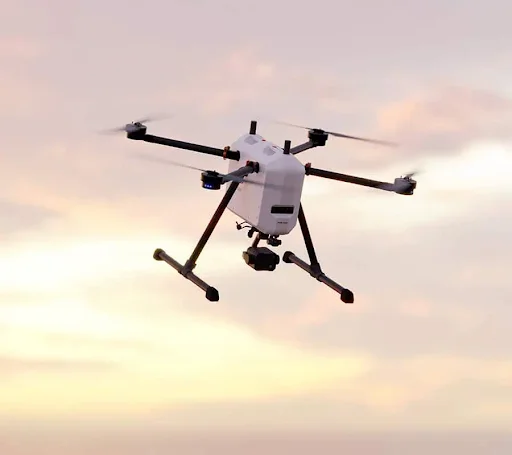
Bearings
Types of Bearings used in Defense and Surveillance Drones
10 December, 2025
35 min read
Defense and surveillance unmanned aerial vehicles (UAVs) are becoming indispensable tools for military operations, border security, and intelligence gathering. These drones perform critical missions – from tactical reconnaissance and patrol to target tracking – where failure is not an option. Every component must work flawlessly, and bearings are among the most important parts, ensuring UAV reliability and stability. In fact, precision bearings support nearly every moving mechanism on a drone, from the spinning rotors to the swiveling gimbal cameras, directly impacting the UAV’s efficiency, stability, and mission success. This article explores the types of bearings commonly used in defense and surveillance drones, why they matter, and how to select the right drone bearings for optimum performance.
The Role of Bearings in Defense and Surveillance UAVs
Bearings enable rotary motion in a drone’s design. In a defense or surveillance UAV, you’ll find bearings in the propulsion system (motor shafts and rotor hubs), in the gimbal assemblies that stabilize electro-optical/infrared cameras, in various actuators (like control surface servos or weapon release mechanisms), and in landing gear and payload deployment systems. Bearings carry out several key roles and must meet demanding performance criteria:
- Support and Smooth Rotation: Bearings support rotating shafts (propellers, motors, gimbal axes) and minimize friction, allowing these parts to move freely and precisely. For example, brushless motors rely on high-precision ball bearings to spin rotors at tens of thousands of RPM with minimal wobble. Without quality bearings, motors would waste energy and vibrate excessively, undermining the drone’s stability.
- Lightweight and Compact: Weight is a critical factor in drones – every gram saved means longer flight time or more payload capacity. Bearing designs like thin-section bearings and hybrid ceramic bearings are favored because they offer the required strength in a lighter, smaller package. Using a slim-profile bearing in a gimbal or a lightweight hybrid ceramic bearing in a motor can reduce overall drone weight without sacrificing performance.
- High Precision and Low Play: Surveillance drones require extremely smooth and accurate motion (for stable cameras and sensors). Precision-grade bearings with tight tolerances ensure there is virtually no “play” or slop in joints. This is crucial in gimbals and control actuators – a loose bearing could cause jittery camera footage or imprecise movements. High-quality bearings keep movements controlled and repeatable, which directly contributes to imaging clarity and targeting accuracy.
- Low Friction Torque: Efficiency is paramount for electric UAVs. Bearings with low friction reduce the torque required to spin a shaft, meaning motors consume less power and generate less heat. Low-friction miniature ball bearings in rotors and fans help maximize battery life by minimizing energy losses to friction. In protracted surveillance missions, these efficiency gains translate to valuable extra minutes of flight endurance.
- Shock and Vibration Tolerance: Defense drones often face high dynamic loads – rapid maneuvers, launcher acceleration, recoil from deploying payloads, or simply rough takeoffs and landings. Bearings must handle shock loads and sustained vibration without deforming or failing. Robust designs like angular contact pairs or tapered rollers are used in high-thrust areas to withstand these forces. Precision bearings also dampen vibration from motors, preventing oscillations that could destabilize the drone.
- Environmental Resilience: Military UAVs encounter harsh environments – desert sand and dust, maritime salt spray, arctic cold, or high-altitude low pressures. Bearings need to be built for these conditions. That means using corrosion-resistant materials (stainless steels or ceramics that won’t rust), special coatings and platings, robust seals to keep out contaminants, and lubricants formulated for wide temperature ranges. For example, many UAV bearings are made of stainless steel (440C) or coated steel, allowing them to operate in humid or salty conditions without corroding. Proper sealing and mil-spec grease ensure bearings continue to perform even in extreme conditions, such as dust storms or freezing temperatures. In short, bearings in defense drones prioritize reliability and longevity in extreme conditions – their failure could compromise the entire mission.
By fulfilling these roles, bearings form the backbone of a drone’s mechanical system. They enable reliable propulsion, stable sensor operation, and durable performance over long missions. Next, we’ll look at specific bearing types and how each is applied in defense and surveillance UAVs.
Miniature Ball Bearings for Motors and Rotors
Tiny high-precision miniature ball bearings are the workhorses of drone propulsion systems. These are deep-groove radial ball bearings in small sizes (often with bores just a few millimeters across) that support the shafts of electric motors, propeller hubs, and cooling fans. In a typical drone brushless DC motor, a pair of miniature ball bearings supports the rotor/prop shaft – one at each end – to maintain alignment and smooth rotation. These bearings handle primarily radial loads from the spinning rotor, as well as minor axial thrust from the propeller. Key features of miniature ball bearings for UAV motors and rotors include:
- Low Friction and High Speed: Quality miniature bearings are manufactured to precise tolerances (often ABEC-5/7 or better) and use smooth, polished balls and raceways to minimize friction. This allows motors to spin up to very high RPM without excessive heat or drag. For example, a common motor bearing size like 5×11×4 mm (used in many small drones) can be rated for over 50,000 RPM. The low friction ensures more of the battery’s energy converts into thrust rather than being lost as heat, which directly improves flight time.
- Precision and Vibration Reduction: At high rotational speeds, any tiny imbalance or misalignment can cause vibration. Pacific International Bearing Sales distributes higher Precision NMB Miniature ball bearings with tight radial clearance and roundness to keep the rotor spinning “true.” They prevent shaft wobble, so the propeller turns with minimal vibration. This not only improves efficiency but also reduces noise and wear. In surveillance drones, where quiet operation can be important, high-quality mini bearings help eliminate any telltale whine or grinding.
- Material Options for Durability: Standard drone bearings are often made from high-carbon chrome steel (52100). However, for defense and all-weather use PIB provides stainless steel or hybrid constructions which are popular. Stainless steel bearings (440C stainless) provide better corrosion resistance than 52100 chrome but the use of rust proof Cronidur steel is even better. Contact PIB about the use of Cronidur. Hybrid ceramic bearings (steel or stainless rings with ceramic balls) are another upgrade (discussed more below) that further reduces friction and prevents corrosion. These material options ensure motor bearings keep spinning freely in any climate, and they prolong service life by resisting corrosion and fatigue.
- Optional Seals and Special Lubrication: Many miniature drone bearings come in shielded or sealed versions (e.g., suffix “ZZ” for metal shields or “2RS” for rubber seals) to keep dust and grit out. Defense UAVs operating in sandy or dusty environments often use sealed bearings on motors to prevent abrasive particles from entering the races. Lubrication is tailored as well – for cold weather operation, a low-temperature grease ensures the bearing doesn’t seize at sub-zero temperatures, whereas high-speed drones might use light oil or synthetic grease that maintains viscosity at high RPM. Proper lubrication and sealing mean the bearings remain smooth throughout the mission with minimal maintenance.
PIB Miniature ball bearings are found everywhere in drones – from the smallest quadcopters to large surveillance UAVs – thanks to their versatility. They provide an optimal mix of compact size, light weight, low friction, and the ability to handle the high speeds and moderate loads of drone motors. By using precision miniature bearings in all rotors and engines, UAV designers ensure the craft can fly efficiently and reliably.
Thin Section and Angular Contact Bearings for Gimbals and Payloads
Defense and surveillance drones typically carry cameras, sensors, or other payloads on stabilized mounts or gimbals. These assemblies often require bearings that are compact in cross-section yet capable of supporting both radial and axial loads with high stiffness. Two types of bearings excel here: thin section bearings and angular contact bearings.
Thin-section bearings are a special class of ball bearings with an extremely small cross-sectional profile relative to their diameter. This slim design is ideal for space-constrained applications – such as gimbal pivots – where standard bulky bearings won’t fit. Thin-section ball bearings (often of the type marketed as “Reali-Slim” or similar) allow designers to use a relatively large-diameter bearing that can handle the moment loads of a gimbal, without adding much weight or thickness to the assembly. In drone gimbals, a thin-section bearing might be used in the yaw (pan) axis, where the camera housing rotates on the drone. Its small width means the gimbal can be low-profile, and its larger diameter provides good support for the cantilevered mass of the camera. As one bearing industry source notes, these slim bearings provide high load capacity in a lightweight form, making them “ideal for space-constrained applications, such as drone gimbals”. By using thin-section bearings, military drone gimbals can achieve the necessary precision and smoothness without overweighting the drone or enlarging the turret.
Angular contact ball bearings are another key solution, especially for gimbals or mounts that carry heavy optics or multiple sensors. Unlike ordinary radial bearings, single-row angular contact bearings are engineered to support significant axial (thrust) loads in one direction in addition to radial loads. This is achieved by designing the raceways at an angle, so the balls contact the races at a predefined contact angle. In practical terms, an angular contact bearing (or more often, a pair of them mounted back-to-back) can sustain the weight of a heavy camera or sensor that is pushing down on the bearing, while also ensuring precise rotational movement. For example, the tilt axis of a large surveillance camera turret might use a pair of angular contact bearings to support the camera’s weight and eliminate any end-play as the camera pitches up and down. Angular contact pairs can be preloaded (clamped together slightly to remove internal clearance), resulting in a very stiff joint with no wobble. This is crucial for imaging stability – the camera can move smoothly without flutter or sag. Many high-end UAV gimbals use a combination of a thin-section bearing for the 360° pan axis and an angular contact bearing pair for the tilt axis, achieving both compactness and high stiffness.
Applications in defense UAVs include EO/IR (electro-optical/infrared) sensor balls, targeting turrets, and radar or antenna gimbals. These often see rapid slewing and require microradian-level stability. Thin-section bearings provide the form factor needed for the spherical gimbal housings, while angular contact bearings (or related types like four-point contact bearings) handle the axial thrust from heavy optics and ensure consistent alignment. Additionally, crossed roller bearings (covered in the next section) are sometimes used in gimbals requiring even greater rigidity.
In summary, thin-section bearings offer space and weight savings for drone gimbals, and angular contact bearings (often used in pairs) provide the necessary axial load support and precision. Together, they enable defense drones to mount sophisticated cameras and sensors that stay rock-steady during maneuvers, yielding clear intelligence imagery and reliable targeting data.
Hybrid Ceramic Bearings for High-Speed and Precision Applications
When drone engineers seek to push the performance envelope – higher speeds, longer endurance, less maintenance – they often turn to hybrid ceramic bearings. A hybrid ceramic bearing typically refers to a ball bearing with steel races (usually 52100 chrome steel or 440C stainless) and rolling elements (balls) made of ceramic, usually silicon nitride (Si_3N_4). This construction offers several advantages that are highly valued in UAV applications:
- Higher Speed and Lower Friction: Ceramic balls are extremely smooth and about 60% lighter than steel balls. The lower mass means reduced centrifugal forces at high RPM, allowing the bearing to operate at greater speeds without overheating. The smoothness and hardness of ceramic result in lower rolling resistance. In high-speed drone motors or generators, swapping steel bearings for hybrids can yield lower friction, less heat generation, and thus higher efficiency. This is why hybrid ceramic bearings are popular in racing drones or high-performance surveillance drones where every bit of efficiency counts – they help motors spin freely and cooler, potentially adding precious minutes to flight time.
- Weight Reduction: Replacing steel balls with lightweight ceramic balls trims a bit of weight from each bearing. While a single bearing’s savings are small, a drone can contain dozens of bearings – in motors, gimbals, gearboxes, etc. Using hybrids broadly can shave off tens of grams, contributing to longer flight or additional payload capacity. For long-endurance defense UAVs, weight savings and efficiency gains from hybrid bearings can significantly extend range or loiter time.
- Extended Lifespan and Durability: Ceramic materials are harder than steel and don’t wear as quickly. They also aren’t prone to surface fatigue like metal (no micro-welding or smearing under marginal lubrication). As a result, hybrid bearings often last longer than all-steel ones, maintaining tight tolerances over more hours of operation. This longevity is a big plus for military drones that must have low maintenance and high mission availability. Furthermore, ceramic balls are non-conductive, which means they can act as electrical insulators in the bearing. In high-power electric systems, this prevents stray currents from arcing through the bearing – avoiding potential pitting of the races and interference with onboard electronics.
- Corrosion Resistance: PIB brand Ceramic balls do not rust, and hybrid bearings can be made with stainless steel races. This makes them highly resistant to corrosion in wet or chemically harsh environments. For naval surveillance drones (operating in salty sea air) or drones in tropical climates, hybrids offer assurance that bearings won’t corrode if moisture ingresses. Even in a standard environment, the corrosion resistance provides an extra layer of reliability for long-term storage or intermittent use.
Due to these benefits, PIB brand hybrid ceramic bearings are often specified in the most demanding UAV subsystems. Common uses include high-speed motors (e.g. the primary lift motors of a long-range surveillance drone or the ducted-fan motors of a high-speed target drone), generator or alternator bearings in drones that have onboard engines or solar-powered systems, and precision instruments like gyro-stabilized platforms or turrets where minimizing friction is critical. In one example, upgrading a drone’s motor bearings from steel to hybrid ceramic showed reduced friction and cooler operation at high RPM, directly translating into longer flight time. While hybrid bearings do cost more than standard ones, the payoff in performance and durability can justify the investment for defense applications.
It’s worth noting that fully ceramic bearings (ceramic races and ceramic balls) also exist and eliminate metal. These are extremely lightweight and non-magnetic, but they tend to be very expensive and somewhat brittle. Fully ceramic bearings are rarely used except in niche aerospace scenarios. For most UAV purposes, hybrids strike the best balance of performance and cost.
In short, hybrid ceramic bearings are an enabling technology for high-performance drone bearings – they run with less friction, handle tough environments, and endure longer. Defense and surveillance UAV designers deploy them strategically in critical areas to squeeze more efficiency and reliability out of their platforms, whether that means a quieter high-speed rotor or a maintenance-free generator bearing that keeps an ISR (intelligence, surveillance, reconnaissance) drone aloft on extended missions.
Slewing Rings, Crossed Roller, and Specialty Bearings
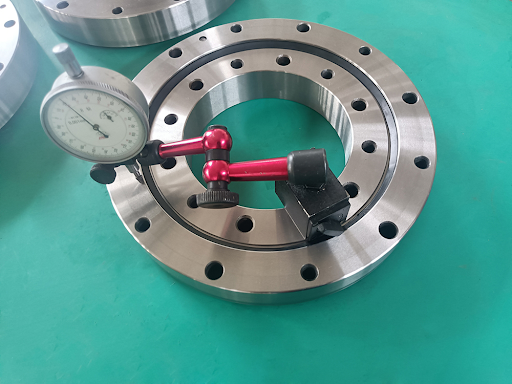
A small precision slewing ring bearing is being measured for run-out, exemplifying the high stiffness and load capacity needed in advanced UAV systems. Slewing ring bearings (also called turntable bearings) and crossed roller bearings are used in defense drones when heavy loads must be supported with minimal play, often in applications requiring rotation through a wide angle (up to 360°). These bearing types are considered “specialty” solutions due to their construction and are typically found in larger UAV subsystems or high-end gimbal assemblies.
A slewing ring is essentially a large-diameter bearing, usually either a ball or roller design, that often comes as a self-contained unit with mounting holes on both the inner and outer rings. This allows the ring to be bolted directly between a rotating platform and a stationary base. In military drones, slewing rings might be employed in multi-sensor turrets, antenna rotators, or even weapon stations on larger UAVs. For example, a surveillance drone with a heavy stabilized camera turret can use a compact slewing ring to support the turret’s weight and allow smooth panning movement. The benefit is that a single slewing bearing can handle combined loads – radial, axial, and tilting moment – that otherwise might require multiple bearings to share. As a case in point, one manufacturer’s 100×200×20 mm slewing ring (a very compact model) is used to support 360° camera rotation in UAV gimbals carrying up to a 5 kg payload. By using a slewing ring, designers replaced what might have been a pair of angular contact bearings with one integrated unit, reducing parts count and simplifying assembly. Importantly for defense use, slewing rings can be made in lightweight alloys (even aluminum) or stainless steel, and can incorporate internal gearing or drive teeth if needed to rotate the platform. Their high precision and stiffness keep heavy payloads steady even under dynamic motion or recoil. Slewing rings in aerospace are custom-engineered to provide micron-level run-out accuracy on large diameters, so that even a turret over a meter wide can rotate without wobble. Despite their size, modern lightweight designs mean even small UAVs can have a precision turntable if required.
Crossed roller bearings are another specialty type often found in advanced gimbals, robotic joints, and stabilized mounts. A crossed roller bearing uses cylindrical rollers arranged orthogonally (each roller’s axis is 90° to the next, in alternating fashion) and runs in a single groove that encompasses both inner and outer ring. The result is a very compact bearing that can support large axial, radial, and moment loads simultaneously. Essentially, crossed rollers combine the load capability of radial and thrust bearings in one unit, with the rollers cross-acting to eliminate nearly all play. In drone applications, a crossed roller bearing might be used in a gimbal roll/pitch joint or in the base of a pan-tilt unit to achieve extremely smooth motion with zero backlash. These bearings are prized for their high rigidity – there is minimal deflection even under heavy loads or rapid moves, which keeps cameras and sensors precisely aligned. Crossed roller bearings also have a compact design relative to their performance, saving space in tight assemblies. For instance, some high-end UAV camera gimbals choose a crossed roller bearing over a ball bearing because the crossed roller can provide the needed stiffness in a thinner profile, maintaining calibration of the imaging sensors even if the drone maneuvers aggressively. Additionally, crossed rollers (and four-point contact bearings, which are a type of angular contact ball bearing that handles dual-direction thrust) are used in UAVs that have multi-axis joints – like a foldable wing or a gimbal that needs to rotate freely on two axes with one compact bearing. They ensure smooth, precise movement without the cumulative slack that multiple conventional bearings might introduce. PIB distributes high end brands for cross roller bearings such as THK and IKO.
Beyond these, “specialty bearings” in defense drones could include custom plain bearings, rod-end (spherical) bearings in control linkages, or even magnetic bearings in rare cases. For example, some VTOL UAVs with tilting rotors use spherical bearings or elastomeric bearings in the tilt mechanism to handle both rotation and misalignment in one joint. Each of these special solutions is chosen to meet a unique requirement of load, alignment, or low maintenance.
In summary, slewing ring bearings and crossed roller bearings are often used for heavy-duty, high-precision tasks in drone systems – whether it’s rotating a hefty sensor turret or providing a rock-solid pivot with minimal footprint. They deliver high rigidity and multi-directional load support in compact assemblies, which is exactly what complex defense UAV mechanisms often need. Notably, these bearings are built to the same environmental standards as the rest of the drone: materials and lubricants are selected to endure combat conditions. Many slewing and crossed roller bearings for aerospace undergo special coatings, seal integrations, and even preload adjustments to ensure accuracy, durability, and corrosion resistance over the life of the aircraft. For instance, a lightweight slewing ring might use stainless steel rolling elements and a thin dense chrome plating on races for corrosion protection, combined with a factory-set preload for zero play. The end result is a bearing assembly that helps critical payloads and systems on defense drones perform with absolute reliability.
Environmental and Reliability Considerations
Designing bearings for defense and surveillance drones isn’t just about load and speed – it’s equally about ensuring reliability under harsh conditions. Military UAVs must operate day in and day out with minimal maintenance, often in extreme environments that quickly degrade ordinary hardware. Bearing selection and specifications, therefore, put heavy emphasis on robustness and resilience:
- Shock and Impact: Drones can experience sudden shocks from hard landings, catapult launches (for fixed-wing military UAVs), or abrupt flight maneuvers. Bearings, especially in rotor shafts and actuator linkages, are chosen to absorb these shock loads without brinelling (dent formation) or loss of alignment. High-quality bearings are heat-treated for toughness, and often a slight internal clearance is set to accommodate differential thermal expansion and shock. Some designs include elastic damping elements around bearings to further cushion impacts. Angular contact and tapered roller bearings are favored in positions like rotor hubs, specifically for their ability to take shock loads along with thrust.
- Vibration and Fatigue: Continuous vibration from spinning rotors and engines can fatigue bearings over time. Precision drone bearings are made to tight tolerances so that they run smoothly, reducing vibration at the source. Additionally, materials like high-purity chrome steel and superior surface finishes are used to resist spalling or pitting under vibration. In critical areas, designers may upsize a bearing or use a special internal design (like a full-complement of rolling elements) to handle vibration stresses. Proper lubrication also combats vibration-related wear. The result is bearings that won’t loosen or degrade even after hundreds of flight hours of high-frequency vibration.
- Temperature Extremes: Defense drones might fly at high altitudes where temperatures drop far below freezing, then descend to hot deserts or ship decks in the sun. Bearings must operate across a wide temperature range. This affects material choice (stainless steels retain toughness at low temperatures, for instance, whereas some alloys might become brittle), clearance (bearing fit may be adjusted to prevent seizure when cold or excessive play when hot), and lubricant. Typically, military-grade greases with wide operating ranges (e.g., MIL-PRF-23827 synthetic grease good from –65 °C to +175 °C) are used in UAV bearings. In some cases, specialized solid lubricants or dry film coatings (like molybdenum disulfide or PTFE-based films) are applied if conventional lube would freeze or outgas. All these measures ensure that whether a drone is loitering at stratospheric cold or parked in scorching midday heat, its bearings turn freely and consistently.
- Dust, Sand, and Moisture Ingress: Battlefields and surveillance zones can present harsh environments like dusty deserts, sandy coastlines, or humid tropics. Bearings are often the first to suffer from grit or water ingress. Therefore, UAV bearings intended for these conditions come with appropriate sealing and corrosion protection. Many bearings are double-sealed (rubber or polymer seals) to keep out fine dust and water spray. Steel components may be stainless or coated with corrosion-resistant platings (cadmium, zinc-nickel, or phosphate treatments common in military hardware). In agricultural or maritime surveillance drones, fully sealed stainless steel bearings are commonly used so that neither crop-spraying chemicals nor saltwater causes rust. Some advanced designs even employ purge systems (for large bearings like slewing rings, a groove to allow grease relief and flushing out contaminants). By maintaining a clean, lubricated contact surface, these protected bearings dramatically reduce the risk of premature failure in abrasive or wet conditions.
- Longevity and Reliability: Defense organizations require UAVs that can stay operational for long durations with minimal downtime. Bearings contribute heavily to this reliability. That’s why aerospace-grade bearings go through rigorous quality control – from material inspection to precision grinding and noise testing – to ensure they meet lifespan expectations. Often, bearings are derated (used well below their maximum load ratings) in drone designs, providing an ample safety margin so they don’t run close to failure limits. Traceability is also a factor: each bearing can be traced to its lot and material certificate, ensuring accountability and consistent quality. For critical drones, some manufacturers opt for redundant bearing arrangements (two bearings where one might suffice) so that if one were to wear out, the other still supports the system until maintenance. All of these practices contribute to mission reliability – the bearings are not the part that will cause an abort or crash. As evidence of their reliability, it’s reported that well-designed UAV bearings can achieve tens of thousands of hours in Mean Time Between Failures (MTBF) under proper lubrication, comparable to aerospace bearings used in piloted aircraft.
In short, environmental and reliability considerations are important in selecting bearings for defense and surveillance drones. The bearings must withstand punishment from the environment and operational stresses beyond what a typical industrial bearing sees. By choosing the right materials (e.g., stainless steel, ceramics), protective seals and coatings, wide-temperature lubricants, and maintaining tight quality control, UAV engineers ensure the bearings will perform their duty throughout the mission envelope. This attention to detail in bearing selection directly translates to drones that are trusted to fly into hazardous conditions, complete their reconnaissance or security mission, and return home without mechanical failure.
How to Select Bearings for UAV Applications
Choosing the right bearing for a defense drone application can be complex. Engineers must balance load capacities, size, precision, and environmental factors. Below is a practical checklist of considerations when selecting UAV bearings – following these steps and leveraging expert help will lead to optimal bearing performance:
- Define Loads and Speeds: Start by quantifying the forces the bearing must support and the speed it will operate at. Determine the radial and axial loads (including dynamic forces like thrust from rotors or inertia from maneuvers) and the RPM or oscillation rate. For example, a gimbal yaw bearing might see a moderate axial load (camera weight) and low speed, whereas a motor bearing sees high radial load at very high RPM. This information is critical for choosing the bearing type and rating – e.g., whether a deep groove ball bearing can handle it, or if an angular contact or tapered roller is needed for thrust support. Also consider load duration and cycles (fatigue life). Always select a bearing with load capacity comfortably above the maximum expected load to ensure longevity.
- Consider Size and Weight Constraints: Examine the spatial envelope available for the bearing and any weight limitations. Drones often have very tight spaces, so a standard bearing might not fit. If width is restricted, consider thin-section bearings. If diameter is limited but load is high, consider high-capacity types or even multiple smaller bearings distributed along a shaft. Weight-wise, if dozens of bearings are used, opting for lighter materials (aluminum hubs, ceramic balls, polymer cages) can collectively save significant weight. Ensure the bearing’s dimensions (inner/outer diameter and thickness) align with the drone’s mechanical design, and account for any required mounting features (like flanges or snap-ring grooves).
- Precision and Runout Requirements: Determine how precise and smooth the motion needs to be. For camera gimbals or inertial platforms, bearing precision (in terms of roundness, runout, and clearance) is very important. Specify an appropriate ABEC or ISO precision grade – higher grades (ABEC-5, -7 or P5, P4, etc.) have tighter tolerances on dimensions and runout, leading to smoother rotation. Low runout ensures that rotation doesn’t translate into vibration or error (critical for sensors). Also consider internal clearance or preload: many UAV applications benefit from a lightly preloaded or zero-clearance bearing setup to eliminate any play. For example, using duplex angular contact bearings with preload can give a very stiff, play-free joint. The trade-off is slightly higher friction, but often worth it for control accuracy.
- Environmental Conditions and Materials: Outline the environmental conditions (temperature range, moisture, dust, etc.) the bearing will face. Choose bearing materials and lubrication to match. For high-corrosion risk, use stainless steel or ceramic hybrids so that rust is not an issue. For wide temperature swings, ensure the grease or oil is rated accordingly (and consider steel vs. stainless as stainless retains hardness at high temp slightly less). If the drone will see sand or debris, specify sealed bearings (e.g., rubber seals) to keep contaminants out. In very clean, weight-sensitive applications, open bearings with light oil might be acceptable, but defense drones generally are sealed and protected. Don’t forget any special requirements like low magnetic signature (fully ceramic or non-magnetic materials) or low outgassing (for high-altitude or aerospace use, certain lubricants and plastics are preferred). Environmental compatibility can drastically affect bearing life – a bearing not suited for the environment will fail early.
- Compliance and Traceability: In defense applications, there are often regulatory requirements for components. Ensure the bearings can be sourced with proper traceability and certifications if needed – for instance, compliance with aerospace standards (AS9100, DFARS regulations for specialty metals, ITAR if export-controlled). Working with an OEM bearing distributor experienced in defense like( PIB Sales) helps here: they can provide documentation for lot traceability, material certs, and ensure the bearings meet any country-of-origin rules or MIL-specs. This is crucial if your drone program must adhere to government procurement standards. It also speaks to quality – aerospace-grade bearings come from audited manufacturers and include inspection records, so you know you’re getting consistency and reliability.
- Consult Engineering Support: Selecting drone bearings is not purely a numbers game – the nuances of fits, mounts, and real-world operation mean you should leverage experienced bearing engineers. Engage with the supplier’s engineering support early in the design process. They can assist in interpreting requirements and recommending the best bearing types or custom solutions (like whether a gimbal should use an angular contact pair or a preloaded cross roller bearing). They’ll also help with practical issues such as tolerances for mating parts, installation methods (press fits vs. adhesives), and optimal lubrication and maintenance intervals for your scenario. With PIB’s engineering team, for example, you can discuss your UAV’s specs and get tailored advice on bearing selection, relubrication options, and even possible design modifications to improve performance. This partnership can prevent costly redesigns and ensure you get the maximum reliability and lifespan from your bearings.
By following this checklist – loads, size, precision, environment, compliance, and expert input – you can confidently select bearings that will meet the rigorous demands of defense and surveillance drones. The right choice of bearing, coupled with proper integration, means fewer failures, smoother performance, and successful missions.
Why Source Drone Bearings from PIB Sales
For over four decades, PIB Sales (Pacific International Bearing Sales, Inc.) has been a trusted partner to the aerospace and defense industries for high-performance bearings. Choosing PIB as your drone bearing supplier brings a host of advantages:
- Deep Expertise in Aerospace/Defense Bearings: PIB Sales has 40+ years of experience supplying bearings for military UAVs, aircraft, satellites, and high-tech applications. We understand the stringent demands of defense drone projects. Our team can guide you to the right solution – whether it’s a miniature instrument bearing for a micro-UAV or a large slewing ring for a reconnaissance drone. We stay current on the latest bearing technologies (like ceramic hybrids and thin-section innovations) to offer state-of-the-art options.
- Engineering Support and Custom Solutions: A hallmark of PIB is our engineering support. Our experts work closely with your design team to select or even develop bearings tailored to your UAV’s requirements. Need a special grease fill for Arctic conditions? A preload tweak for zero backlash? A custom-coated bearing for corrosion resistance? We provide those services. In fact, PIB is ISO 9001:2015 certified and offers in-house relubrication services under cleanroom conditions, so standard bearings can be modified with specialty greases or dry lubricants to meet MIL-spec or environmental needs. This level of support ensures you get drone-ready bearings that integrate seamlessly into your system.
- Quality and Traceability: At PIB, quality is paramount. We source from top-tier manufacturers (SKF, RBC, Kaydon, THK, and NMB, and many more), and all our aerospace bearing partners are certified to ISO 9001 and AS9100 standards. Bearings can be provided with full traceability documentation – you’ll know the exact manufacturing lot and can get material/test certifications on request. For defense contracts requiring DFARS-compliant bearings or ITAR-controlled items, PIB has the experience to navigate and supply those as well. When you buy from PIB, you can trust that every bearing has passed rigorous quality control and meets the specifications claimed.
- Extensive Inventory and Logistics Programs: Time is often critical in defense projects. PIB Sales maintains a large stock inventory of standard and specialty bearings – including NMB miniature ball bearings, Kaydon thin section bearings, and hybrid ceramics popular in drones – ready for immediate shipment. We also offer JIT programs and stocking agreements for OEMs: we’ll stock the bearings you need and deliver on a schedule that aligns with your production, ensuring you never face line-down delays. Our logistics team is adept at handling urgent requirements and export paperwork, so whether you need a one-off part overnight or a scheduled delivery to an assembly line, we make it smooth.
- Online Catalog and Easy Purchasing: Uniquely, PIB Sales offers an online shop where engineers and buyers can browse our catalog 24/7. You can easily search by bearing dimensions or type, check specifications, and see available quantities. For many standard drone bearings (like deep groove miniatures or thin sections), you can purchase directly online or request a rapid quote. This convenient access, combined with our knowledgeable sales staff available by phone/email, means you get both self-service speed and human support as needed.
Ultimately, PIB Sales is not just a vendor – we consider ourselves a part of your supply chain team, dedicated to the success of your drone program. Our track record in aerospace/defense, technical know-how, and customer-centric services (like custom relubrication and flexibility in stocking) set us apart as an OEM bearing distributor that truly understands UAV needs. Many leading drone manufacturers and defense contractors rely on PIB for their bearing requirements because we deliver value: the right products, top quality, and reliable support from prototype through production.
FAQ
Q: Which bearing types are most common in drone gimbals?
A: Most drone gimbals use thin-section ball bearings and precision miniature/angular contact bearings at their pivot points. The thin-section bearings (with very small cross-sections) allow 360° rotation in a compact form factor, which is ideal for the pan/yaw axis of camera turrets. For the tilt/pitch axes, gimbals often use either duplexed angular contact bearings (providing high axial load support for the camera’s weight) or small deep groove ball bearings with preload, to ensure there is no looseness. These bearing choices let the gimbal move smoothly with minimal friction or backlash, resulting in stable, clear imagery. In very heavy gimbals (like those on large surveillance drones), you may even find crossed roller bearings because they offer extreme stiffness and can handle combined loads in one compact unit, further improving stability.
Q: When should I use hybrid ceramic bearings in a UAV?
A: Hybrid ceramic bearings (steel races with ceramic balls) are best used when you need extra performance in terms of speed, efficiency, or durability beyond what standard steel bearings can provide. For instance, if your drone’s motors run at very high RPM or you’re pushing for maximum flight time, hybrid ceramics can reduce friction and run cooler at those speeds, directly improving efficiency. They’re also advisable in harsh environments – the ceramic balls won’t corrode, and they can handle temperature extremes better – so for a drone operating in wet, salty, or very hot/cold conditions, hybrids will last longer with less wear. Another case is if you’ve experienced electrical pitting in bearings (from current passing through the motor bearings); hybrid ceramic balls act as insulators to prevent that. In summary, use hybrid ceramics for high-speed rotors, long-endurance or high-temperature applications, or whenever you need a premium bearing to ensure reliability. Keep in mind they are more expensive, so they’re typically reserved for critical components where the performance gain justifies the cost.
Q: What information does PIB need to recommend the right bearings for my UAV?
A: To assist you effectively, PIB would need details on your application and requirements:
- Mechanical specs: the loads (radial and axial) the bearing must support, and the speeds or rotation rates involved. Also any size constraints (max OD/ID or width) and weight targets.
- Operational environment: the temperature range, exposure to dust/water/corrosion, shock/vibration conditions, etc. This helps in selecting materials and seals/lubes that can handle those conditions.
- Performance needs: for example, required lifespan or maintenance interval, any precision or runout tolerance needed, and if low noise or low friction is a priority.
- Interface details: how the bearing will be mounted (press-fit, housing materials, shaft fits) and any standards or certifications needed (say, aerospace certification or traceability paperwork).
The more specifics you provide – e.g. “bearing for a gimbal axis carrying a 2 kg load, rotating ±90° at 30°/s, needs to withstand -20°C to +50°C and be as low-friction as possible” – the better our engineers can pinpoint an ideal solution. We often can propose a few options (including any trade-offs in cost vs. performance). Our goal is to use your info to recommend bearings that meet your UAV’s technical needs and integrate well into your design and supply chain.
Q: Are PIB’s UAV bearings export-compliant or traceable for defense contracts?
A: Yes. PIB Sales supplies bearings fully suited for defense and aerospace use, and we can provide all necessary documentation for compliance. All our major bearing manufacturing partners hold ISO 9001 and AS9100 certifications, and they maintain strict traceability processes – every bearing lot is documented so its material and origin are tracked. If your project requires DFARS-compliant bearings (specific to U.S. defense acquisition rules about domestic material sources) or ITAR-controlled items, we can source bearings that meet those regulations and furnish the certs to prove it. We regularly work with defense contractors, so we’re familiar with handling export licenses or NDAA compliance for bearings (for example, ensuring no restricted foreign sources). When you purchase from PIB for a defense UAV, you can be confident the products are fully traceable and compliant with military procurement standards. We’ll assist with any paperwork audits or quality assurance queries related to bearings.
Ready to equip your defense or surveillance drone with the best bearings? Visit the PIB Sales online shop to explore our drone-ready miniature ball bearings, thin section bearings, and hybrid ceramic bearings in stock. You can also request a quote or connect with our engineering support team for personalized assistance in selecting the ideal bearings for your UAV project. With PIB’s expertise and inventory, you’ll get the quality, reliability, and performance your mission-critical drones demand – delivered on time, every time. Let us help you boost your UAV’s performance and ensure success on every flight!