Your cart is empty
 Short Rigid Couplings
 Controlflex Couplings
 Jaw Couplings
 Oldham Couplings
 Bearing Locknuts – TCN
 Double Wide Shaft Collars
 Heavy Duty Shaft Collars
 International Series Shaft Collars
 Keyed Shaft Collars
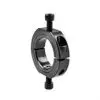 Mountable Shaft Collars
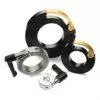 Quick Clamping Shaft Collars
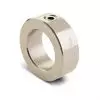 Set Screw Shaft Collars
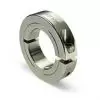 Thin Line Shaft Collars
 Threaded Shaft Collars – Pacific International Bearing Products
 Two-Piece Shaft Collars
 Friction Bearing Universal Joints
 Needle Bearing Universal Joints
Bearings
Transmission Shaft Seals: What Matters for Leakage Control, Reliability, and Service Life
09 November, 2026
20 min read
A practical guide to seal design, materials, shaft condition, contamination control, and installation in automotive and power-transmission applications.
Transmission shaft seals work at a deceptively difficult interface: a rotating shaft passes through a stationary housing, lubricant must stay inside, contamination must stay outside, and the sealing lip has to survive speed, heat, shaft movement, and fluid chemistry without adding unnecessary drag. When the seal is right for the application, the transmission stays dry, lubricant stays where the gears and bearings need it, and the machine can run without the repeated cleanup and teardown that come with a persistent leak.
Pacific International Bearing Sales works with OEM, MRO, and repair applications where shaft sealing is part of the reliability system, not a stand-alone consumable. PIB helps match seal design, lip material, counterface condition, and installation method to the actual operating conditions so the replacement does more than fit the bore.
Key Takeaways
- Transmission shaft seals commonly protect input, output, pump, and shifter shafts, as well as related shafts in differentials, transfer cases, and power take-off units.
- The main seal choices include spring-loaded elastomer lips, PTFE lips, low-friction elastomer designs, and unitized arrangements that add a controlled wear surface.
- Fluid compatibility, shaft speed and direction, temperature, runout, misalignment, pressure, contamination, and counterface condition all affect seal life.
- A new seal installed on a grooved, corroded, or poorly finished shaft can leak again even when the seal itself is correct.
- Installation details matter: lip protection over splines and sharp edges, correct orientation, square seating, seal-specific lubrication, and proper housing condition are part of the sealing system.
What Transmission Shaft Seals Actually Do
A transmission shaft seal closes the annular gap between a rotating shaft and a stationary housing. Its primary job is usually to retain transmission fluid or gear oil. Depending on location, it may also exclude road splash, dust, water, clutch debris, or other contamination. Some designs must manage both functions at the same time.
The dynamic interface is the sealing lip against the shaft or wear surface. A thin lubricant film at that contact helps control friction and wear. The seal case or rubber outside diameter anchors the seal in the housing bore, while a garter spring may maintain radial contact as the lip and shaft move through temperature and operating cycles.
That makes the seal part of a system. The shaft surface, housing bore, lubricant, venting, alignment, and nearby bearings all influence whether the lip can maintain stable contact.
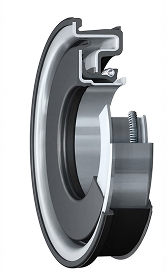
Example of a radial lip shaft seal construction used for rotating-shaft sealing.
Where Transmission Shaft Seals Are Used
Shaft seals appear wherever torque, hydraulic drive, or control motion passes through a transmission housing. The exact locations vary by transmission architecture, but the same sealing principles apply across manual, automatic, dual-clutch, continuously variable, industrial gearbox, and related driveline systems.
| Seal location | What the shaft is doing | What the seal must control |
| Input shaft | Transfers torque into the transmission | Lubricant retention, contamination exclusion, shaft movement and installation over splines or steps |
| Output shaft | Transfers torque from the transmission to the driveline | Oil retention, external contamination, runout, yoke/flange counterface condition |
| Pump shaft | Drives or supports the transmission fluid pump | Fluid retention, speed, temperature, fluid compatibility, low friction |
| Shifter or selector shaft | Moves through a smaller rotary or oscillating range | Leak control under oscillation, contamination, shaft finish and low-speed lip behavior |
| Transfer case / differential shaft | Transfers torque to another driveline stage | Oil retention, road contamination, speed, shaft condition and misalignment |
The seal at an input shaft is not automatically interchangeable with one at an output shaft. Shaft direction, contamination exposure, fluid, available space, and the condition of the running surface can be different even when the nominal diameter is similar.
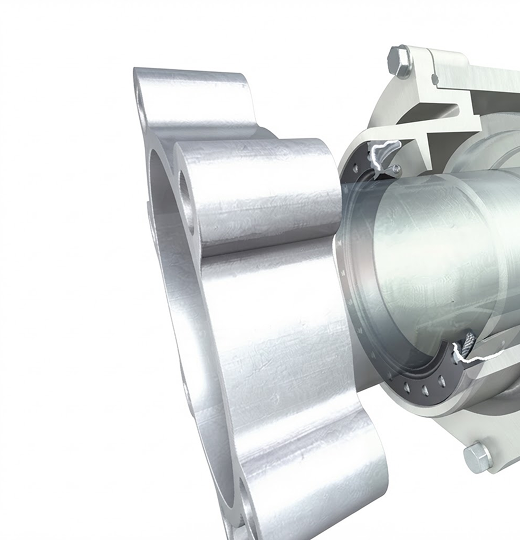
Example of an input-shaft sealing arrangement integrated with
the surrounding transmission structure.
The Main Seal Designs Used on Transmission Shafts
Spring-loaded elastomer lip seals
A spring-loaded elastomer seal is the familiar radial shaft seal used in many transmission positions. The garter spring helps maintain lip contact, while the lip geometry manages the lubricant film at the shaft. These designs are useful where the shaft can reverse direction because the sealing concept does not have to depend on a single-direction spiral feature.
For an application with moderate shaft movement and a compatible fluid, a well-chosen elastomer lip gives a practical balance of sealing, tolerance to normal manufacturing variation, and serviceability. If the lip material is wrong for the fluid or temperature, that same simple design can harden, swell, soften, or lose contact.
PTFE lip seals
PTFE sealing lips are used where low friction, chemical resistance, or the possibility of limited dry running makes a conventional elastomer less attractive. PTFE can also be formed with hydrodynamic features that help direct fluid toward the oil side during rotation.
The important limitation is that PTFE designs are more application-specific than they first appear. Shaft direction, installation tooling, lip pre-forming, counterface finish, and whether the lip is intended to be installed dry or lubricated must follow the seal design. Treating every PTFE seal like a conventional rubber lip is a common way to damage it before operation starts.
Low-friction elastomer lip seals
Low-friction elastomer profiles reduce radial lip load compared with a conventional spring-loaded design. They are useful where efficiency and heat generation matter but the application still benefits from elastomer compliance. The tradeoff is that lower contact force leaves less margin for a poor shaft surface, excessive runout, or unexpected pressure. Low friction is valuable only when the rest of the sealing system is controlled.
Unitized seal and wear-surface arrangements
A unitized arrangement combines the seal with a dedicated running surface or wear sleeve. That controlled counterface reduces dependence on the finish of the original shaft and helps protect the lip during assembly. It can be especially useful when installation risk, shaft preparation, or repeat leakage from a worn sealing track is driving maintenance.
| Seal approach | Where it helps | What still has to be controlled |
| Spring-loaded elastomer | General transmission shafts, reversing rotation, broad service use | Fluid and temperature compatibility, lip load, runout, shaft finish |
| PTFE lip | Aggressive fluids, low-friction duty, selected dry-running conditions | Rotation direction, installation method, counterface finish, design-specific prep |
| Low-friction elastomer | Efficiency-sensitive shafts with controlled geometry | Pressure, runout, surface condition, contamination |
| Unitized / wear-surface design | Worn or difficult counterfaces, simplified assembly, contamination control | Correct fit, sleeve position, seal compatibility, installation damage |
Material Choice: Match the Seal to the Fluid and Heat
Transmission fluids are not all the same. Automatic transmission fluid, manual gearbox oil, hypoid gear oil, synthetic lubricants, and application-specific additives can interact differently with elastomers. Temperature at the seal lip can also be higher than the bulk fluid temperature because friction is generated at the contact band.
| Material family | Typical reason to consider it | Selection caution |
| NBR | General oil and grease service where temperature and chemistry are moderate | Not the default choice for every modern synthetic fluid or high-temperature position |
| ACM | Transmission and automotive oil service with elevated temperature capability | Low-temperature and fluid compatibility still need verification |
| FKM | Higher temperature and stronger chemical resistance for demanding oils and additives | Cost, low-temperature behavior, and exact fluid chemistry remain application-dependent |
| PTFE | Low friction, broad chemical resistance, selected dry-running capability | Installation and shaft-finish requirements can be less forgiving and often design-specific |
The practical rule is simple: do not upgrade material by name alone. A more heat-resistant compound does not automatically fix a leak caused by runout, pressure, or a damaged shaft. Material solves a material problem; geometry and installation problems need their own correction.
The Counterface Matters as Much as the Seal
A radial seal does not seal against an abstract shaft diameter. It runs on a specific band of metal. If that band is grooved, corroded, nicked, tapered, or has unsuitable machining lead, the lip may pump fluid in the wrong direction or fail to maintain a stable film.
This is why repeat leaks often survive a seal replacement. The new part is installed at the same depth, the lip lands in the old wear groove, and the repair recreates the original failure condition. A better repair changes the system: restore the counterface, move the lip to a sound track when the design allows it, replace the shaft or yoke, or install a compatible repair sleeve.
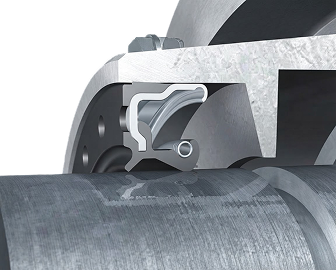
The seal lip and shaft counterface form the working dynamic interface; both surfaces affect leakage and wear.
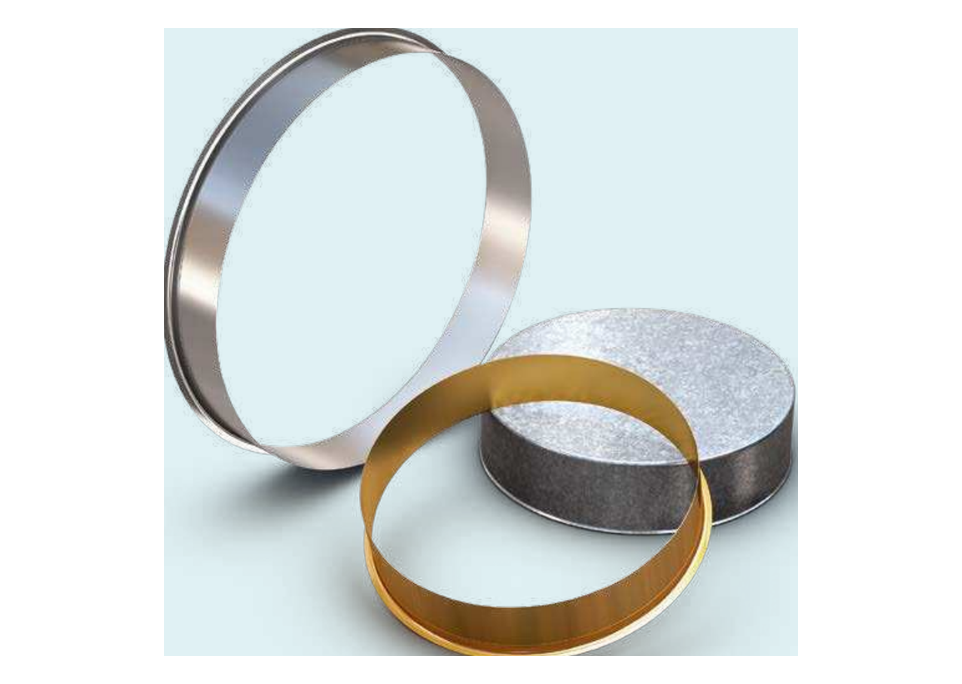
Wear Sleeves and Worn Transmission Shafts
A wear sleeve can restore a smooth sealing track without replacing or re-machining the entire shaft when the application allows it. The sleeve provides a new counterface for the original seal size or for a compatible seal selected for the repaired diameter, depending on the sleeve system.
Sleeves are useful when the problem is localized shaft wear, but they are not a shortcut around diagnosis. Excessive shaft movement, bearing looseness, housing distortion, or pressure behind the lip will still damage a new sealing surface.
Runout, Misalignment, and Bearing Condition
The seal follows the shaft; it does not control it. Dynamic runout makes the lip chase the shaft once per revolution, while shaft-to-bore misalignment creates an uneven contact condition around the circumference. A flexible lip can tolerate some movement, but every design has a limit.
If the bearings supporting the shaft are worn or loose, replacing only the seal can hide the symptom for a short time without fixing the cause. Before-and-after is easy to see: with excessive shaft movement, the lip wears unevenly and leakage returns; with the shaft supported and aligned correctly, the seal can maintain a more consistent film and contact load.
Pressure and Venting: A Seal Is Not a Pressure Regulator
Many transmission shaft seals are designed around low differential pressure. A blocked breather, thermal expansion, fluid foaming, or hydraulic pressure reaching a cavity that was intended to be vented can load the lip from behind. That can increase friction, invert or distort the lip, or force fluid past the sealing edge.
When a seal repeatedly leaks after replacement, check the venting and pressure path before moving to a more aggressive seal. A higher-contact lip can sometimes make the symptom worse by adding heat while leaving the pressure problem untouched.
Contamination Exclusion
A transmission output seal may see road water and grit. An internal pump-shaft seal may see very little external contamination. Those two positions should not automatically use the same exclusion strategy.
Radial dirt lips, axial excluder lips, felt rings, shields, and unitized barriers can keep contamination away from the primary oil-retaining lip. The more aggressive the exclusion system, the more carefully friction, space, and temperature should be considered. The goal is to stop the contamination that actually exists, not to add contact surfaces without a reason.
Installation Details That Decide Whether the Seal Works
Many premature leaks begin during installation. A seal can be correctly specified and still fail immediately if the lip is cut by a spline, the case is cocked in the bore, the spring is displaced, or the seal is driven against the wrong surface.
Inspect the housing bore for burrs, corrosion, old sealant, damage, and evidence that the previous seal spun or moved.
Inspect the shaft or yoke counterface before the new seal is opened; do not assume a polished groove is acceptable.
Protect the sealing lip as it passes over splines, threads, keyways, steps, or sharp chamfers. Use the installation sleeve or guard specified for the design.
Drive or press the seal squarely using a tool that loads the correct case surface. Do not hammer directly on the sealing lip or spring area.
Orient the primary lip toward the fluid being retained unless the application documentation specifies another arrangement.
Follow the seal-specific instructions for pre-lubrication. Elastomer lips commonly need lubrication at startup, while some PTFE designs use different preparation and forming procedures.
Confirm final installation depth. Moving the lip away from a wear track can be useful only when the housing and seal design allow a different seating position.
What the Wrong Transmission Seal Looks Like in Service
| Problem | What happens before the fix | What improves after the correct fix |
| Wrong lip material | Swelling, hardening, softening, cracking, or loss of lip geometry | Stable material behavior with the actual fluid and temperature |
| Worn shaft track | New seal leaks again on the same groove | Restored or relocated running surface gives the lip a controlled counterface |
| Excessive runout / loose bearing | Uneven lip wear, heat, intermittent leakage | Correct shaft support lets the lip follow a predictable path |
| Blocked vent / pressure | Lip overload, heat, fluid forced past the seal | Pressure returns to the seal design envelope |
| Poor installation | Cut lip, cocked case, displaced spring, immediate leakage | Square seating and protected lip preserve the seal geometry |
| Too much exclusion / lip load | Unnecessary friction and heat | Seal architecture matches the real contamination requirement |
A Practical Selection Process
For PIB, the fastest way to narrow a transmission shaft seal is to start with the application rather than the seal catalog. Dimensions identify what can physically fit; the operating data identifies what can work reliably.
- Identify the shaft location: input, output, pump, selector, transfer case, differential, or another rotating position.
- Confirm shaft diameter, housing bore, seal width, installation depth, and available axial space.
- Identify the lubricant or transmission fluid by exact specification when possible, including whether it is synthetic or contains aggressive additive chemistry.
- Record shaft speed range and whether rotation is one direction or reversible.
- Check expected temperature, transient heat, pressure, and whether the cavity is properly vented.
- Measure or assess shaft runout, shaft-to-bore misalignment, and bearing condition.
- Inspect the counterface finish, wear track, corrosion, and machining directionality.
- Define the contamination level and whether the seal needs an auxiliary exclusion lip, separate excluder, or unitized barrier.
- Confirm the installation path over splines, threads, shoulders, and other features that can damage the lip.
Frequently Asked Questions
What is a transmission shaft seal?
A transmission shaft seal is a radial sealing component installed between a rotating transmission shaft and a stationary housing. It normally retains transmission fluid or gear oil and may also exclude dirt, water, and other contamination.
Where are shaft seals used in a transmission?
Common positions include input shafts, output shafts, pump shafts, and shifter or selector shafts. Related seals are also used in differentials, transfer cases, and power take-off units.
When is a PTFE shaft seal a better choice?
PTFE is useful when the application needs low friction, strong chemical resistance, or a seal design suited to limited dry-running conditions. The exact benefit depends on shaft direction, surface finish, pressure, and the installation method specified for that PTFE design.
Can a new transmission seal leak because of the shaft?
Yes. A groove, corrosion, nicks, machining lead, excessive runout, or bearing movement can prevent a new lip from forming a stable seal. A repeat leak should trigger inspection of the entire sealing interface.
Should the seal lip be lubricated before installation?
Many elastomer radial lip seals are lubricated with the retained fluid before startup, but PTFE and specialized designs can have different requirements. Follow the installation instructions for the exact seal rather than using one procedure for every material.
Can a wear sleeve repair a leaking transmission shaft?
A compatible wear sleeve can restore a damaged seal-running surface when the shaft wear is localized and the rest of the system is sound. It will not correct excessive shaft motion, a damaged housing, or pressure behind the seal.
Why does a transmission seal keep leaking after replacement?
Common causes include a worn counterface, the wrong material, runout or misalignment, loose bearings, blocked venting, pressure, contamination, incorrect installation depth, or lip damage during assembly. Replacing the seal again without finding the cause usually repeats the same failure mode.
Final Thoughts
Transmission shaft seals are small components, but they sit at the point where lubricant control, shaft motion, contamination, and friction all meet. The right seal is not simply the one with the correct dimensions. It is the design that matches the fluid, temperature, shaft direction, counterface, movement, pressure, and installation conditions of the actual transmission.
PIB can help narrow the seal design, material, and repair approach. Start with the shaft position, fluid, dimensions, operating conditions, and counterface condition; those details usually make the correct direction much clearer.
Call us (800) 228-8895, email us [email protected], visit us www.pibsales.com.