Your cart is empty
 Short Rigid Couplings
 Controlflex Couplings
 Jaw Couplings
 Oldham Couplings
 Bearing Locknuts – TCN
 Double Wide Shaft Collars
 Heavy Duty Shaft Collars
 International Series Shaft Collars
 Keyed Shaft Collars
 Mountable Shaft Collars
 Quick Clamping Shaft Collars
 Set Screw Shaft Collars
 Thin Line Shaft Collars
 Threaded Shaft Collars – Pacific International Bearing Products
 Two-Piece Shaft Collars
 Friction Bearing Universal Joints
 Needle Bearing Universal Joints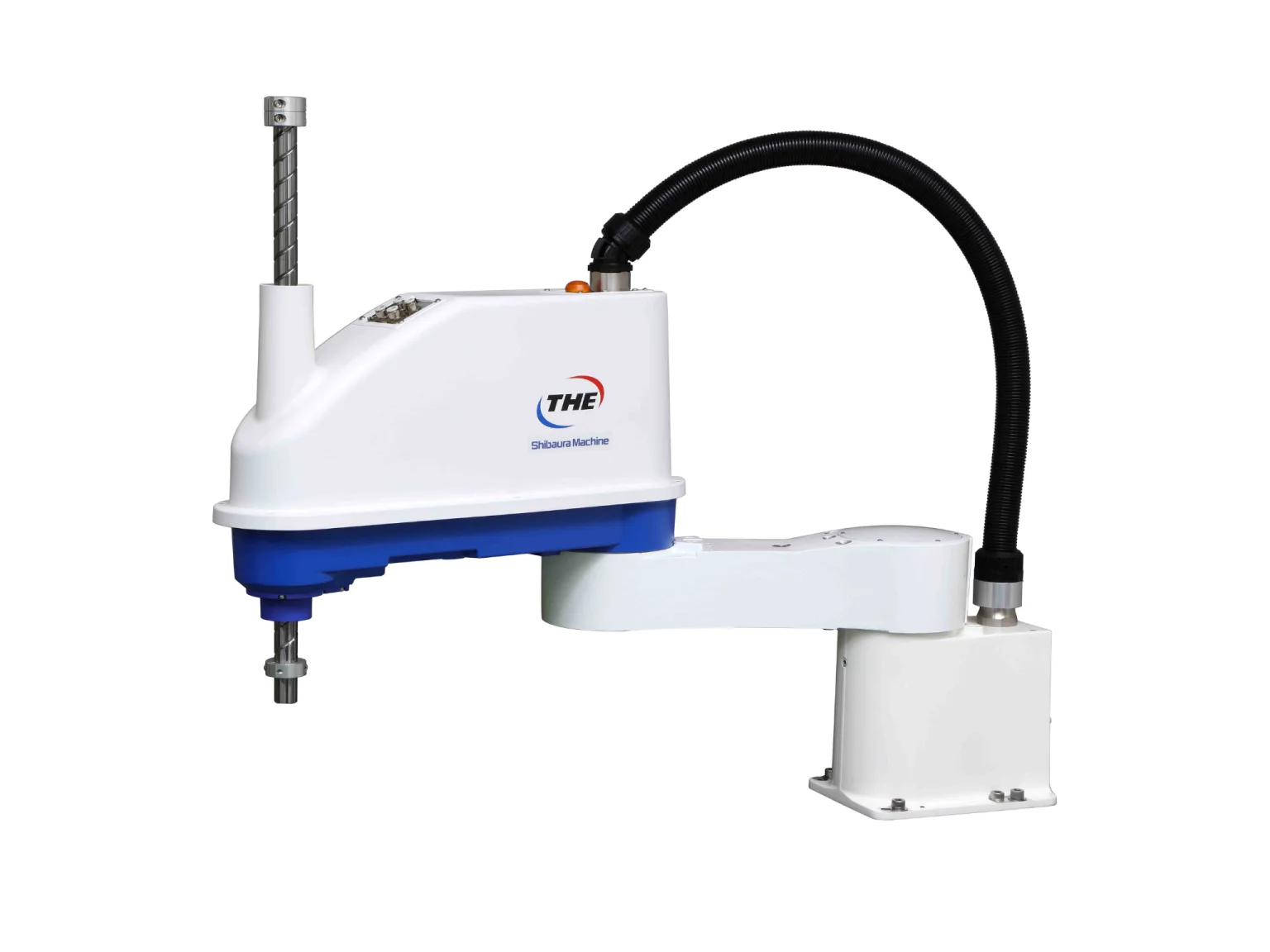
Bearings
Bearings Used in SCARA Robots
02 June, 2026
14 min read
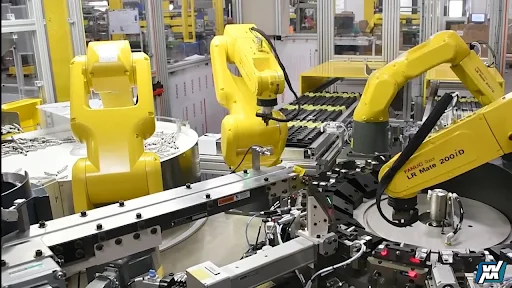
The name SCARA stands for Selective Compliance Assembly Robot Arm, referring to the robot’s ability to move freely and maintain stiffness in three axes while being compliant in the final axis. This flexibility makes them well-suited to tasks such as pick and place, sorting, and assembly.
SCARA robots commonly use precision thin-section bearings, angular contact bearings, deep groove ball bearings, crossed roller bearings, linear guides for the Z-axis, and needle roller bearings in compact support points. The right bearing choice keeps the arm fast, repeatable, clean-running, and stable under combined radial, axial, and moment loads.
Key Takeaways
- SCARA robots do not rely on one universal bearing style. J1 and J2 arm joints, the Z-axis, and the wrist each place different demands on stiffness, friction, sealing, and load support.
- The incorrect bearing usually shows up as repeatability drift, rising torque, more noise, heat, contamination problems, and shorter maintenance intervals.
- Thin-section bearings help when space and cable routing are tight. Crossed roller bearings help when one compact joint has to resist radial, axial, and moment loads with very little play.
- Preload, mounting accuracy, sealing, and lubrication matter almost as much as bearing type. Good bearing geometry can still underperform if the support stack is not calculated correctly.
Why Bearings Matter in SCARA Robots
SCARA robots are built for fast, repetitive work. That is why they are commonly used for assembly, pick-and-place, packaging, inspection, dispensing, and other small-part handling jobs where cycle time and repeatability matter. In that kind of duty, the bearing is not just a support part. It is part of the motion system.
A SCARA can have good motors, good controls, and a clean path program and still miss the mark if the joint bearings are too loose, create friction, or are poorly matched to the load. What shows up on the floor is familiar: a softer stop at the tool point, pickup inconsistency, more correction in the servo loop, rising heat, and a robot that technically still runs but no longer feels sharp.
That is why SCARA bearing selection usually comes back to the same practical questions. How much stiffness does the axis need? Is the joint carrying radial load only, or radial plus axial plus moment? Does the joint need low runout and smooth rotation more than load capacity? Is the envelope considered for a large bore and slim cross section.
In short, SCARA robots typically need precision bearings because they combine fast starts and stops, compact geometry, high repetition, and application demands that expose any bearing weakness quickly.
Technical basis.
Where Bearings Are Used in a SCARA Robot
The bearing layout in a SCARA robot follows the axis layout.
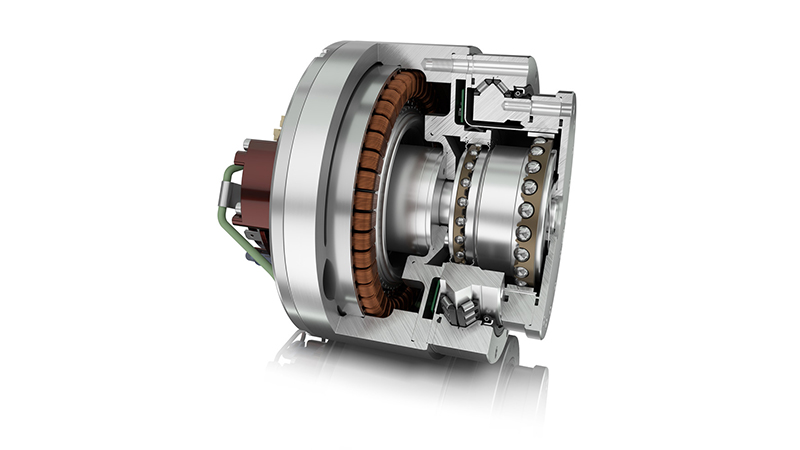
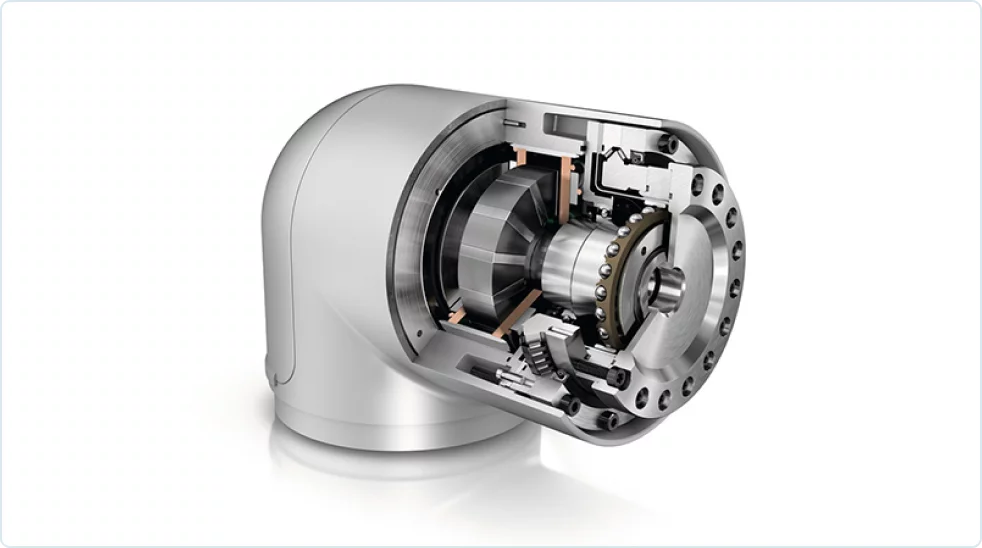
J1 and J2 are the main rotary joints that create the robot’s X-Y motion. These joints need attention because they see high cyclic loading and have the biggest effect on tool-point repeatability. J1 generally carries the whole downstream arm system, while J2 deals with the forearm, wrist, and tool loads. In both cases, bearing stiffness and control of internal play are important.
J3 is the vertical Z-axis. This is the lift axis that moves the tool up and down for insertion, placement, dispensing height, or part engagement. Here, the bearing requirement shifts from rotary support to linear guidance. A Z-axis that is smooth but not rigid can still create bad insertion behavior, tool chatter, or inconsistent vertical positioning.
J4 is the wrist or end-effector rotation axis. It usually has to turn smoothly, hold orientation, and stay compact. In some SCARA layouts, this area also benefits from an open center for air lines, wiring, or gripper services, so compact bearings with useful bore geometry can become important.
The short version is simple: J1 and J2 are usually about rotary stiffness and combined load handling, J3 is about straight and clean vertical travel, and J4 is about smooth rotational support in a tight package.
Technical basis.
Common Bearing Types Used in SCARA Robots
Thin-section bearings. These are a strong fit when the robot joint needs a relatively large diameter but very little cross-sectional width. That matters in slim arm joints, hollow wrist areas, and packaging-sensitive designs where you do not want the bearing to consume valuable space. Thin-section four-point versions are especially useful when one compact bearing has to carry mixed load directions and help simplify the stack.
Angular contact bearings. These are commonly used where the joint or shaft support sees combined radial and axial loading and where preload is part of the accuracy plan. In SCARA robots, that often makes them a practical choice for arm pivots, drive supports, or reducer-related shaft support positions where stiffness and low runout are important.
Deep groove ball bearings. Often specified in standard duty applications combining both radial and some axial load capabilities. They are versatile, low-friction, and good at moderate combined loading, which makes them useful for motor shafts, idlers, lighter wrist supports, and other positions where speed and simplicity matter more than maximum moment rigidity.
Crossed roller bearings. Uses where a compact rotary joint needs to support radial, axial, and moment loads at the same time with high rigidity and good rotational accuracy. They make a lot of sense when a SCARA joint is compact. Not every SCARA needs them, but when joint stiffness is a priority and has a combined load they are commonly specified.
Linear bearings or guides for Z-axis motion. The Z-axis usually needs a guide system designed for precise straight-line movement. That may be a recirculating linear guide, a compact linear bearing arrangement, or a crossed roller guide depending on the machine. What matters is low friction, good rigidity, clean travel, and predictable behavior under side load.
Needle roller bearings. These are valuable where radial support has to fit inside a very tight envelope. If a SCARA design has a compact support point, gearbox output support, or nested joint packaging problem, needle rollers can deliver high radial capacity and stiffness without demanding much cross-sectional height.
A useful rule of thumb is this: thin-section bearings solve packaging problems, angular contact bearings solve controlled stiffness problems, deep groove bearings are used in standard applications and, crossed roller bearings solve compact combined-load requirements., Z-axis guides solve straight-line accuracy, and needle rollers solve compact radial support problems.
Technical basis.
Bearing Selection Specifications for SCARA Robots
The most useful way to select a SCARA bearing is not to start with bore size. The table below identifies load demands, rigidity, environment, and what failure analysis.
| Robot area or axis | Common bearing type | Main load condition | Key selection factor | Why it matters |
| J1 shoulder / base rotary joint | Angular contact pair, thin-section four-point, or crossed roller | Combined radial, axial, and moment load from the full arm system | Stiffness, preload strategy, moment resistance | This joint heavily influences overall repeatability and stop quality |
| J2 elbow joint | Thin-section angular contact, angular contact pair, or crossed roller | Combined load with frequent reversals and compact packaging | Low play under reversal, compact envelope, smooth torque | Small clearance growth here shows up at the tool point |
| J3 Z-axis lift | Linear guide, compact linear bearing, or crossed roller guide | Vertical travel plus side load from the tool or offset payload | Straightness, rigidity, seal option, lubrication fit | Affects insertion quality, vertical repeatability, and clean travel |
| J4 wrist rotation | Miniature deep groove, angular contact, or thin-section bearing | Rotational duty with tool inertia, cable routing limits, and possible axial load | Low runout, compact design, smooth rotation | Keeps tool orientation stable and motion predictable |
| End-effector module | Miniature deep groove or angular contact bearing | Lighter radial and axial loads, frequent motion cycles | Low friction, low noise, size efficiency | Helps grippers, tooling, and rotating accessories stay responsive |
| Motor shafts and idlers | Deep groove ball bearing | Mostly radial load, moderate axial effect, higher speed | Low friction, speed capability, simple mounting | Good supporting choice when the position is not carrying major moment loads |
| Compact support points near gearboxes or nested assemblies | Needle roller bearing or combined needle arrangement | High radial load in limited radial space | Low cross-sectional height, stiffness, relubrication access | Useful when package size is tight and radial support is the main requirement |
The other specifications that deserve attention early are preload, internal clearance, seal drag, lubricant compatibility, mounting accuracy, and contamination risk. They directly affect torque, noise, heat, runout, and life.
Technical basis.
Bearing Type Comparison for SCARA Applications
| Bearing type | Best fit in SCARA robots | Strengths |
| Thin-section ball bearing | Slim arm joints, large-bore hollow joints, compact wrists | Saves space and weight, useful large bore, good packaging flexibility |
| Thin-section four-point contact bearing | Compact mixed-load rotary joints | Carries radial, axial, and moment loads in one compact package, can simplify the stack |
| Angular contact bearing pair | Arm pivots, drive supports, shaft support positions | Handles combined load well, preload can improve stiffness and runout control |
| Deep groove ball bearing | Motor shafts, idlers, lighter support roles, some compact wrist duties | Low friction, low noise, easy mounting, versatile |
| Crossed roller bearing | Compact high-rigidity rotary joints | Excellent combined-load support and high rigidity in one bearing |
| Linear guide or crossed roller guide | Z-axis lift and precise straight-line motion | High rigidity, accurate linear travel, good control of side load |
| Needle roller bearing | Tight radial support positions | High radial capacity and stiffness in a small cross section |
Practical Selection Notes
If you are selecting bearings for a SCARA robot, begin with the load and speed and dimensional envelope. Ask what the joint really sees in production: peak moment from an overhung tool, repeated reversing motion, contamination from dust or washdown, vertical insertion force on the Z-axis, or simply thousands of fast cycles where low friction and stable preload matter more than high load rating. Two bearings can fit the same and behave very differently once the axis starts seeing moment load, and hard reversals. Careful selection will help eliminate functional issues after installation.
Clean operation deserves extra attention in SCARA work because these robots are often used in electronics, medical, food, packaging, and other controlled environments. In those cases, bearing sealing and lubricant choice have to match the contamination goal.
How PIB Supports SCARA Robot Bearing Selection
Pacific International Bearing Sales can help narrow the search through its online catalog being a practical place to compare thin-section, angular contact, deep groove, crossed roller, linear guide, and needle bearing options when you are matching a bearing to a SCARA joint, Z-axis, or end-effector support point. Also selecting bearings If the robot has specific requirements for cleanliness, or combined-load requirements.
Technical basis.
FAQ
What bearings are commonly used in SCARA robots?
Most SCARA robots use a mix rather than a single type. Common choices include thin-section bearings, angular contact bearings, deep groove ball bearings, crossed roller bearings, linear guides for the Z-axis, and needle roller bearings where radial support has to fit inside a small cross section envelope.
Why are thin-section bearings used in robotic arms?
Because they let designers keep a relatively large bore while controlling width and weight. That helps in slim joints, hollow wrist areas, and layouts where wiring, tubing, or compact packaging matter as much as load requirements. These bearings can achieve both..
Are crossed roller bearings necessary in SCARA robots?
Not always. They are most useful when one compact rotary joint must resist radial, axial, and moment loads with high rigidity. Many SCARA designs can do the job well with paired angular contact or thin-section arrangements if the load ratings fit.
What bearing issues cause loss of repeatability?
The usual causes are loss of preload, internal clearance, contamination ingress, poor lubrication, mounting error, seal drag, or using a bearing type that cannot function in a moment-loaded joint.
How does lubrication affect SCARA robot performance?
Lubrication affects friction, wear, heat, corrosion protection, and service life. Too little lubricant or the wrong grease can raise torque and shorten life. A lubricant that does not fit the speed or environment can also create drag, leakage, or contamination problems.
How do I choose bearings for a SCARA robot joint?
Start with the axis . Define load direction, moment loads, speed type, duty cycle, available envelope, cleanliness requirements, mounting accuracy, and whether preload is needed. Then choose the bearing type best suited using standard products whenever possible.
Can PIB help source bearings for robotic applications?
Yes. A practical starting point is the PIB online catalog, especially when you need to compare bearing types.. If the application involves unusual combined loads, hollow-joint packaging, seal tradeoffs, or replacement planning, PIB can help narrow the search faster.
Final Thoughts
A SCARA robot bearing arrangement should do more than let the joint move. It should help the robot stop with precision accuracy, pick and place accuracy and stay clean, and have long life.
If you are choosing between bearing options for a new build or trying to solve repeatability drift in an existing application contact us for assistance.
Contact us at 1(800) 228-8895 or visit our website at www.pibsales.com.