Your cart is empty
 Short Rigid Couplings
 Controlflex Couplings
 Jaw Couplings
 Oldham Couplings
 Bearing Locknuts – TCN
 Double Wide Shaft Collars
 Heavy Duty Shaft Collars
 International Series Shaft Collars
 Keyed Shaft Collars
 Mountable Shaft Collars
 Quick Clamping Shaft Collars
 Set Screw Shaft Collars
 Thin Line Shaft Collars
 Threaded Shaft Collars – Pacific International Bearing Products
 Two-Piece Shaft Collars
 Friction Bearing Universal Joints
 Needle Bearing Universal Joints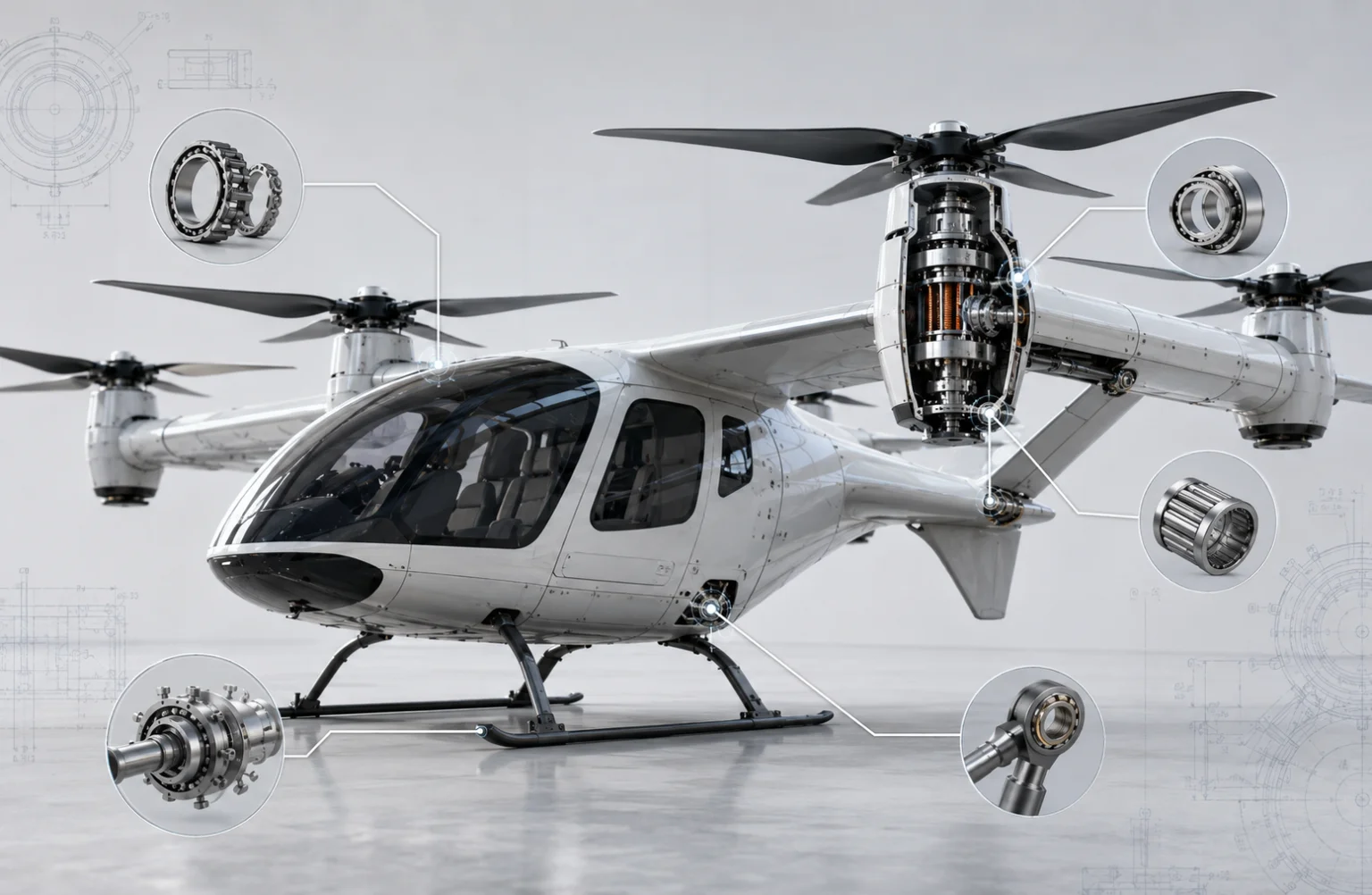
Bearings
eVTOL Bearings Used in Electric Vertical Takeoff and Landing Aircraft
14 August, 2026
35 min read
Electric vertical takeoff and landing aircraft place bearings in several very different operating positions. A propulsion motor bearing may run at high speed while maintaining a controlled rotor air gap. A gearbox bearing may carry combined gear and thrust loads. Bearings in a tilt mechanism or flight-control linkage may spend most of their life making short, reversing movements under load.
Those positions cannot be addressed with one standard bearing arrangement.
Pacific International Bearing Sales works with OEMs, engineering teams, and sourcing organizations that need bearing specifications matched to the actual mechanism and program requirements. For eVTOL applications, PIB considers the aircraft architecture, mission duty cycle, thermal growth, lubrication, precision, documentation, and consequences of bearing degradation together.
Why eVTOL Bearing Applications Are Different
An eVTOL aircraft combines the weight and reliability pressures of aerospace design with the speed, heat, and electromagnetic conditions found in electric propulsion.
The propulsion system may use one large motor, several distributed motors, ducted fans, open propellers, tilting rotors, or separate lift and cruise systems. Some architectures use reduction gearboxes, while others connect the motor directly to the propeller or rotor.
The bearing conditions change with the architecture.
During vertical takeoff and hover, the propulsion system may operate under high thrust. Transition can change thrust direction, aerodynamic loading, motor speed, and structural deflection. Cruise creates another load pattern, followed by descent, hover, and landing.
Bearings in these systems may have to manage:
- High rotational speed
- Radial and axial loads
- Overhung rotor or propeller moments
- Rapid speed changes
- Repeated starts and stops
- Temperature gradients
- Vibration and gust loading
- Limited installation space
- Low mass requirements
- Corrosion exposure
- Electrical-current paths
- Strict documentation and change control
Weight matters, but reducing bearing or housing mass without maintaining stiffness can create a less stable shaft arrangement. Efficiency matters, but reducing friction cannot come at the expense of required load capacity, lubrication, or shaft control.
The best bearing solution is therefore determined at the assembly level rather than by selecting the lightest available individual component.
Where Bearings Are Used in eVTOL Aircraft
Bearing locations vary by aircraft, but common positions can include:
- Electric propulsion motors
- Actuation motors
- Optional reduction gearboxes
- Power and rotary generators
- Propeller and rotor shafts
- Tilt-rotor or tilt-wing systems
- Flaperons and other control surfaces
- Electromechanical actuators
- Flight-control linkages
- Landing-gear mechanisms
- Pumps and accessory drives
- Positioning and sensor assemblies
Each location has its own motion profile.
A propulsion motor bearing may rotate continuously at high speed. A control-linkage bearing may move through only a few degrees, reverse direction, and then hold its position. A gearbox shaft may carry gear-separation forces and thrust at the same time.
This is why “aerospace bearing” is not a complete specification. Bearing type, material, precision, preload, closure, lubricant, and documentation have to match the exact installation.
Propulsion Motor Bearings
Propulsion motor bearings support the rotor and maintain its position relative to the stator. Stable rotor location helps control the motor air gap, vibration, torque behavior, and alignment of the connected propeller, rotor, or gearbox.
The bearing arrangement may carry radial load from rotor mass and imbalance, axial load from propulsion thrust, and moment load from an overhung rotating assembly.
Radial ball bearings
Radial ball bearings can provide a compact, relatively low-friction solution where radial load is dominant and axial loads remain within the bearing arrangement’s capability.
They may be used in accessory motors and certain propulsion configurations, depending on speed, thrust, preload, and shaft-location requirements.
A radial bearing can carry some axial load in both directions, but that does not mean it will provide the axial stiffness required by every propulsion motor.
Angular contact ball bearings
Angular contact ball bearings are useful when the system must carry combined radial and axial loads while controlling shaft position more closely.
They may be installed individually, in matched pairs, or in larger sets.
A back-to-back pair can provide a broad effective support span and useful resistance to overturning moment. A face-to-face pair responds differently to alignment and moment loading. A tandem arrangement may be used when greater thrust capacity is needed in one direction.
The arrangement depends on the motor architecture and load direction. There is no universal pairing configuration for all eVTOL propulsion systems.
Preload in propulsion motors
Preload removes internal clearance and establishes controlled rolling-element contact. In a propulsion motor, it can improve rotor positioning, stiffness, and response during changing thrust or speed.
Too little preload may allow:
- Axial rotor movement
- Vibration
- Changing air-gap conditions
- Unstable rolling-element motion
- Reduced shaft stiffness
Too much preload may cause:
- Higher bearing torque
- Additional heat
- Lubricant stress
- Reduced speed capability
- Accelerated raceway damage
The preload measured during assembly is not necessarily the preload seen during flight. Shaft, housing, and bearing temperatures can change the operating condition significantly.
Hybrid bearing options
Hybrid bearings use steel rings with ceramic rolling elements, commonly silicon nitride balls.
They may be evaluated where lower rolling-element mass, high speed, thermal behavior, or electrical isolation provides an application benefit.
A hybrid bearing is an option, not a default eVTOL solution. It still depends on suitable raceway material, internal geometry, preload, lubricant, fits, and contamination control.
Ceramic balls do not correct a flexible shaft, distorted housing, poor preload selection, or an unsuitable lubricant.
Electrical-current damage
Electric motors can create shaft voltages and unintended current paths.
If current passes through the rolling contacts, localized electrical discharge may damage the raceways and lubricant. The resulting surface distress can increase vibration and bearing noise.
Possible system-level responses can include insulated bearing features, hybrid arrangements, shaft grounding, current bypasses, or changes to motor and inverter design.
The correct approach depends on the electrical architecture. Electrical bearing protection should be coordinated with the motor, controls, grounding, and surrounding structure rather than treated as an isolated bearing option.
Gearbox Bearing Arrangements
Not every eVTOL aircraft uses a reduction gearbox. Where a gearbox is present, its bearings must maintain shaft location and gear alignment while transferring torque in a compact package.
Loads can include:
- Radial gear-separation forces
- Axial thrust from helical or bevel gears
- Combined radial and axial loading
- Torque reversals
- Housing deflection
- Shaft bending
- Vibration
- Transient loads during changing propulsion conditions
Depending on the gearbox design, the arrangement may use angular contact ball bearings, radial ball bearings, cylindrical roller bearings, tapered roller bearings, or specialized aerospace ball and roller designs.
Ball bearings can provide high-speed capability and combined-load support. Roller bearings may provide greater radial stiffness or load capacity where the shaft and axial-location strategy permit their use.
The bearing arrangement must be evaluated with the gear geometry.
If shaft movement changes the gear contact pattern, the gearbox may develop:
- Uneven tooth loading
- Higher noise
- Heat
- Vibration
- Reduced torque-transfer efficiency
- Accelerated gear and bearing wear
Before correction, the gearbox may appear to have a gear-quality problem when the underlying issue is insufficient bearing stiffness, loss of preload, or housing distortion.
With the correct bearing arrangement, the shaft stays closer to its intended position and the gear mesh remains more consistent under load.
Lubrication also has to work for both the gears and bearings. An oil selected around gear protection must still provide suitable bearing film formation, heat control, material compatibility, and aeration behavior.
Actuators, Tilt Mechanisms, and Flight Controls
Electromechanical actuators are used to move flight-control surfaces and, in some aircraft, to change the orientation of rotors, wings, or propulsion units.
Bearings in these mechanisms often experience oscillating rather than continuous motion.
A joint may move through a limited angle, hold aerodynamic load, reverse, and return. A screw-driven actuator may carry axial load while its motor and support bearings cycle repeatedly. A tilt mechanism may combine rotation, moment load, alignment variation, and structural deflection.
Potential bearing types include:
- Airframe control ball bearings
- Angular contact ball bearings
- Spherical plain bearings
- Self-lubricating plain bearings
- Ball bearing rod ends
- Plain rod ends
- Track rollers
- Thin-section bearings
- Screw-support bearings
Rod ends and spherical plain bearings
Rod ends connect control rods and actuator links while allowing angular movement.
Spherical plain bearings support high loads and accommodate misalignment between connected structures.
Metal-to-metal constructions may be appropriate where high load and relubrication are acceptable. Self-lubricating liners can reduce dependence on field lubrication, but liner wear, temperature, load, oscillation angle, and environmental exposure must still match the application.
The threaded shank, housing, liner, ball, and attachment structure all contribute to the load path. A rod end should not be evaluated only by the bearing element inside its head.
Track rollers
Track rollers may be used where a mechanism follows a cam or guided path.
Their performance depends on the track as much as the bearing. Track hardness, surface finish, crown, alignment, edge loading, and lubrication all affect contact stress and service life.
Small-angle movement
Limited oscillation can prevent lubricant from redistributing across the complete contact area.
The same section of raceway or liner may carry repeated load, increasing the risk of local wear, fretting, or lubricant starvation.
A bearing that performs well in continuous rotation may require a different lubricant, internal clearance, liner, or maintenance strategy when used in a small-angle flight-control joint.
Thin-Section and Compact Bearing Designs
eVTOL mechanisms are often constrained by mass and space. Thin-section bearings provide a relatively large bore with a small radial cross-section, allowing cables, shafts, fasteners, or other components to pass through the center.
They can be used in compact rotary mechanisms, sensor platforms, control assemblies, and actuator systems.
Available contact configurations include radial, angular, and four-point contact designs.
Radial-contact designs
Radial-contact thin-section bearings are primarily intended for radial loading. Depending on their design, they may also carry limited axial and moment loads.
Angular-contact designs
Angular-contact thin-section bearings provide stronger thrust capability in one direction. They may be paired when the mechanism requires axial support in both directions or increased stiffness.
Four-point-contact designs
A four-point-contact bearing can carry radial load, axial load in either direction, and moment load within one compact position.
That does not make it the best choice for every combined load. High simultaneous radial and axial loads can create contact conditions that need careful review.
Thin rings are sensitive to supporting-hardware accuracy. A lightweight bearing installed in a flexible or out-of-round housing may follow the housing distortion.
The bearing may have adequate catalog capacity while operating with uneven internal contact because the surrounding structure is not stiff enough.
Mission Duty Cycle and Load Cases
A bearing review should follow the aircraft mission rather than relying on one constant load.
Vertical takeoff and hover
Lift-producing systems may operate under high thrust while the aircraft has limited forward airflow. Propulsion bearings may see significant axial loading, motor heat, and vibration.
Transition
Transition can change thrust direction, rotor speed, control-surface load, and structural deflection. Bearings may experience load combinations not present in steady hover or cruise.
Cruise
Cruise may reduce the load on some lift systems while increasing or stabilizing loads on others. Aircraft with separate lift and cruise propulsion can place some motors into reduced-speed or stopped conditions.
Descent and landing
The system returns through changing thrust, aerodynamic, and control loads. Landing can also introduce short-duration structural and ground-handling forces.
Gusts and maneuvers
Gust response and rapid control input create transient loads. These may affect propulsion shafts, tilt systems, linkages, and actuators.
Emergency and abnormal events
Program-specific analysis may need to consider emergency stops, actuator stalls, control-system faults, loss of one propulsion unit, hard landings, or other abnormal conditions.
No generic article can assign the load values for these cases. They must come from the actual aircraft architecture and system analysis.
A useful bearing duty cycle includes load magnitude, direction, duration, speed, temperature, starts, stops, and oscillation for each mission phase.
Preload, Stiffness, and Thermal Growth
Preload is often used to increase stiffness and control shaft movement, but its operating value changes with temperature.
An electric propulsion system may have several different temperatures at the same time:
- Rotor and shaft temperature
- Inner-ring temperature
- Outer-ring temperature
- Housing temperature
- Lubricant temperature
- Nearby motor-winding temperature
- Gearbox or power-electronics temperature
If the shaft grows more than the housing, bearing preload may increase. If the housing expands differently, preload may decrease.
An arrangement that feels correct during room-temperature assembly can become too tight or too loose in service.
Excessive operating preload can create heat, lubricant degradation, and high contact stress. Insufficient preload can allow shaft movement, vibration, and changes in gear or motor alignment.
Fits also affect internal clearance. A tight shaft fit expands the inner ring, while a tight housing fit can compress the outer ring.
The calculation should include:
- Initial bearing clearance
- Assembly preload
- Shaft interference
- Housing interference
- Bearing geometry
- Material expansion
- Operating temperature distribution
- External loads
- Housing and shaft stiffness
Higher preload is not automatically better. The correct preload is the amount needed to meet stiffness and control requirements without producing unacceptable torque or temperature.
Lubrication and Service-Life Limits
Lubrication reduces friction, protects rolling surfaces, carries away some heat, and helps prevent corrosion.
Grease may be practical in sealed or shielded bearings that do not have access to an external oil system. Oil is commonly used in gearboxes and other assemblies where circulation, cooling, or integrated lubrication is required.
Grease selection
Aerospace bearing grease may be selected around:
- Speed
- Operating torque
- Temperature
- Water resistance
- Oxidation stability
- Start-stop duty
- Oscillating motion
- Material compatibility
- Storage requirements
Fill quantity matters. Excess grease can increase churning and heat. Too little can reduce lubricant availability and accelerate wear.
Oil systems
Oil-lubricated arrangements must provide enough lubricant to the bearing without excessive aeration, drag, or heat generation.
Flow, delivery path, filtration, temperature, and return drainage all influence bearing performance.
Lubricant life and fatigue life
A bearing may have an acceptable calculated rolling-contact fatigue life while its lubricant has a shorter useful operating period.
This is particularly relevant in sealed, high-speed, or high-temperature bearing positions where the lubricant cannot be replaced easily.
Lubricant life does not always control the bearing’s service life, but it should be evaluated separately rather than assumed to match the fatigue calculation.
Start-stop and oscillation
Frequent starts can create more time under mixed lubrication conditions than steady running. Small-angle oscillation can limit lubricant redistribution.
The lubrication review should match the real motion profile rather than relying only on maximum speed.
Materials, Corrosion, and Electrical Effects
Aerospace bearing materials are selected around fatigue, temperature, corrosion, load, weight, and lubrication.
Potential material families include:
- AISI 52100 bearing steel
- AISI 440C stainless bearing steel
- Corrosion-resistant aerospace bearing steels
- M50 and M50-NIL
- BG42
- Specialized stainless and high-temperature alloys
- Silicon nitride rolling elements
- Aluminum or titanium in selected specialized designs
These are options, not universal assignments to specific eVTOL positions.
52100 bearing steel
AISI 52100 provides high hardness and useful rolling-contact fatigue performance in a controlled lubricated environment.
Where moisture or corrosive exposure is significant, additional protection or another material may be needed.
440C stainless steel
Hardened 440C can provide corrosion resistance for bearing rings and rolling elements.
Its load, fatigue, and thermal characteristics should be included in the design review rather than assumed to be identical to chrome bearing steel.
High-temperature and specialty steels
M50, M50-NIL, BG42, and other aerospace steels may be evaluated where temperature, load, or fatigue requirements justify their use.
The lubricant, heat treatment, coatings, and surrounding materials must remain compatible.
Corrosion control
eVTOL bearings may be exposed to humidity, condensation, rain, cleaning fluids, temperature cycling, and storage.
Protection may include corrosion-resistant materials, coatings, seals, shields, compatible grease, drainage, and controlled storage.
A stainless bearing can still corrode if water remains trapped or the lubricant no longer protects the raceways.
Electrical protection
Material selection can also form part of an electrical-current mitigation strategy. Hybrid bearings or insulating features may interrupt certain current paths.
The bearing solution should still be coordinated with grounding and inverter design because current can find alternate paths through the assembly.
Precision, Runout, and Vibration
Bearing precision influences rotor location, gear mesh, actuator response, and measurement accuracy.
Higher precision may be justified where the system needs:
- Tight rotor-air-gap control
- Low radial or axial runout
- Stable preload
- Controlled gearbox alignment
- Accurate sensor positioning
- Low vibration
A higher ABEC class does not correct:
- A bent shaft
- An out-of-round housing
- Poor shoulder squareness
- Rotor imbalance
- Flexible structure
- Incorrect mounting
- Unstable preload
The bearing, shaft, housing, rotor, and attachment structure form one mechanical system.
Vibration should also be traced to its source. Bearing damage can cause vibration, but so can rotor imbalance, motor electromagnetic forces, gear mesh, structural resonance, propeller loading, or looseness.
Replacing the bearing without correcting the source may produce only a temporary improvement.
Oscillation, False Brinelling, and Storage
Bearings in control systems and tilt mechanisms may experience repeated small-angle movement. Bearings can also be exposed to vibration while stationary during transport, ground operation, or storage.
These conditions can produce raceway damage even when the bearing does not complete full revolutions.
True brinelling is permanent indentation caused by a static or shock load that exceeds the contact’s ability to remain elastically deformed.
False brinelling is wear damage associated with small-amplitude oscillation or vibration, often under limited lubricant-film conditions. Its marks may resemble true brinelling, but the mechanism is different.
Preventive measures depend on the cause and may involve:
- Better transport restraint
- Suitable lubricant
- Controlled preload
- Improved isolation
- Periodic movement
- Different bearing geometry
- Corrosion protection
- Revised storage procedures
A maintenance response should distinguish impact damage from vibration wear before selecting a corrective action.
Aerospace Quality, Traceability, and Change Control
Aerospace sourcing includes more than finding a bearing with the required dimensions and load rating.
The exact program may require:
- Approved quality systems
- Material certifications
- Lot and batch traceability
- Controlled special processes
- Inspection documentation
- First-article records
- Non-destructive testing
- Source inspection
- Supplier approvals
- Configuration control
- Change notification
- Preservation and packaging requirements
Aerospace manufacturers commonly maintain documented quality and traceability systems capable of linking products to specific manufacturing lots, material processes, and components.
Those controls apply to an exact manufacturer, facility, process, and part number. A bearing that looks equivalent physically may not carry the same records, approvals, or change controls.
PIB does not assume that every component in the general catalog meets every aerospace program requirement. The purchase specification needs to identify the required documentation and quality controls before the bearing is sourced.
This is especially important during prototype development. A commercial bearing may be useful for a bench or early engineering test, but that does not automatically make it suitable for flight hardware.
Frequently Asked Questions About eVTOL Bearings
What types of bearings are used in eVTOL propulsion motors?
Radial and angular contact ball bearings are possible options. The arrangement depends on motor speed, radial load, propulsion thrust, preload, rotor stiffness, temperature, electrical-current risk, and whether the motor connects directly to the rotor or through a gearbox.
Why are angular contact bearings used in electric propulsion systems?
Angular contact bearings can carry combined radial and axial loads while providing controlled shaft location. They may be paired to support thrust in both directions or increase moment stiffness, but configuration and preload must match the specific motor architecture.
Are hybrid ceramic bearings required in eVTOL motors?
No. Hybrid bearings may be useful for high speed, electrical isolation, rolling-element mass, or thermal behavior. They are one design option and do not replace the need for correct raceways, lubrication, preload, fits, and shaft alignment.
Do all eVTOL propulsion systems use gearboxes?
No. Some architectures use reduction gearing, while others use direct-drive motors. Where a gearbox is used, bearing selection must account for gear-separation forces, thrust, shaft location, housing deflection, lubrication, and the mission duty cycle.
Where are thin-section bearings used in eVTOL aircraft?
Thin-section bearings may be considered in compact rotary mechanisms, control assemblies, sensor systems, actuators, and other positions needing a large bore with limited radial space. Housing stiffness is particularly important because thin rings can follow surrounding distortion.
What bearings are used in flight-control linkages?
Possible options include airframe control ball bearings, rod ends, spherical plain bearings, self-lubricating plain bearings, and track rollers. Selection depends on load, misalignment, oscillation angle, friction, maintenance access, corrosion exposure, and required stiffness.
How does preload affect an eVTOL bearing?
Preload reduces internal movement and increases stiffness. Too little can allow vibration or shaft displacement, while too much increases torque, heat, and contact stress. Thermal growth and mounting fits determine the actual operating preload.
Are sealed bearings always better for eVTOL applications?
No. Contact seals improve contamination exclusion but add friction and heat. Shields usually create less drag but provide less environmental protection. Closure selection depends on the bearing position, lubricant system, contamination exposure, speed, and acceptable torque.
Which bearing materials are suitable for eVTOL aircraft?
Options can include 52100, 440C, corrosion-resistant aerospace steels, M50, M50-NIL, BG42, and ceramic rolling elements. The correct material depends on load, temperature, corrosion, lubrication, electrical behavior, and program requirements.
Why is aerospace bearing traceability important?
Traceability connects a bearing to its manufacturing lot, material, processes, inspections, and configuration. It supports quality control, change management, failure investigation, and compliance with the exact aircraft program’s procurement requirements.
Can an industrial bearing be used in an eVTOL prototype?
It may be suitable for certain ground or development tests if engineering approves it. Flight hardware may require different materials, documentation, quality systems, traceability, qualification, and change control. Suitability must be established for the exact test and program.
Final Considerations
eVTOL bearings operate across high-speed propulsion motors, optional gearboxes, compact actuators, tilt mechanisms, and flight-control linkages. Each position creates a different combination of speed, load, stiffness, temperature, lubrication, oscillation, and documentation requirements.
Dimensions establish whether a bearing fits the installation. The complete application determines whether it performs correctly.
A practical review includes the mission duty cycle, operating preload, thermal growth, shaft and housing accuracy, material, lubrication, precision, electrical environment, corrosion exposure, and program quality requirements.
The PIB online catalog is a starting point for reviewing angular contact, radial, thin-section, rod-end, spherical plain, and other bearing families. For eVTOL programs involving specialized aerospace materials, documentation, preload, lubrication, or sourcing requirements, PIB engineering support can help review the application and available supply options.