Your cart is empty
 Short Rigid Couplings
 Controlflex Couplings
 Jaw Couplings
 Oldham Couplings
 Bearing Locknuts – TCN
 Double Wide Shaft Collars
 Heavy Duty Shaft Collars
 International Series Shaft Collars
 Keyed Shaft Collars
 Mountable Shaft Collars
 Quick Clamping Shaft Collars
 Set Screw Shaft Collars
 Thin Line Shaft Collars
 Threaded Shaft Collars – Pacific International Bearing Products
 Two-Piece Shaft Collars
 Friction Bearing Universal Joints
 Needle Bearing Universal Joints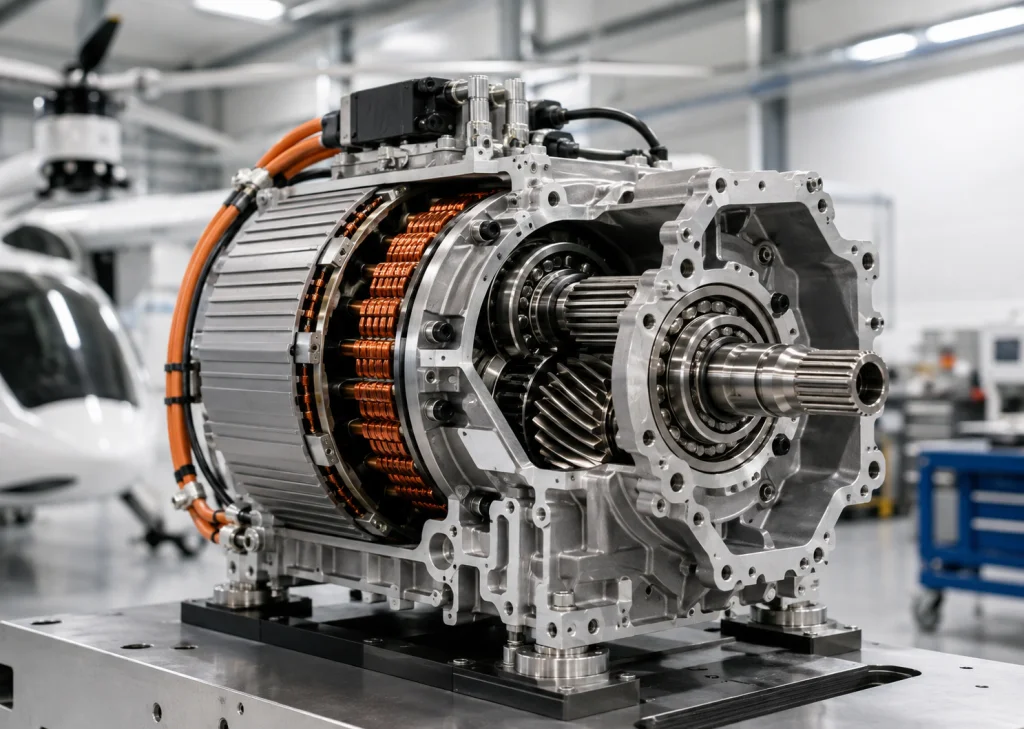
Bearings
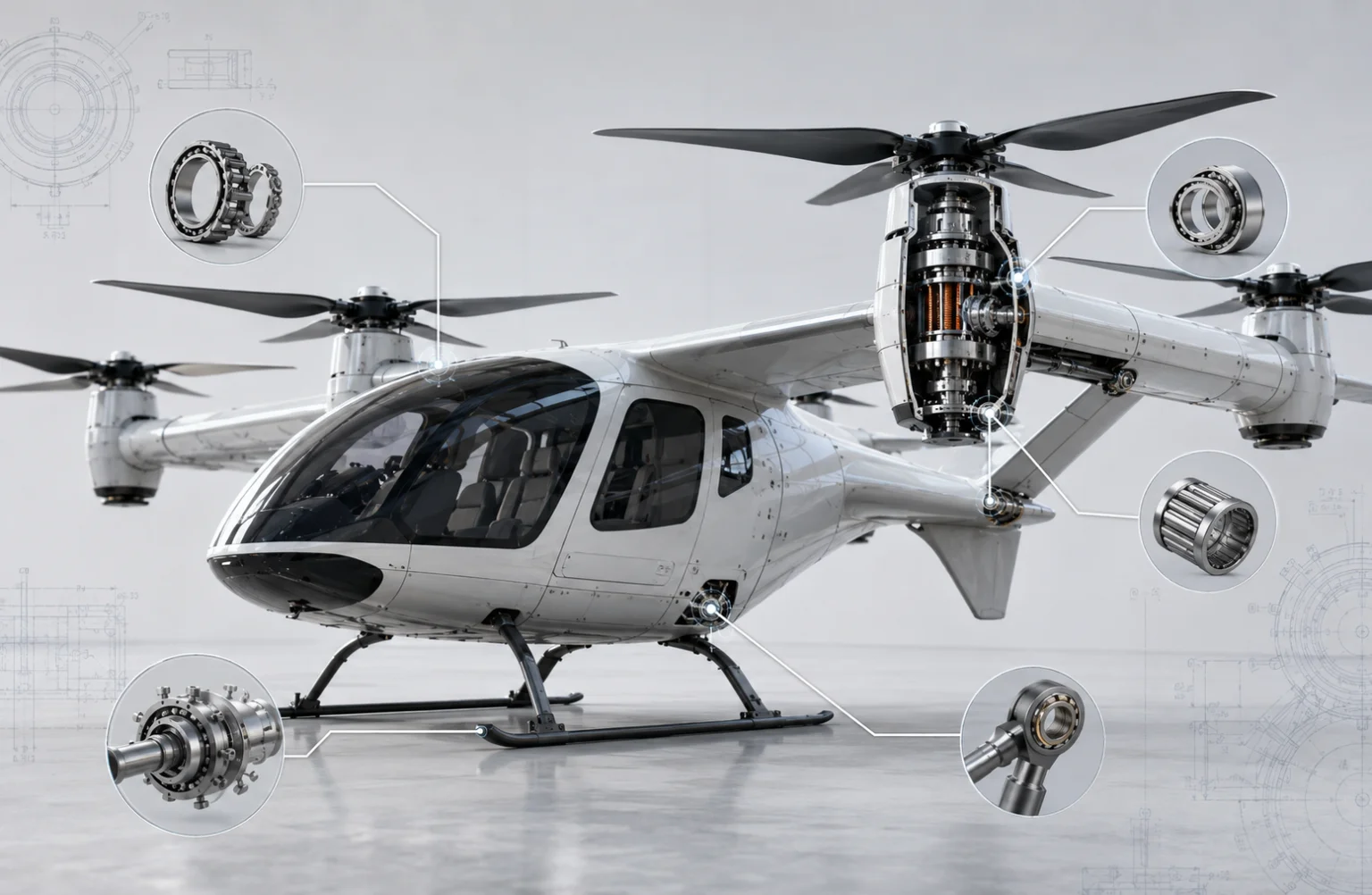
eVTOL Bearings Used in Rotary Generators and Gearboxes
05 October, 2026
19 min read
eVTOL powertrains do not all use the same mechanical architecture. A fully battery-electric aircraft may connect its propulsion motor directly to a propeller or rotor and have no onboard generator. Other designs use reduction gearing, and hybrid-electric or range-extender aircraft can add a rotary generator or turbogenerator to produce electrical power in flight. The bearing requirements change with each architecture.
In a generator, the bearing system has to locate a high-speed rotor accurately while managing heat, vibration, lubrication, and possible electrical-current paths. In a gearbox, the bearings have a different job: hold shafts and gears in position while carrying gear-separation forces, thrust, bending, and transient loads without letting the mesh move out of alignment.
Pacific International Bearing Sales works with OEMs and engineering teams that need bearing selections matched to the actual speed, load path, thermal condition, lubrication system, and installation. For eVTOL rotary generators and gearboxes, PIB looks at the complete rotating assembly rather than treating the bearing as an isolated catalog item.
Why Rotary Generators and Gearboxes Need Different Bearing Strategies
A rotary generator and a gearbox may sit in the same hybrid-electric powertrain, but the operating problems are not identical. Generator bearings are usually dominated by rotor speed, shaft location, thermal growth, lubricant behavior, and electrical effects. Gearbox bearings are dominated by gear geometry, torque transfer, shaft stiffness, preload or endplay, lubricant delivery, and the need to keep the gear contact pattern stable.
That distinction matters in eVTOL design because mass and packaging pressure can push both systems toward compact, high-power-density layouts. Reducing envelope size is useful only if the shaft stays controlled under the real duty cycle. A bearing arrangement that is light but thermally unstable, under-lubricated, or too flexible can create more heat, noise, wear, and maintenance.
Where Bearings Work in an eVTOL Generator and Gearbox
Bearing locations depend on the aircraft and drivetrain architecture. Hybrid-electric aircraft can use a turbine-driven generator to recharge batteries, feed the electrical propulsion system, or support both functions. Separately, an electric propulsion drivetrain may use a reduction gearbox when the efficient operating speed of the motor is higher than the desired propeller or rotor speed. Some designs use direct drive and eliminate the gearbox entirely.
| Bearing location | Typical duty | Main bearing priorities |
| Generator drive-end support | Continuous high-speed rotation; radial load with architecture-dependent thrust | Rotor location, low friction, thermal stability, electrical protection if required |
| Generator non-drive-end support | High-speed radial support; may accommodate thermal expansion depending on arrangement | Stable clearance, low heat, suitable lubrication, controlled shaft growth |
| Gearbox input shaft | High input speed, gear-mesh forces, possible axial thrust | Speed capability, shaft stiffness, preload/endplay control, lubrication |
| Intermediate or planet gear support | High radial load in compact space; repeated tooth loading | Load capacity, stiffness, compact geometry, oil-film formation, contamination control |
| Gearbox output shaft | High transmitted torque; radial and axial loads depend on gear type and propulsor interface | Combined-load capacity, gear alignment, housing stiffness, controlled axial position |
Bearings in Rotary Generators
A generator bearing supports the rotor while maintaining a controlled relationship between the rotating and stationary parts of the electrical machine. That sounds straightforward, but high rotational speed turns small mechanical errors into heat and vibration. Rotor imbalance, shaft runout, housing distortion, excessive preload, or an unsuitable lubricant can all increase bearing temperature and change the way the generator runs.
High-speed ball bearings
Deep-groove ball bearings are commonly considered where radial load is dominant and the required axial load remains within the arrangement’s capability. Their relatively low friction and high-speed capability can suit compact rotating electrical machines. The design still has to account for cage behavior, internal clearance, fits, lubricant, and the temperature difference between shaft and housing.
Angular contact ball bearings become more useful when the generator needs tighter axial location or must carry meaningful combined radial and thrust loads. Paired arrangements can increase axial stiffness and control shaft position in both directions. Preload can improve rigidity, but too much preload raises torque and heat and can reduce the available speed margin.
Hybrid and electrically insulated bearing options
Rotating electrical machines can develop unwanted shaft voltage and bearing current paths. If electrical discharge occurs through the rolling contacts, localized surface damage can develop on the raceways and the lubricant can also be affected. The practical result may be rising noise, vibration, temperature, and eventually premature bearing damage.
Hybrid bearings, which use steel rings with silicon-nitride rolling elements, can interrupt a current path through the rolling contacts and can also be attractive in high-speed applications because the ceramic rolling elements have lower density than steel. Coated or otherwise insulated bearing arrangements are another option. Neither approach should be treated as a stand-alone cure: grounding, inverter behavior, shaft voltage, adjacent conductive paths, fits, and lubrication still need to be reviewed as one electrical-mechanical system.
Thermal growth and operating clearance
The clearance or preload established during assembly is not necessarily the condition the bearing sees in operation. A generator shaft and inner ring can heat differently from the housing and outer ring. If the shaft grows more, operating clearance can decrease and preload can rise. If the arrangement is too loose at temperature, rotor movement and vibration can increase.
The correct target is controlled internal geometry at operating temperature, not simply the tightest possible assembly. Shaft fits, housing fits, ring material, bearing geometry, cooling, and lubricant temperature all influence the result.
Bearings in eVTOL Gearboxes
A reduction gearbox allows a high-speed motor to operate at a different rotational speed from the propeller or rotor. That can be useful because the motor and propulsor do not necessarily reach their best size, mass, or efficiency at the same shaft speed. The gearbox adds mechanical components, however, and the bearings become part of the gear-alignment system.
Gear teeth create forces that the bearings must react to. Spur gears primarily generate radial separation forces. Helical and bevel gears add axial components. Planetary stages can put high radial loads into planet supports in a very compact envelope. The exact load path depends on tooth geometry, shaft layout, torque, bearing spacing, and housing stiffness.
Angular contact ball bearings
Angular contact ball bearings can support combined radial and axial loads while providing controlled shaft location. They are useful where speed is high and thrust direction is known, or where paired bearings are used to locate a shaft in both directions. The contact angle, pairing arrangement, preload, lubrication, and support stiffness all affect how the bearing shares load.
Cylindrical roller bearings
Cylindrical roller bearings provide high radial load capacity and stiffness for their envelope. They can be useful on gearbox shafts or in compact planetary arrangements where radial loading is dominant. Depending on the bearing design, axial location may need to be provided by another bearing or by a locating variant. That separation of functions can be helpful, but only when shaft thermal growth and the overall locating/floating strategy are designed deliberately.
Tapered roller bearings
Tapered roller bearings are designed to carry radial and axial load at the same time. Opposed pairs can provide strong shaft location and moment stiffness, which is useful where gear mesh must remain stable under combined loading. They can also be adjusted to a target endplay or preload. The tradeoff is that preload, speed, lubrication, and friction have to be controlled carefully; more preload is not automatically better.
Deep-groove ball bearings
Deep-groove ball bearings may fit gearbox positions where speed is high, radial load is moderate, and axial load does not demand the stiffness of an angular-contact or tapered arrangement. Their compactness and low friction are useful, but the gearbox load calculation must confirm that the actual thrust and shaft-location requirements are appropriate for the bearing arrangement.
| Bearing family | Where it may fit | Why it can work | What still needs checking |
| Deep-groove ball bearing | Generator rotors; selected gearbox shafts | Low friction, high-speed capability, compact radial support | Axial stiffness and thrust capacity may be limiting in some arrangements |
| Angular contact ball bearing | Generator locating end; gearbox input/output shafts | Combined-load support and controlled axial location | Preload, thermal growth, contact angle, and pairing must be correct |
| Cylindrical roller bearing | Gearbox shafts and planet supports where radial load dominates | High radial capacity and stiffness in compact space | Axial location depends on bearing design and system arrangement |
| Tapered roller bearing | Gearbox shafts with combined load and gear-mesh stiffness requirements | Radial plus axial capacity; adjustable endplay/preload | Friction, heat, preload, speed, and lubrication require careful control |
| Hybrid ceramic ball bearing | Selected high-speed generator or electric-machine positions | Electrical isolation through rolling contacts; lower rolling-element mass | Not a substitute for correct fits, lubrication, grounding, and shaft/housing design |
Gear Mesh Depends on Bearing Stiffness
The gearbox bearing arrangement does more than carry load. It holds the gears where the designer expects them to run. If the shaft moves because of bearing clearance, loss of preload, housing deflection, or thermal growth, the contact pattern between gear teeth can shift. The result can be increased mesh noise, localized tooth loading, higher temperature, and accelerated wear.
This is why a gearbox that appears to have a gear-quality problem can sometimes have a bearing-system problem underneath it. The bearing may have adequate catalog load capacity and still allow too much movement for the gear mesh. Conversely, an arrangement that is preloaded too heavily can run hot and waste power. The goal is enough stiffness and shaft control to preserve the mesh without creating unnecessary friction.
Lubrication Has to Serve the Whole System
Generator and gearbox bearings can have very different lubrication arrangements. A compact generator may use grease-lubricated bearings, oil-fed bearings, or a shared lubrication system depending on the machine. Gearboxes commonly use oil because the same lubricant can protect the gears, feed the bearings, carry heat, and transport debris toward filtration or a sump.
For gearbox bearings, oil viscosity at operating temperature has to create an adequate lubricant film at the bearing contacts while still meeting the needs of the gears. Flow path matters too. A bearing can receive enough oil in a static test but still run hot if high speed causes aeration, churning, poor drainage, or starvation at the actual operating condition.
Contamination control is especially important in a gearbox because wear particles from gears or other components can circulate through the bearings. Filtration, cleanliness during assembly, sealing, oil change criteria, and debris monitoring all contribute to bearing life and to the health of the gearbox as a whole.
What Happens When the Bearing Selection Is Wrong
A bearing mismatch usually shows up first as a system symptom rather than a clean bearing-only failure. In a generator, the warning may be increasing temperature, vibration, noise, rotor movement, or electrical surface damage. In a gearbox, the first signs may be changing gear noise, excessive heat, oil debris, unstable backlash, or wear concentrated in one part of the tooth contact.
| Mismatch | What it can look like in service | What improves with the right solution |
| Insufficient shaft stiffness or excessive clearance | Rotor or gear position changes under load; vibration and inconsistent mesh | Better shaft control and more repeatable rotor/gear alignment |
| Excessive preload | Higher torque, heat, lubricant stress, reduced speed margin | Controlled stiffness with lower parasitic loss and more stable temperature |
| Bearing family mismatched to load direction | Edge loading, excessive axial movement, overloaded rolling contacts | Load is carried through the intended contact geometry |
| Poor lubrication or oil delivery | Heat, surface distress, smearing or accelerated wear | More stable lubricant film and more predictable wear behavior |
| Electrical current through generator bearing | Raceway pitting/fluting, rising noise and vibration | Reduced risk of electrical rolling-contact damage when the full electrical path is addressed |
| Contamination or inadequate filtration | Indentation, abrasive wear, shortened gear and bearing life | Cleaner contacts, more consistent condition monitoring, fewer avoidable maintenance events |
Selection Factors That Matter Most
1. Start with the architecture. Confirm whether the aircraft is battery-electric, hybrid-electric, direct drive, or geared. A generator or gearbox should not be assumed to exist simply because the aircraft is an eVTOL.
2. Define the complete duty cycle. Use speed, torque, load direction, duration, starts, stops, acceleration, dwell, and transient events for each flight phase. Maximum load alone is not enough.
3. Calculate the real shaft loads. For the gearbox, include gear-separation forces and thrust from the actual tooth geometry. For the generator, include rotor mass, imbalance, coupling loads, and any axial forces from the machine or drive interface.
4. Set a shaft-location requirement. Translate acceptable rotor movement, gear mesh, backlash, runout, and vibration into bearing stiffness, clearance, preload, and support-spacing requirements.
5. Model thermal growth. Check shaft, housing, rings, lubricant, and adjacent structure at operating temperatures. Verify that the locating and floating positions can accommodate expansion without losing control or creating excessive preload.
6. Match lubrication to speed and load. Confirm lubricant type, viscosity, delivery, fill or flow, drainage, filtration, temperature, and material compatibility. Validate the lubrication system at representative speed, not only at room-temperature assembly conditions.
7. Review electrical-current risk in generators. If shaft voltages or inverter-related currents are possible, evaluate current-insulating bearings, hybrid rolling elements, grounding, or bypass strategies at the system level.
8. Design the fits and housing with the bearing. A high-quality bearing can still run poorly if the shaft seat is out of round, the shoulder is not square, the housing is too flexible, or interference fits consume too much internal clearance.
9. Build contamination control into the gearbox. Oil cleanliness, filtration, assembly practice, sealing, and debris monitoring should be treated as design inputs rather than maintenance details added later.
10. Validate the assembled unit. Bench testing should measure the parameters that matter to the system: temperature, torque or power loss, vibration, shaft movement, oil condition, electrical behavior, and changes after representative duty cycling.
Frequently Asked Questions
Do all eVTOL aircraft use generators and gearboxes?
No. Fully battery-electric aircraft can operate without an onboard generator, and some propulsion systems use direct-drive motors without reduction gearing. Hybrid-electric aircraft can use rotary generators or turbogenerators, while other eVTOL drivetrains may use a gearbox to match motor speed to propeller or rotor speed.
What bearings are commonly considered for eVTOL rotary generators?
Deep-groove and angular contact ball bearings are common candidates for high-speed rotating electrical machines. Hybrid ceramic or electrically insulated versions may be evaluated where speed, temperature, or bearing-current risk justifies them. The final arrangement depends on rotor loads, shaft location, lubrication, fits, thermal growth, and the electrical architecture.
What bearings are used in eVTOL gearboxes?
Possible choices include angular contact ball bearings, cylindrical roller bearings, tapered roller bearings, deep-groove ball bearings, and specialized planetary-gear bearing arrangements. Gear type, shaft speed, radial and axial loads, required stiffness, lubrication, and packaging determine which family is appropriate.
Why is preload important in a gearbox?
Preload can reduce internal movement and increase shaft stiffness, helping maintain a stable gear contact pattern. Too much preload increases friction and heat, while too little can allow gear alignment and backlash to change under load. The operating preload must be checked after fits and thermal growth are included.
Are hybrid ceramic bearings always better for eVTOL generators?
No. Hybrid bearings can provide useful high-speed and electrical-isolation characteristics, but they are not automatically the best choice for every generator. Cost, loads, raceway design, lubrication, grounding strategy, installation, and validation still determine whether the benefit is real in a specific machine.
How does gearbox contamination affect bearings?
Hard particles in the lubricant can indent or abrade bearing raceways and rolling elements, while the same contamination can damage gear teeth. Because the lubricant often circulates through the entire gearbox, filtration, sealing, clean assembly, and oil-condition monitoring directly affect both bearing and gear reliability.
Final Thoughts
Bearings in eVTOL rotary generators and gearboxes work in two different but tightly connected jobs. Generator bearings keep a high-speed electrical rotor located and running with controlled friction, temperature, and vibration. Gearbox bearings hold shafts and gears in alignment while reacting the forces created by torque transfer. In both cases, the correct choice comes from the real load path, speed, thermal condition, lubrication system, stiffness target, and installation – not from bearing dimensions alone.
PIB can help review bearing arrangements for rotary generators, geared electric drivetrains, planetary stages, and other eVTOL rotating systems. Starting with the actual architecture and duty cycle makes it easier to identify the bearing type, internal geometry, material, lubrication, and mounting details that support reliable operation without adding unnecessary complexity or maintenance.