Your cart is empty
 Short Rigid Couplings
 Controlflex Couplings
 Jaw Couplings
 Oldham Couplings
 Bearing Locknuts – TCN
 Double Wide Shaft Collars
 Heavy Duty Shaft Collars
 International Series Shaft Collars
 Keyed Shaft Collars
 Mountable Shaft Collars
 Quick Clamping Shaft Collars
 Set Screw Shaft Collars
 Thin Line Shaft Collars
 Threaded Shaft Collars – Pacific International Bearing Products
 Two-Piece Shaft Collars
 Friction Bearing Universal Joints
 Needle Bearing Universal Joints
Bearings
How Bearings Affect Die Placement Accuracy in Pick-and-Place Machines
13 November, 2026
24 min read
What controls speed, repeatability, clean motion, and placement stability
Semiconductor pick-and-place equipment asks a lot from small motion components. A die can be tiny, the travel can be short, and the moving mass can be light, yet the machine still has to accelerate hard, settle quickly, place consistently, and do it without adding particles, lubricant scatter, or unwanted vibration around the product.
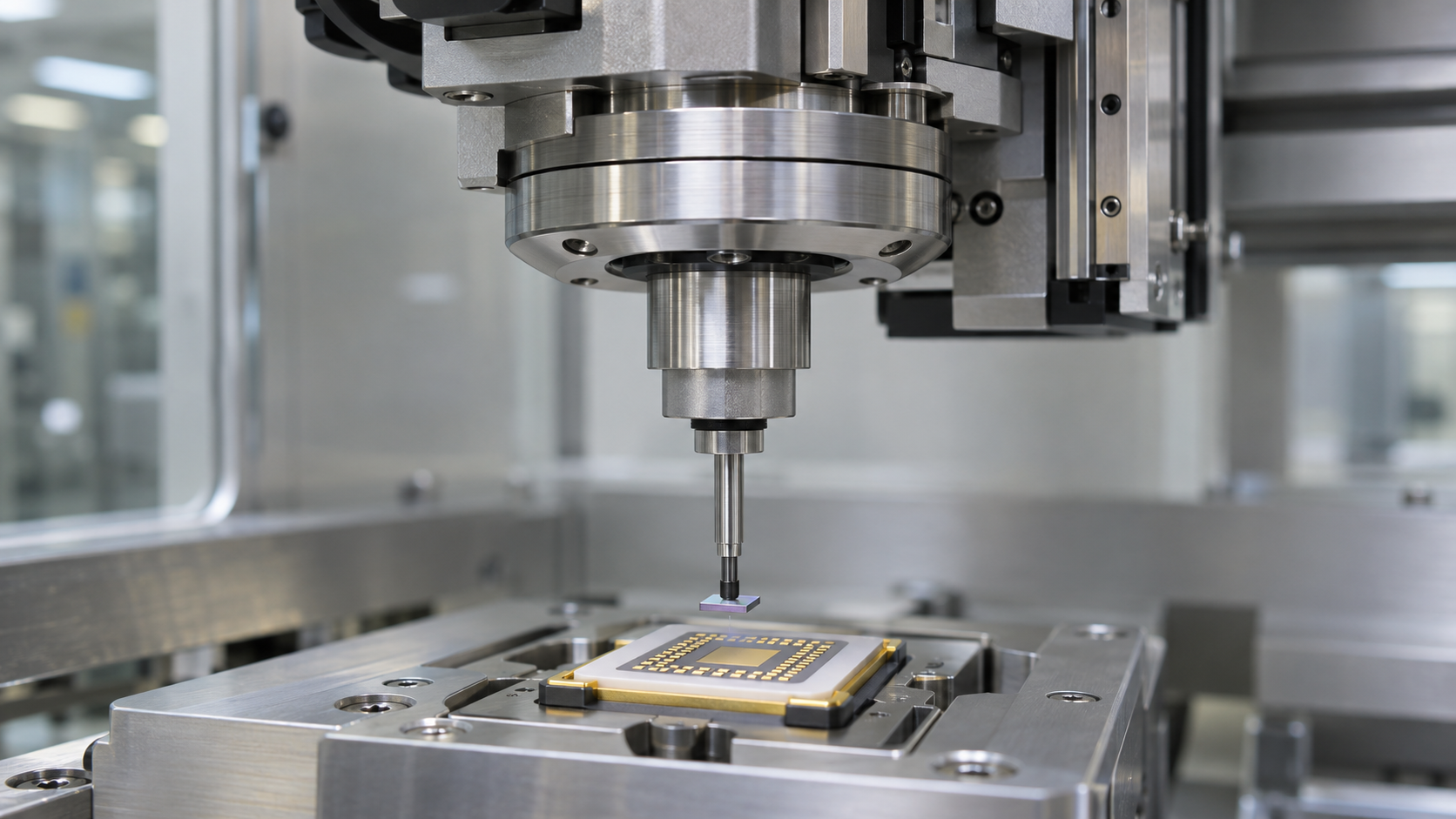
Pacific International Bearing Sales supports bearing and precision-motion applications where those details matter. In semiconductor die bonders, flip-chip bonders, chip handling systems, and related pick-and-place platforms, the bearing is not just there to carry load. It is part of the accuracy loop. Bearing stiffness, preload, friction, runout, lubrication, and mounting accuracy all show up at the pickup nozzle or placement point.
There is also an important distinction: semiconductor pick-and-place is not one single machine architecture. Some systems use ball-screw-driven stages, others use linear motors. Some use compact rotary pick heads, others use multi-axis gantries. A high-precision machine may combine rolling bearings, linear guides, crossed-roller bearings, and direct-drive stages in the same platform. The right selection depends on what each axis actually has to do.
Key Takeaways
– X-Y motion is usually about stiffness, straightness, low friction, and rapid settling. Linear rolling guides, crossed-roller guides, and ball-screw support bearings are common where rolling-element guidance is used.
– Z and theta axes place a premium on low runout, compact packaging, controlled preload, and predictable torque because errors at the pickup head directly affect die position and orientation.
– Cleanroom compatibility changes bearing selection. Low particle emissions, low lubricant scatter, low outgassing, and corrosion resistance may matter as much as basic load capacity.
– Crossed-roller bearings are useful for compact rotary stages that must resist radial, axial, and moment loads with high rigidity.
– The wrong preload or lubricant can turn a precision bearing into a source of heat, drag, particle generation, servo load, and repeatability drift.
What “Pick and Place” Means in Semiconductor Equipment
In semiconductor back-end and advanced-packaging equipment, pick and place typically means taking a die or small component from a wafer, tray, tape, or carrier; aligning it with vision; moving it to the destination; controlling Z height and bond force; and placing it on a substrate, package, submount, or another die. Depending on the process, the same machine may also flip the die, dispense or stamp material, heat the bond area, inspect the result, and index the next part.
That sequence creates several different motion problems inside one machine. The long-travel X-Y axes need fast, accurate translation. The pickup head needs compact vertical motion and very low lost motion. Theta rotation has to orient the die without adding runout. Motors and ball screws need their own support bearings. Transfer and indexing mechanisms may use cam followers or needle bearings. Each location sees a different mix of speed, load, moment, cleanliness, and stiffness.
The result is simple: there is no universal ‘semiconductor bearing.’ There is a bearing arrangement for each axis, and the quality of the whole machine depends on how those arrangements work together.
Where Bearings and Rolling Guides Are Used
| Machine area | Common rolling element | What it actually does |
| X-Y gantry or positioning stage | Linear guide / crossed-roller guide | Carries moving mass while controlling straightness, side load, pitch, yaw, and friction during rapid travel. |
| Ball-screw drive | Angular-contact support bearing pair | Locates the screw axially, supports thrust from acceleration, and controls end play so commanded motion becomes predictable travel. |
| Z-axis / bond head | Miniature linear guide, ball bushing, or compact support bearing | Guides short vertical strokes with low friction while keeping the pickup tool aligned. |
| Theta / rotary stage | Crossed-roller ring or angular-contact pair | Supports radial, axial, and moment loads while controlling rotational runout and stiffness. |
| Servo and direct-drive motor | Deep-groove or angular-contact ball bearing | Supports the motor shaft at speed and keeps rotor position stable under radial and axial load. |
| Indexer, cam, or transfer mechanism | Cam follower / needle roller bearing | Carries concentrated rolling contact loads in compact oscillating or indexing mechanisms. |
X-Y Stages: Linear Guides Are Part of the Accuracy System
The X-Y stage is where throughput and precision meet. A pick-and-place axis may accelerate aggressively, reverse direction thousands of times, then settle for vision alignment or placement. The guide has to carry the carriage without letting side load, pitch, yaw, or friction variation disturb the position loop.
Recirculating ball linear guides are common because they offer low friction, compact size, high rigidity, and long travel. Roller-type guides or crossed-roller guides are useful when stiffness and load distribution matter more than the absolute lowest friction. In limited-stroke precision mechanisms, crossed rollers can provide very smooth motion and high rigidity because alternating rollers carry load in perpendicular directions.
The design detail that often separates a good axis from a frustrating one is preload. Too little preload can leave measurable compliance or play. Too much preload raises friction, servo force, heat, and wear. The right preload keeps the stage stiff enough to settle repeatably without turning every acceleration into unnecessary drag.
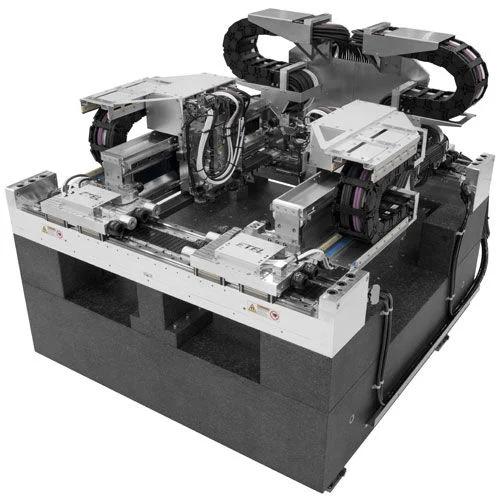
A multi-axis semiconductor motion platform illustrates how linear guidance supports the positioning architecture.
For high-throughput machines, smoothness matters at both low and high speed. A guide that feels acceptable during a manual check can still create force ripple, vibration, or settling delay during production. Rail mounting surfaces, parallelism, carriage spacing, and lubrication condition all influence the result.
Ball-Screw Support Bearings: Small End Play Becomes Placement Error
When a semiconductor axis uses a ball screw, the support bearings are part of the positioning chain. The fixed end is commonly supported by precision angular-contact bearings arranged to carry axial load in both directions. Their job is to keep the screw located axially while the motor reverses torque and the carriage accelerates.
If the support bearing arrangement has too much internal clearance, the screw can shift before the carriage responds. On the machine, that can look like backlash, inconsistent reversal behavior, or more correction from the servo. If preload is excessive, the opposite problem appears: more bearing torque, more heat, greater thermal growth, and potentially shorter lubricant life.
Correct support-bearing selection therefore depends on screw thrust, speed, required axial stiffness, mounting arrangement, thermal growth, lubrication, and the accuracy class of the complete screw system. The bearing alone cannot compensate for a misaligned screw, poor shoulder squareness, or an incorrectly machined housing.
Z-Axis and Pick Head Bearings
The Z-axis usually moves less distance than X or Y, but it is closer to the process. It controls pickup height, die clearance, placement height, and often part of the bond-force sequence. That makes friction consistency and alignment especially important.
Miniature linear guides, compact ball bushings, small deep-groove bearings, and angular-contact bearings can all appear around the pick head depending on architecture. The design goal is not maximum load capacity. It is controlled motion in a small package with enough stiffness to prevent the nozzle or collet from tilting under acceleration or placement force.
A loose Z guide can produce inconsistent tool attitude. A guide with excessive drag can make force control harder and increase actuator effort. A properly matched guide and bearing stack lets the controller move the head smoothly, stop cleanly, and apply force without adding mechanical uncertainty.
Theta Axes and Rotary Stages: Crossed-Roller Bearings Earn Their Space
Theta rotation corrects die orientation before placement. Some machines also use rotary tables, wafer handling axes, or compact swivel stages. These positions often see more than simple radial load: the bearing may have to resist axial load and overturning moment while maintaining low runout.
Crossed-roller bearings are a strong fit when one compact bearing has to carry radial, axial, and moment loads with high rigidity. Cylindrical rollers are arranged alternately at right angles, which lets the bearing support loads from multiple directions in a relatively thin section. Preload can be used to reduce internal play and improve rotational stiffness.
Paired angular-contact bearings are another practical solution, especially when speed, packaging, or shaft geometry favors a conventional bearing pair. The important point is to match the arrangement to the moment load, axial load direction, runout requirement, available space, and allowable torque.
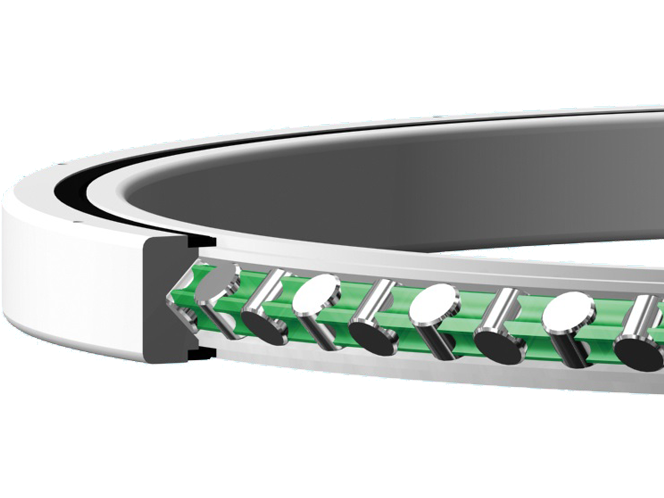
Crossed rollers provide compact support for combined radial, axial, and moment loading in precision rotary axes.
For a theta axis, the before-and-after difference is easy to see. A bearing with excessive play lets orientation change slightly under cable load, acceleration, or bond force. A properly preloaded, rigid rotary bearing keeps the rotational axis defined, reducing the amount of correction the vision and servo system have to chase.
Motor Bearings and High-Speed Support Positions
Servo motors, direct-drive rotary motors, vacuum-compatible motors, and auxiliary spindles all rely on bearings even when the main positioning axis uses a linear motor. Deep-groove ball bearings are common where radial load dominates and axial load is modest. Angular-contact bearings are used when axial stiffness, preload, or higher running accuracy is required.
The best choice is not automatically the bearing with the highest precision class. Higher precision only helps when the shaft, housing, fits, preload, rotor balance, and lubrication can support it. In compact motors, seal drag and grease torque also matter because small increases in friction can show up as heat and control effort.
Where electrical current can pass through a motor bearing, insulation strategy may also matter, but that is application-specific. Ceramic rolling elements, coated rings, or other current-control measures should be selected only when the electrical environment actually requires them.
Cam Followers and Needle Bearings in Indexing Mechanisms
Not every motion in a pick-and-place machine is servo-driven through a precision stage. Tray handling, eject mechanisms, indexing systems, covers, feeders, and compact transfer mechanisms may use cams, links, and oscillating pivots. Cam followers and needle roller bearings work well here because they carry high radial load in a small envelope.
These bearings are less about micron-level rotary runout and more about reliable rolling contact, stiffness, and packaging. The main selection concerns are load concentration, track hardness, lubrication, alignment, shock, and whether the follower sees continuous rotation or oscillation.
Cleanroom Bearings: Lubrication Is Part of Contamination Control
Semiconductor equipment can turn a normal bearing practice into a contamination problem. Grease that migrates, separates, or is over-applied can scatter from the bearing and reach wafers, dies, optics, sensors, or bonding surfaces. Wear debris and corrosion products create the same concern.
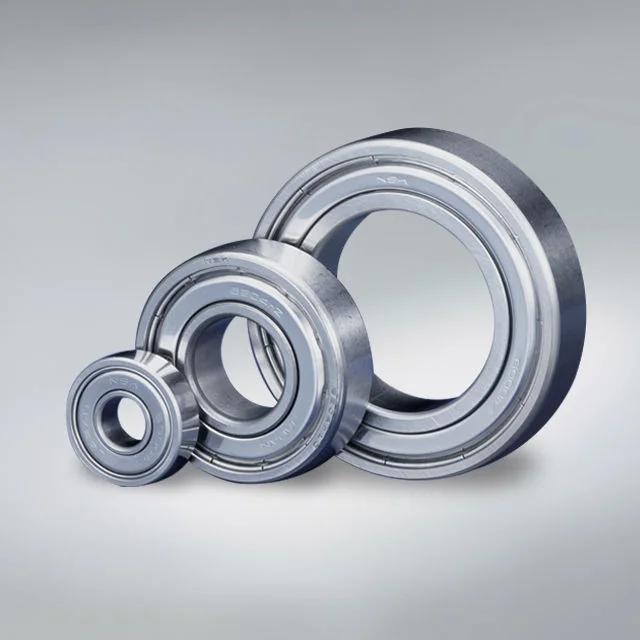
Cleanroom bearing configurations address this with stainless or corrosion-resistant materials, controlled grease fill, low-scatter lubricants, shields or seals where appropriate, and lubricant systems designed for low particle emission. For vacuum areas, low vapor pressure and low outgassing become additional requirements. Some special-environment bearings use solid-lubricant or lubricant-coating approaches where conventional grease is not suitable.
The practical rule is to select the lubrication system for the machine environment, not only for bearing life. A grease that performs well in a general industrial motor may be a poor choice next to a sensitive semiconductor process.
Cleanliness also changes maintenance. Adding extra grease ‘to be safe’ can be exactly the wrong move. Fill quantity, relubrication method, compatibility between old and new grease, and handling cleanliness should follow the component and machine specification.
Common Bearing Types and What They Do in Pick-and-Place Equipment
| Bearing / guide type | Typical role | Why it is selected | Common mistake |
| Deep-groove ball bearing | Motor shafts, idlers, light rotary supports | Low friction, compact, versatile at speed | Using it where high axial stiffness or moment capacity is actually required |
| Angular-contact ball bearing | Ball-screw supports, precision motor shafts, rotary axes | Combined-load capacity and controllable preload | Preloading too heavily and creating heat or torque |
| Crossed-roller bearing | Theta axes, rotary tables, compact swivels | High rigidity with radial, axial, and moment support | Ignoring housing stiffness or mounting accuracy |
| Linear ball guide | X-Y-Z translation | Low friction, long travel, good rigidity and repeatability | Poor rail alignment or too much/too little preload |
| Crossed-roller guide | Short-stroke precision linear motion | Very high rigidity and smooth limited travel | Using it where required stroke exceeds the guide concept |
| Needle roller / cam follower | Indexers, cams, compact pivots | High radial capacity in small space | Insufficient track hardness, lubrication, or alignment |
| Special-environment bearing | Cleanroom or vacuum mechanisms | Low particle emission, low outgassing, corrosion control | Selecting only by size and ignoring lubricant/environment compatibility |
What Matters Most When Selecting Bearings for Semiconductor Pick-and-Place
1. Stiffness Before Maximum Load Rating
In precision handling equipment, the bearing may be lightly loaded relative to its catalog capacity and still be the wrong choice. Deflection under moment load, preload stiffness, rail spacing, and support geometry can affect placement repeatability long before basic fatigue capacity becomes the limiting factor.
2. Preload and Internal Clearance
Preload removes mechanical play and raises stiffness, but it also raises friction and heat. The target is enough preload to control motion without making the actuator fight the bearing. This applies to angular-contact pairs, crossed-roller bearings, and preloaded linear guides.
3. Friction Consistency, Not Just Low Friction
Servo systems can compensate for a known load better than for an unstable one. Stick-slip, grease churning, seal drag variation, or uneven guide resistance can lengthen settling time and make small moves less predictable. Stable torque is often more valuable than an impressive no-load friction number.
4. Runout and Mounting Accuracy
Rotary runout at a theta axis or motor can become tool-point motion. Bearing accuracy matters, but shoulders, bores, shafts, clamping, and housing distortion matter too. Precision bearings should be mounted on precision geometry.
5. Cleanliness and Lubricant Behavior
The machine environment determines whether normal grease is acceptable. Cleanroom and vacuum applications may require low-scatter grease, low-outgassing lubricant, controlled fill quantity, stainless materials, or special lubrication coatings.
6. Thermal Stability
Bond heads, heaters, motors, and repeated acceleration create temperature gradients. Heat changes fits, preload, lubricant viscosity, and structural dimensions. Bearing selection should account for the temperature seen by the bearing, not just the ambient room temperature.
7. Acceleration, Reversal, and Duty Cycle
Pick-and-place machines do not run like constant-speed fans. They accelerate, stop, reverse, dwell, and repeat. Peak inertial loads, reversing thrust, and high cycle count should be included in the bearing and guide calculation.
8. Vacuum Is a Separate Requirement
A cleanroom at atmospheric pressure and a vacuum chamber are not the same environment. In vacuum, lubricant vapor pressure, outgassing, heat transfer, cage material, and solid lubrication options can become selection drivers.
What the Wrong Bearing Looks Like in Production
| Selection or installation problem | What shows up on the machine | What improves with the correct setup |
| Too much internal play | Tool-point movement, orientation shift, repeatability drift | Higher stiffness and more predictable settling |
| Excessive preload | High servo effort, heat, torque rise, shorter lubricant life | Lower friction while retaining required rigidity |
| Wrong lubricant | Grease scatter, outgassing, torque instability, contamination risk | Cleaner operation and more stable friction |
| Misaligned linear rails | Binding, uneven carriage load, noise, premature wear | Smooth travel and balanced load sharing |
| Insufficient rotary rigidity | Theta error under cable load or placement force | Stable orientation and lower corrective motion |
| Worn or contaminated bearing | Noise, vibration, settling-time increase, maintenance stops | Consistent motion and lower risk of unplanned downtime |
Installation and Maintenance Practices That Protect Accuracy
– Keep bearings, rails, tools, hands, and work surfaces as clean as the assembly requires. Precision contamination starts during installation, not after startup.
– Inspect shaft and housing shoulders for burrs, nicks, and poor squareness before installing precision bearings.
– Use the specified preload, spacer dimensions, tightening sequence, and bearing orientation for angular-contact sets.
– Align parallel linear rails from a defined master reference rather than forcing carriages to compensate for mounting error.
– Use only the specified lubricant and fill quantity. Avoid mixing greases unless compatibility is established.
– Protect bearing raceways from mounting force through the rolling elements. Press or heat the ring that has the interference fit.
– After assembly, check running torque, noise, temperature trend, and axis behavior before assuming that dimensional fit alone confirms a good installation.
– Track changes in servo load, settling time, noise, and vibration. Precision motion problems often appear in machine data before a bearing fails visibly.
A Practical Selection Process
1. Define the axis function: long-travel X-Y, short-stroke Z, theta rotation, motor support, ball-screw support, or cam/indexing duty.
2. Calculate radial, axial, moment, and inertial loads including acceleration and reversal, not just steady-state weight.
3. Set the stiffness, runout, repeatability, and allowable torque targets for that axis.
4. Identify the environment: general enclosure, cleanroom, corrosive exposure, heated area, or vacuum.
5. Choose the bearing or guide family that matches the motion and load directions before choosing a specific size.
6. Select internal clearance or preload together with shaft, housing, rail, and mounting tolerances.
7. Specify lubrication, seals or shields, materials, and grease quantity for the actual clean or vacuum requirement.
8. Validate the full assembly by checking temperature, torque, vibration, settling behavior, and contamination performance under the real duty cycle.
Frequently Asked Questions
What bearings are commonly used in semiconductor pick-and-place machines?
Common choices include deep-groove ball bearings, precision angular-contact bearings, crossed-roller bearings, linear rolling guides, crossed-roller guides, ball-screw support bearings, needle bearings, and cam followers. The mix depends on the machine architecture and axis function.
Why are crossed-roller bearings used in semiconductor equipment?
They provide high rigidity and can carry radial, axial, and moment loads in one compact rotary bearing. That makes them useful for theta axes, rotary tables, and other precision swivel mechanisms.
Are linear guides considered bearings?
Yes. Linear rolling guides are linear bearings: rolling elements recirculate between a carriage and rail to support load while allowing low-friction straight-line motion.
Do all pick-and-place machines use ball screws?
No. Some axes use ball screws, while high-performance platforms may use linear motors or direct-drive motors. Even direct-drive systems still need mechanical guidance unless the architecture uses an air-bearing or other non-contact guide.
Why is cleanroom grease different from normal bearing grease?
Cleanroom grease is formulated and applied to reduce particle generation and lubricant scatter. Depending on the environment, low outgassing and corrosion resistance may also be required.
Does higher bearing preload always improve placement accuracy?
No. More preload can increase stiffness, but too much preload raises friction, heat, actuator load, and wear. The correct preload balances stiffness with thermal and torque limits.
When are vacuum bearings required?
They are required when the bearing operates in a vacuum environment where conventional grease, cage materials, or seals may outgas or perform poorly. Vacuum-compatible lubrication and materials should be specified for the actual pressure and temperature range.
What should be checked when a pick-and-place axis starts losing repeatability?
Check the complete motion chain: bearing and guide play, preload, rail alignment, lubrication condition, screw support, couplings, mounting fasteners, encoder feedback, temperature, servo load, and contamination. Bearing wear is one possibility, not the only one.
Where Air Bearings Fit
Some ultra-precision semiconductor stages use air bearings, flexures, or magnetic guidance instead of rolling-element bearings on the primary positioning axis. These systems can eliminate rolling contact and reduce friction or particle generation, but they come with different requirements for air quality, stiffness, damping, controls, and cost.
That does not make rolling bearings obsolete. Most semiconductor tools still contain many rotating and linear support points where rolling bearings provide the best balance of stiffness, size, reliability, and serviceability. The engineering decision is about using the right motion technology in the right location.
Final Thoughts
Semiconductor pick-and-place machines make bearing problems visible quickly because the process leaves very little room for mechanical uncertainty. A bearing can be well within its basic load capacity and still be a poor fit if it adds play, unstable friction, heat, runout, or contamination to the axis.
PIB can help match precision bearings and rolling-motion components to the real job: load direction, stiffness, preload, speed, cleanroom or vacuum environment, lubrication, and available space. The best selection is the one that keeps the axis smooth and predictable through production.
Call us (800) 228-8895, email us [email protected], visit us www.pibsales.com.