Your cart is empty
 Short Rigid Couplings
 Controlflex Couplings
 Jaw Couplings
 Oldham Couplings
 Bearing Locknuts – TCN
 Double Wide Shaft Collars
 Heavy Duty Shaft Collars
 International Series Shaft Collars
 Keyed Shaft Collars
 Mountable Shaft Collars
 Quick Clamping Shaft Collars
 Set Screw Shaft Collars
 Thin Line Shaft Collars
 Threaded Shaft Collars – Pacific International Bearing Products
 Two-Piece Shaft Collars
 Friction Bearing Universal Joints
 Needle Bearing Universal Joints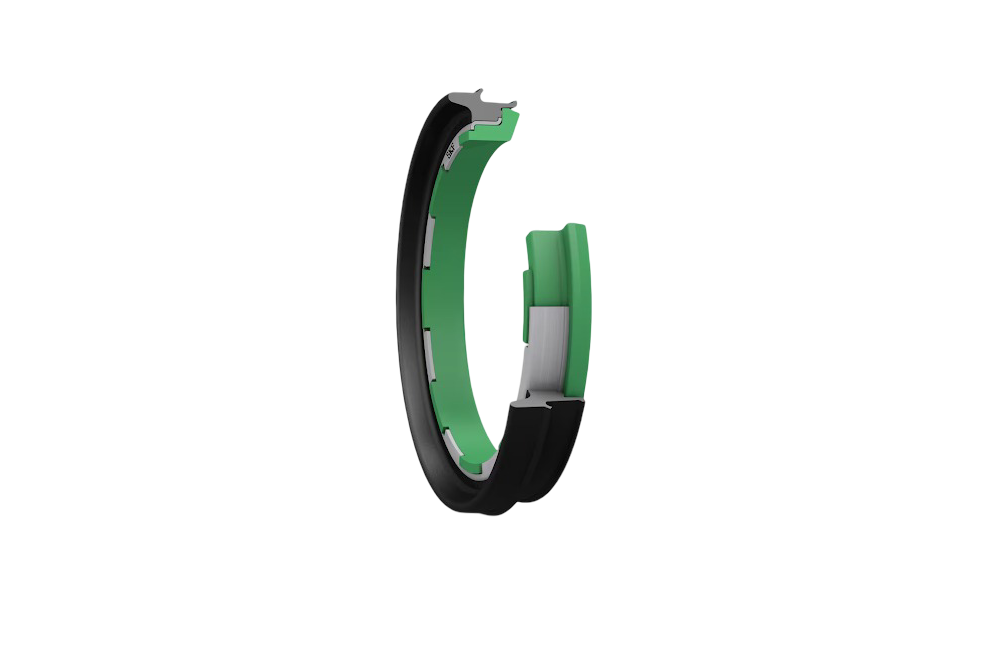
Bearings
Metal face seals
19 March, 2026
15 min read
Metal face seals are heavy-duty face seals: two metal rings seal against each other while elastomer energizers maintain the contact load. Choose them for slow-to-moderate speed equipment working in mud, sand, water, or abrasive slurry. Pacific International Bearing Sales can help you select the right design to keep lubricant in and unplanned downtime out.
Metal face seals are a deliberate choice when failure is driven by contamination, not speed. Below, we break down how they work, what performance envelope to expect, where people get tripped up (lubrication + installation), and how to decide when a metal face seal is the right move versus a radial shaft seal or a track pin seal.
Key Takeaways
- You’ll understand what makes a metal face seal survive where lip seals struggle: face-to-face sealing plus controlled loading.
- You’ll get a clear spec snapshot (metric + imperial) and what “varies by design” really means in the field.
- You’ll avoid the two most common early-life failure causes: wrong lubrication approach and poor installation process, cleanliness/alignment.
- You’ll leave with a basic decision framework: metal face vs radial shaft vs track pin, based on environment and duty.
Use this as for related PIB resources:
- PIB online catalog
- Power transmission seals overview
- CR Seals from SKF
- Services & engineering support
What a Metal Face Seal Actually Is
A metal face seal (often called a mechanical face seal in industry conversations) is built around a simple idea: seal with faces, not with a thin lip.
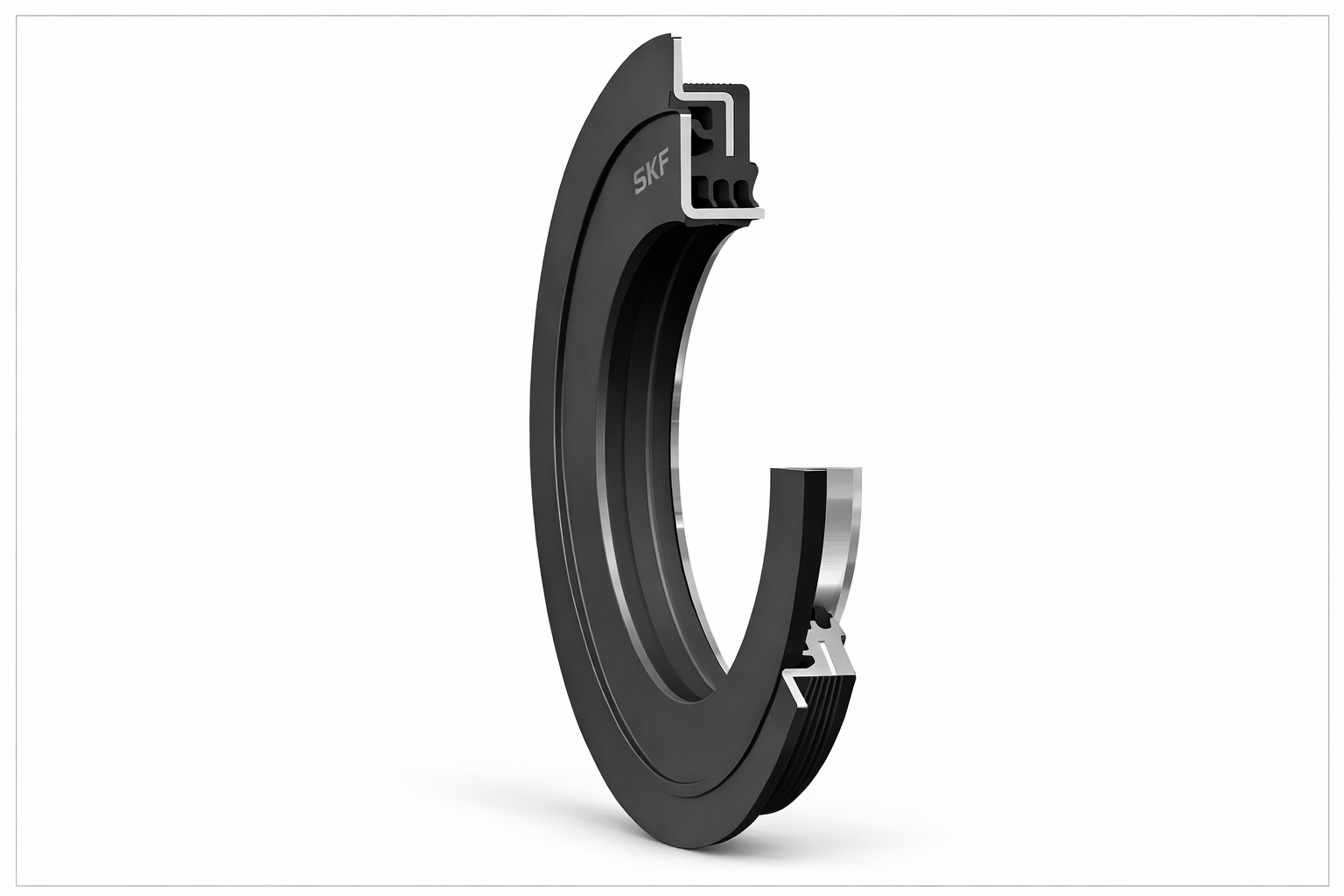
In common SKF-style designs, the seal consists of:
- Two identical metal sealing rings with finely finished sliding/sealing faces, typically made from wear-resistant cast alloy (with other materials available by request).
- Two elastomer energizers that both seal statically and apply the load that keeps the faces in contact. Depending on design, the energizers can be O-rings (“DO type”) or Belleville-style elastomer washers (“DF type”).
Where metal face seals earn their keep is in contamination. SKF notes these seals are often used in heavily contaminated environments (mud, sand, soil, water), where “mud packing” can push energizers out of place and compromise face load if the design and material selection aren’t right.
Typical use cases are exactly what you’d expect: mixers, conveyors, mining and off-highway equipment, sand treatment equipment, washing equipment, grinding mills, dump/haul trucks, and similar “abrasive + wet + dirty” realities.
How It Works
If you’ve ever watched a standard lip seal fail in gritty slurry, you’ve seen the core problem: the sealing edge is fighting both motion and abrasion.
A metal face seal changes the story:
- The sealing surfaces are robust metal faces designed to run together.
- The energizers maintain the face load while also sealing at the bore/outside diameters.
- The seal is typically at home in low circumferential speed situations where contamination control is more important than ultra-low friction at high RPM.
Two design patterns show up often in SKF documentation:
- DO type: uses two O-rings to keep sealing rings in constant contact and accommodate small movements.
- DF type / HDDF family: uses elastomer Belleville washers (cup-spring style) to provide uniform face loading and sealing at both the bore and outside diameters.
Key practical note: for face seals, the housing bore diameter and bore depth are not “close enough” dimensions. SKF explicitly calls out that bore diameter and depth must align with the dimensions in product tables and that adequate tolerances between the seal assembly and mating components are necessary for proper sealing performance.
Technical Specification Snapshot
Metal face seals vary by design and size, and SKF also cautions that not all maximum values are allowed at the same time.
Metal face seal specifications (metric + imperial)
| Parameter | Recommended / guideline (metric) | Recommended / guideline (imperial) | Notes |
| Temperature limit, NBR (continuous) | −25 to +100 °C | −15 to +210 °F | Typical HDDF guidance. |
| Temperature limit, FKM (continuous) | −10 to +190 °C | +15 to +375 °F | Typical HDDF guidance. |
| Circumferential speed (continuous) | 1.8 m/s | 350 ft/min | Typical HDDF guidance. |
| Circumferential speed (brief periods) | 3.8 m/s | 750 ft/min | Brief excursions, not steady-state. |
| Pressure (continuous) | 0.25 MPa | 35 psi | SKF notes pressure depends on design and is generally maintained below this level for best results. |
| Pressure (brief periods) | 0.35 MPa | 50 psi | Brief excursions. |
| Lubrication coverage on faces | ≥30% of sealing surface needs oil coverage | same | Practical requirement to prevent scoring and provide cooling. |
| Grease-only speed guideline | ≤0.5 m/s | ≤100 ft/min | Grease can be used in slow/oscillating applications; above this, oil is required for lubrication + cooling. |
| Installation tolerances (bore / depth) | Varies by size; bore diameter & depth must match product tables | Varies by size | Example HDDF tables show bore diameter tolerances commonly on the order of ±0.13 mm / ±0.005 in for many sizes—verify your exact size. |
| “Shaft hardness” requirement | Typical/varies by design | Typical/varies by design | For metal face seals, sealing is face-to-face (ring to ring), so shaft counterface hardness is less central than for lip seals. If you’re comparing with radial shaft seals, SKF’s radial shaft seal guidance includes counterface hardness guidance (see next section). |
SKF explicitly notes design dependence and that not all maxima can be used simultaneously. When your application pushes the envelope, it’s a datasheet + application review conversation, not a guess.
Lubrication & Installation: Where Good Seals Get Ruined
If we had to boil early failures down to one sentence: metal face seals fail fast when they’re installed dirty, dry, or crooked.
Lubrication rules that actually matter
SKF guidance is refreshingly direct:
- Apply lubricant on the dynamic sealing surfaces to prevent scoring and ensure at least 30% coverage so the faces are lubricated and cooled.
- Mineral oils are generally recommended; example oils include detergent oils like SAE 10W‑40 and mineral oils in ranges like 10 WT to 90 WT, depending on ambient temperature.
- Grease can be used in slow-rotating/oscillating applications where face surface speed does not exceed 0.5 m/s (100 ft/min). Above that, oil is required not just for lubrication, but also for cooling.
- Watch additive compatibility: some oils can degrade elastomers (especially at elevated temperatures).
Installation
SKF’s HDDF installation steps are basically a checklist for preventing immediate leakage:
- Seat the elastomer elements correctly; push each seal half fully into the housing; confirm it isn’t cocked. Uneven seating can create uneven face loads, scoring, or ring separation and oil leakage.
- Clean sealing faces with a lint-free wipe and apply a thin film of oil only to ring faces.
- Verify housings are concentric/aligned; bring housings together carefully—avoid high-impact assembly that can scratch or break components.
- After assembly, rotate one half relative to the other (SKF calls for at least ten revolutions) to confirm alignment; if it wobbles, disassemble and reseat.
Field tip that saves hours: When “it leaked immediately,” don’t assume the seal design is wrong. First suspect a cocked seal half, lint on the faces, or an assembly impact event, because those are the failure modes that show up instantly.
Choosing the Right Seal: Metal Face vs Radial Shaft vs Track Pin
PIB supports a broad mix of sealing solutions (including CR Seals from SKF for radial and axial shaft seals).
When metal face seals are the right call
Choose a metal face seal when:
- contamination is heavy (mud/water/abrasives),
- speeds are low-to-moderate (face seal territory),
- you need leak-proof lubricant retention and strong exclusion,
- you’d rather engineer out field repairs than schedule them.
When a radial shaft seal is the better fit
Radial shaft seals are selected when:
- you’re sealing around a rotating shaft where speed can be high,
- the environment is more controlled (or you can add exclusion features),
- you can meet shaft and housing bore requirements reliably,
- low friction and straightforward packaging matter.
SKF guidance emphasizes that radial shaft seals depend heavily on counterface quality and installation conditions. Examples of the kinds of requirements that matter include:
- counterface surface roughness guidance (Ra ranges are specified as recommended values),
- housing bore tolerance machining to H8 (plus notes on out-of-roundness),
- counterface hardness guidance (at least 30 HRC; higher for PTFE lips and higher if damage risk is present).
When a track pin seal is the right tool
Track pin seals exist for a very specific world: oil-lubricated track chains in off-highway applications. SKF describes the Trackstar track pin seal as installed on the pin connecting chain links, using a polyurethane sealing ring and nitrile rubber energizer; the sealing ring retains oil between pin and bushing and excludes contaminants, while the energizer provides static sealing. It also notes ribs that allow oil to pass for lubrication, and heavy-duty versions with a metal reinforcement ring.
Quick selection matrix
| Your situation | Likely best starting point | Why |
| Mud/water/abrasive contamination + low-to-moderate speed | Metal face seal | Built for contaminated environments; face sealing with controlled load. |
| Higher speed rotating shaft in industrial equipment | Radial shaft seal | Optimized for shaft sealing; relies on correct counterface + bore tolerances. |
| Oil-lubricated track chain pin/bushing (undercarriage) | Track pin seal | Purpose-built geometry/materials for track chain pins and oil retention. |
Before/After: A Scenario That Feels Familiar
Before: A maintenance team is chasing repeated seal failures on slow-moving equipment that lives in an abrasive washdown. Lip seals get installed, they look fine… then contamination works its way in, lubricant works its way out, and the “quick seal swap” becomes a recurring downtime tax.
After: The sealing strategy changes. A metal face seal is selected specifically for the contamination profile and speed range, with oil lubrication managed correctly and installation treated like a precision step (clean faces, correct seating, alignment checks). The result is less drama: better exclusion, better retention, fewer emergency fixes.
FAQ
What is a metal face seal, in one sentence?
A metal face seal is a heavy-duty face-to-face sealing system using two metal rings and elastomer energizers to maintain sealing contact, designed for harsh, contaminated environments.
What applications are metal face seals typically used in?
Common examples include off-highway and construction equipment, mining equipment, conveyors, mixers, grinding mills, and other applications exposed to sand, soil, mud, and water.
What are typical temperature limits for NBR vs FKM energizers?
For HDDF guidance, SKF lists NBR at −25 to +100 °C (−15 to +210 °F) and FKM at −10 to +190 °C (+15 to +375 °F) for continuous operation.
How fast can metal face seals run?
Metal face seals are generally “best at relatively low circumferential speeds.” SKF’s HDDF guidance lists 1.8 m/s (350 ft/min) continuous and 3.8 m/s (750 ft/min) for brief periods, but design variants and lubrication mode can change the envelope — maxima are not necessarily simultaneous.
Do metal face seals need oil, or can I run grease?
SKF recommends mineral oil in general and notes that grease can be used for slow rotating/oscillating duties when face speed does not exceed 0.5 m/s (100 ft/min). Above that, oil is required for lubrication and for cooling the sealing rings.
Why do some metal face seals leak immediately after installation?
Common immediate-leak causes include cocked seal halves, uneven seating that creates uneven face loads, contaminants (dirt/lint) on sealing faces, or high-impact assembly that damages components. SKF’s installation procedure emphasizes clean faces, correct seating, alignment, and a rotation check to catch wobble.
How are track pin seals different (and when do I need them)?
Track pin seals are specifically designed for oil-lubricated track chains. SKF describes them as installed on the pin connecting chain links, with a polyurethane sealing ring and nitrile rubber energizer to retain oil between the pin and bushing while excluding contaminants.
Ready to spec a seal that fits your real conditions?
Browse the PIB online catalog to narrow down options by size, series, and application: online catalog
If you want a fast second set of eyes on speed, pressure, temperature, contamination, and installation constraints, reach out to PIB. For a broader context on sealing families and how they protect rotating equipment, you can also explore PIB’s power transmission seals overview.

1
/
1