Your cart is empty
 Short Rigid Couplings
 Controlflex Couplings
 Jaw Couplings
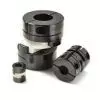 Oldham Couplings
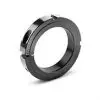 Bearing Locknuts – TCN
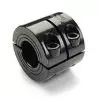 Double Wide Shaft Collars
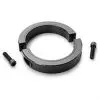 Heavy Duty Shaft Collars
 International Series Shaft Collars
 Keyed Shaft Collars
 Mountable Shaft Collars
 Quick Clamping Shaft Collars
 Set Screw Shaft Collars
 Thin Line Shaft Collars
 Threaded Shaft Collars – Pacific International Bearing Products
 Two-Piece Shaft Collars
 Friction Bearing Universal Joints
 Needle Bearing Universal Joints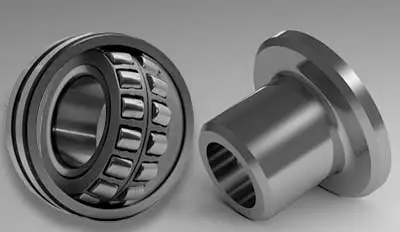
Bearings
Bushings vs. Bearings: Key Factors to Consider
06 April, 2026
14 min read
When it comes to choosing between bushings and bearings for use in applications, there are several factors to consider. Often bushings and bearings are mentioned as being synonymous but are inherently different in design and purpose.
Both bushings and bearings provide support and reduce friction between moving parts, they differ in design, application use, and maintenance requirements.
I will examine and explain the key differences between bushings and bearings and provide insights into how to choose the right bearing or bushing for your needs.
Key Takeaways
- Bushings are plain bearings that reduce friction with sliding contact, they’re compact, low-cost, and handle dirty or misaligned setups well.
- Rolling bearings (ball or roller) reduce friction with rolling contact, they support higher speeds and lower torque, but need cleaner conditions and better alignment.
- Choose bushings when loads are moderate, speeds are low to medium, and maintenance access is limited (or contamination is likely).
- Choose rolling bearings when speed is high, friction must stay low, or tight shaft positioning and accuracy matter.
- Selection depends on load type (radial or axial), speed, environment (dust, water, temperature), lubrication plan, and expected service life.
Bushings vs. Bearings: A Comparison
Bushings
For this article’s purposes, I have selected bronze bushings for comparison to radial ball bearings. Of course, there are many different materials used to manufacture bushings. Categorically, bushings are made from bronze, polyamide, steel, wood, ceramic, and countless other mixtures of materials.
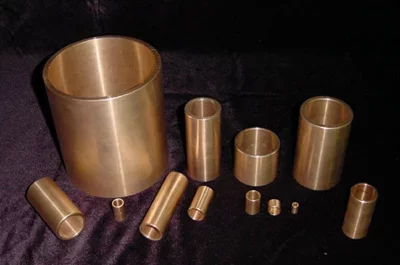
In a nutshell, standard stock Powdered Metal Bronze Bushings are manufactured from SAE 841-copper (87-90%), tin (8-9%), carbon, and other elements. As a powdered metal bronze material, it provides interconnected reservoirs for oil. The material is Vacuum impregnated with SAE 30 oil during the manufacturing process (approx. 19% by vol).
This process produces a Self-lubricating bushing. When the bushing is in motion, oil rises to the surface for lubrication and restores itself when at rest.
Applications
Bushings are ideal for heavy loads at moderate speeds or light loads at high speeds – max Pv 50,000, P-Load 2,000, V-SFM-1,200.
Effective in a temperature range of +10°F to + 175°F with standard oil. Standard tolerances vary by size.
What is important is how compact the bushing cross section is as compared to a radial ball bearing. The compact size and self-lubricating feature make bronze bushings ideal in many applications where radial ball or roller bearings simply would not fit. The high load carrying capacity at medium speeds is another major consideration for using bronze bushings instead of ball or roller bearings.
Design Differences
Design differences between bushings and bearings impact functionality, performance, and suitability. The design of a bushing is simple, typically cylindrical, and comprises an outer surface that contacts the bore or housing and a smooth inner surface fitted around the shaft.
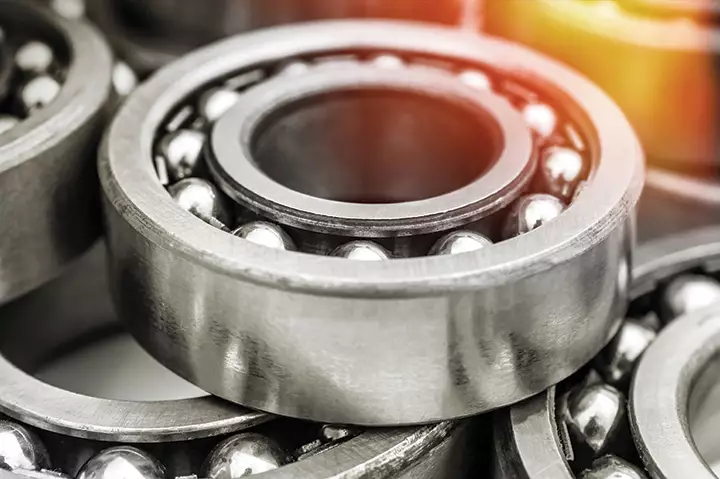
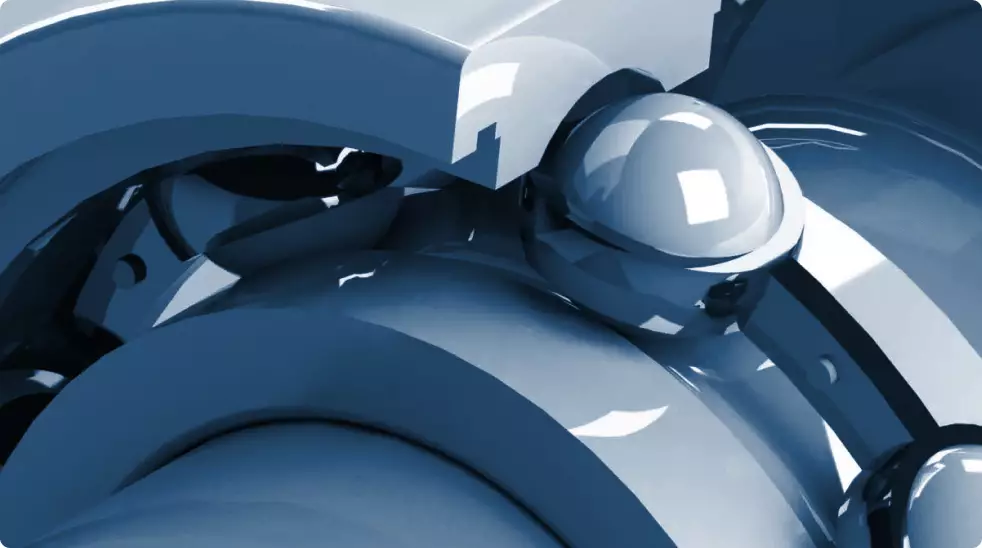
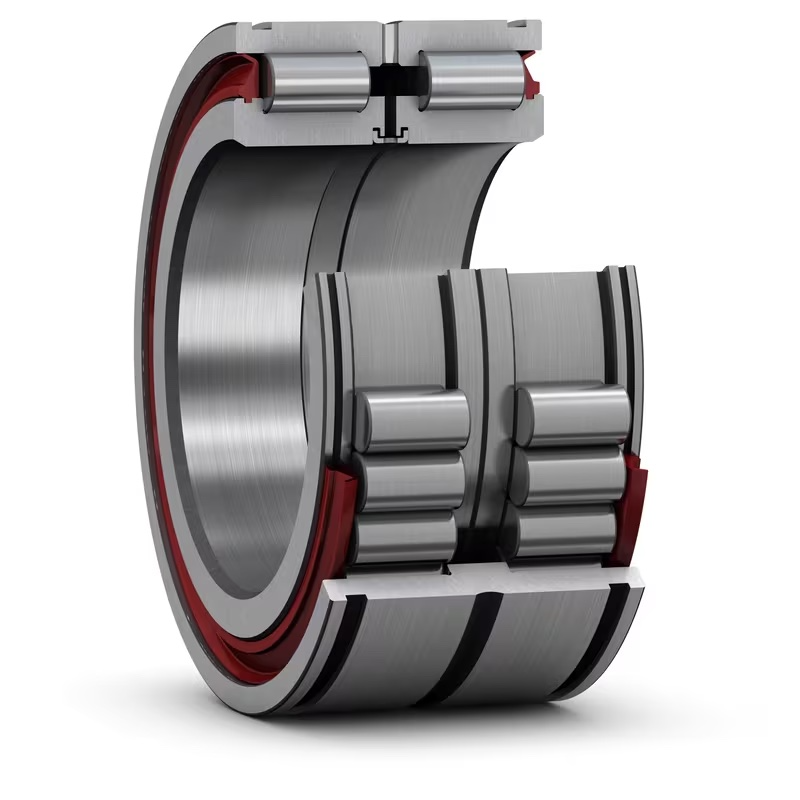
In contrast, a radial ball and or roller bearings design consist of an outer raceway, an inner raceway, and rolling elements such as balls or rollers. The rolling elements minimize the contact area reducing friction and allowing for smoother operation at higher speeds and loads.
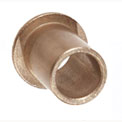
The design differences between bushings and bearings impact their load-carrying and speed capacity.
Generally Ball bearings are designed to carry medium to higher loads and operate at higher speeds. Generally Roller bearings are designed to carry higher loads at lower speeds. Bearings allow for better distribution of loads and reduced stress concentrations, improving the bearing’s service life and reliability.
To illustrate the design differences between bushings and bearings, let’s consider this example. Assume a shaft with a diameter of 2 inches rotating at a speed of 300 rpm. The load on the shaft is 125 lbs, and the temperature in the application is 150°F.
If a bushing were used in this application, the load would be directly transferred to the bore or housing, generating frictional forces that could lead to wear and damage. A properly sized self lubricating bronze bushing however would in this case possibly be the correct choice if the application had space restrictions.
In contrast, if a bearing were used in this application, the rolling elements would reduce the contact area between the inner and outer raceways, minimizing friction and wear. The bearing’s design would allow for better distribution of loads and reduced stress concentrations, improving its service life and reliability.
Manufacturing Differences
Bushings are usually made by machining a cylindrical shape from a solid material, such as bronze, brass, or plastic. This process is relatively simple and requires minimal tooling, making it cost-effective for small-scale production runs.
In contrast, bearings are manufactured using highly precise automated manufacturing machines. The exacting precision and control of bearing tolerances are guaranteed.
The manufacturing differences between bushings and bearings affect dimensional accuracy and surface finish. Bushings made by machining may have slight variations in size and surface finish, which can affect their fit and function in the application.
Bearings manufactured using precision processes have tighter tolerances and smoother surface finishes.
Material Properties Differences
Material properties differ between bushings and bearings and should be considered when selecting a bearing or bushing for an application. Bushings are typically made from materials such as bronze, brass, steel or plastic, while bearings are often made from steel or ceramic. These materials have distinct advantages and disadvantages that impact their performance and durability in specific applications.
- Bronze and brass are popular materials for bushings due to their high strength, corrosion resistance, and low coefficient of friction. Bronze bushings can handle high loads and provide long service life in low-speed, high-load applications, such as in agriculture and construction equipment. Brass bushings are commonly used in low-load, high-speed applications, such as in pumps and compressors.
- Plastic bushings, on the other hand, offer excellent chemical resistance, low coefficient of friction, and good wear resistance.
- Steel bearings can handle high loads and provide long service life in high-speed, high-load applications, such as in automotive and industrial equipment.
- Ceramic bearings offer superior wear resistance and can operate at higher speeds and temperatures than steel bearings.
Maintenance Differences
Bushings require minimal maintenance since they have a simple design and do not require lubrication. However, they may need to be periodically inspected and replaced if they wear out or become damaged. Inspecting bushings for wear can be done visually or by measuring the clearance between the shaft and the bushing. If the clearance exceeds the manufacturer’s specifications, the bushing should be replaced.
Bearings may require regular lubrication to reduce friction and prevent wear depending upon the application . Many bearings are sealed for life and will never require additional lubrication.
When a Bushing Should Be Used Instead of a Bearing?
Choosing between a bushing and a bearing often depends on the specific requirements of an application, including load capacity, speed, alignment, lubrication, and maintenance considerations. Here are the scenarios where opting for a bushing over a bearing might be more appropriate:
- Bushings generally have a larger surface area in contact with the shaft compared to bearings. This makes them better suited for applications where higher loads are present but at lower speeds.
- Many bushings are made of materials like bronze, which have self-lubricating properties. This can be advantageous in applications where regular maintenance or external lubrication is impractical or undesirable.
- Bushings can often be easier to install and replace than bearings. If the application demands frequent replacements or if ease of installation is a significant factor, bushings might be a preferable choice.
- In general, bushings tend to be less expensive than bearings. For applications where budget constraints are a primary concern and the operational demands are within the capabilities of a bushing, it could be a cost-effective solution.
- Some bushing materials can operate at higher or lower temperatures than standard bearings. If the application exposes components to extreme temperatures, a suitable bushing material might be a more reliable choice.
It’s essential to assess the specific needs of each application and make a decision based on the technical requirements. While both bushings and bearings serve the fundamental purpose of reducing friction between moving parts, their characteristics can lead to one being more suitable than the other in specific scenarios. Consulting with an expert in the field or a manufacturer can also provide additional insights tailored to a particular situation.
KEY FACTORS TO CONSIDER WHEN CHOOSING BETWEEN BUSHINGS AND BEARINGS
When selecting between bushings and bearings, a few key factors to consider are space restrictions, load carrying capacity, speed, accuracy, vibration, noise, and cost.
- Load capacity: Bushings are suitable for low , moderate and heavy load applications, while bearings can handle high loads and high speeds.
- Speed: Bearings are well suited for high-speed applications due to their low friction and high stiffness. Bushings have a higher friction coefficient and are not normally recommended for high-speed applications.
- Accuracy: Bearings are suitable for applications that require high precision and accuracy, such as machine tool spindles, robotics and many other precision applications.
- Bushings generally are not specified due to lower manufacturing tolerances and lack of precision characteristics.
- Vibration and noise: Bearings are suitable for applications that require low vibration and noise since they have a higher stiffness and lower friction coefficient. Bushings are fitted to shafts and housings with less precision and due to wear will result in more vibration and noise and earlier failure..
- Finally, Cost is a factor to consider when selecting between bushings and bearings. Bushings are typically less expensive than bearings, but bearings have a longer service life and can reduce downtime and maintenance costs. Therefore, the overall cost of the application should be considered when selecting between bushings and bearings.
FAQ About Bushings vs. Bearings
What is the main difference between a bushing and a bearing?
A bushing is a plain bearing that supports a shaft using sliding contact between two surfaces. A rolling bearing uses balls or rollers between races, which reduces friction at higher speeds.
When should I use a bushing instead of a rolling bearing?
Use a bushing when the application runs at low to medium speed, sees shock or vibration, or operates in dirt, moisture, or other contamination. Bushings also work well when you expect misalignment and want a simpler, compact part.
When should I use a ball bearing or roller bearing instead of a bushing?
Use rolling bearings when you need higher speed, lower friction, or more precise shaft location. They’re a better fit when alignment is controlled and you can protect the bearing from contamination.
Do bushings need lubrication?
Some bushings require grease or oil, while others are self-lubricating (for example, polymer or sintered types designed to run with minimal added lubricant). The correct choice depends on temperature, load, speed, and whether your system can support regular maintenance.
What factors matter most when choosing between bushings and bearings?
The main factors are load direction (radial, axial, or combined), speed, friction and heat limits, misalignment tolerance, contamination risk, lubrication method, noise, and total cost over the part’s life.
Choosing the Right Bushings and Bearings
In the design phase understanding your application and its demands will be helpful in selecting either a bushing or bearing. Weigh the pros and the cons considering cost and simplicity versus performance and longevity. Careful consideration of the application’s load, speed, space limitations and environmental conditions should be your starting consideration points.
Contact us for further information or buy bearings in PIB online store.
Call 800-228-8895 or send email to [email protected]