Your cart is empty
 Short Rigid Couplings
 Controlflex Couplings
 Jaw Couplings
 Oldham Couplings
 Bearing Locknuts – TCN
 Double Wide Shaft Collars
 Heavy Duty Shaft Collars
 International Series Shaft Collars
 Keyed Shaft Collars
 Mountable Shaft Collars
 Quick Clamping Shaft Collars
 Set Screw Shaft Collars
 Thin Line Shaft Collars
 Threaded Shaft Collars – Pacific International Bearing Products
 Two-Piece Shaft Collars
 Friction Bearing Universal Joints
 Needle Bearing Universal Joints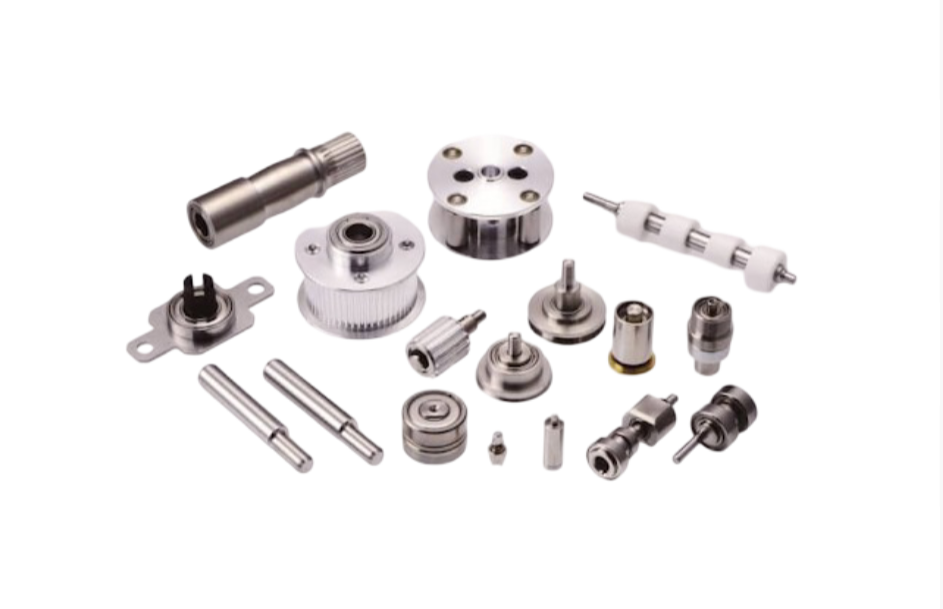
Bearings
Custom Machined Components for Mechanical Integration of Subsystems
20 January, 2026
12 min read
Pacific International Bearing Sales (PIB) partners with world-class manufacturers to provide custom precision-machined components that underpin the structural and mechanical integration of advanced subsystems. From robotics and medical devices to industrial automation, these custom-engineered mounts, housings, couplers, brackets, spacers, and adaptors play a critical role in aligning and assembling complex equipment with high precision. This article explores the value of precision-machined parts in ensuring subsystem performance, highlighting benefits such as optimized material selection, ultra-tight tolerances, weight-saving designs, structural integrity, and tailored thermal/mechanical fit.
Assorted precision-machined components and subassemblies, including custom pulleys with integrated bearings, shafts, and specialized mounting brackets. These custom parts are specifically engineered to meet unique design requirements, providing solutions that standard off-the-shelf hardware cannot always deliver. By leveraging precision CNC machining and design expertise, PIB helps engineers achieve perfect fits and alignments that improve overall system reliability and performance.
Applications in Robotics, Medical & Automation
Precision-machined components provide critical support in many high-tech fields, ensuring that subsystems come together accurately and reliably:
- Robotics: Custom brackets and frames mount motors, sensors, and joints with exact alignment, enabling smooth motion in robotic arms and mobile robots. For example, a tailor-made aluminum bracket can hold a robotic arm’s actuator and bearing in a perfect position, eliminating play or binding that would occur with generic hardware. This precision improves the robot’s repeatability and reduces wear on moving parts.
- Medical Devices: Imaging equipment and surgical robots rely on custom-machined housings and alignment fixtures to maintain calibration and structural integrity. In a CT scanner or robotic surgical tool, bespoke component mounts can keep optical paths and mechanical linkages aligned to within microns, ensuring the device operates safely and accurately under strict regulatory standards.
- Industrial Automation: Factory machinery and automated systems use custom adaptors, spacers, and couplings to join subsystems seamlessly. A precision-machined adapter plate might connect a conveyor module to a robotic picker with all bolt patterns and datums matched exactly, saving assembly time. Likewise, tight-tolerance couplers and spacers reduce vibration and misalignment in high-speed packaging or assembly equipment, improving throughput and machine longevity.
Leading manufacturers like MinebeaMitsumi (NMB) have even developed integrated mechanical assemblies (such as custom pulley-and-bearing units or tape guide modules) to address these challenges. In such assemblies, miniature precision bearings are combined with machined components (gears, hubs, magnet holders, etc.) into one pre-aligned unit. The result is a subsystem building block that arrives ready to install, with critical alignments and fits already perfected at the factory. By working with PIB on similar custom solutions, engineers can simplify their designs – instead of improvising with off-the-shelf parts, they get components purpose-built for their exact needs.
Key Benefits of Precision-Machined Parts
Custom-machined components offer several advantages for subsystem integration that go beyond what standard catalog parts provide:
- Tailored Material Selection: Engineers can choose materials to suit specific environments and performance goals. Whether it’s lightweight 6061-T6 aluminum for a robot to reduce payload, 303 stainless steel for a corrosion-resistant medical fixture, or even advanced plastics and composites, custom parts use the optimal material for the job. For instance, a tape guide assembly might require non-magnetic materials (aluminum or polymer) and special coatings so as not to interfere with sensitive media – a need easily met with a custom-machined solution.
- Tight Tolerances & Precision Alignment: Custom components can be manufactured to ultra-tight tolerances that ensure perfect alignment of mating parts. This is critical when integrating precision bearings, linear guides, or optical elements. By holding dimensions to within a few thousandths (or even ten-thousandths) of an inch, a machined housing or bracket guarantees that shafts remain coaxial, surfaces are flush, and fasteners line up exactly. Such accuracy improves performance (e.g., smoother motion, lower friction) and prevents stress caused by misalignment.
- Optimized Weight & Geometry: With custom machining, designers can optimize the part’s geometry for strength-to-weight efficiency. Non-essential material can be milled away (pockets, ribs, thin walls) to create a lighter component without sacrificing rigidity where it counts. This lightweighting is especially valuable in aerospace and robotics applications, where reducing mass translates to better speed, energy efficiency, or payload capacity. Off-the-shelf parts often carry excess material or bulky shapes, whereas a custom design is trimmed to exactly fit the space and load conditions required.
- Structural Integrity & Durability: Custom-machined parts are built to handle the specific loads and stresses of your system. Engineers can add fillets, gussets, or choose higher-strength alloys exactly where needed to ensure longevity and safety. The result is often a more robust assembly than a generic part could offer. Moreover, by integrating multiple functions into one machined piece (for example, combining a bearing housing with a mounting flange), you eliminate joint interfaces that might loosen over time. Fewer parts and fasteners mean a stiffer, more durable structure with less maintenance.
- Thermal and Mechanical Fit: In high-performance systems, thermal expansion and mechanical clearances must be managed precisely. Custom components allow you to match materials with compatible thermal expansion rates or include features like expansion slots and precision shims to maintain alignment over temperature changes. Additionally, the mechanical fit of a custom part is exact – hole patterns, dowel pin locations, and alignment features are all designed to mate with the rest of your assembly perfectly. This tailored fit minimizes play and ensures that assembling the subsystem is straightforward and repeatable on the production floor.
Sample Custom Component Specifications
To illustrate the capabilities of custom-machined parts, the table below shows example specifications for a variety of component types commonly used in subsystem integration. These examples highlight typical tolerances, material choices, and finish options that engineers specify for high-precision applications:
| Component Type | Typical Tolerances ( dimensional accuracy ) | Common Materials | Typical Finishes |
| Mounting Bracket (motor/sensor mount) | ±0.005″ (±0.13 mm) general; hole spacing ±0.002″ | Aluminum 6061, Steel 1018 | Clear or color anodize (Al); Zinc plating or powder coat (Steel) |
| Precision Housing (bearing or gearbox housing) | ±0.0005″ (±0.012 mm) on critical bores; ±0.002″ on other dims | Alloy steel (e.g. 4140), Aluminum 7075 | Ground bearing seats; Black oxide or Nickel plating for corrosion protection |
| Shaft Coupler (drive coupling) | ±0.001″ (±0.025 mm) on bore diameter and keyway alignment | Stainless steel 303/316, Alloy steel | Light oil coating; Precision ground surfaces; Passivation (stainless) |
| Spacer / Standoff (structural spacer) | ±0.001″ (±0.025 mm) on length for stack-up control | Aluminum 6061, Delrin® acetal (plastic) | Anodize (Aluminum); None or matte finish (Plastic) |
| Adapter Plate (interface adaptor) | ±0.005″ (±0.13 mm) on hole locations and outlines | Aluminum 6061, Stainless 304 | Anodize (Aluminum); Passivated or brushed finish (Stainless) |
Table: Example part types and their typical precision, materials, and finishes. Actual achievable tolerances and available materials will depend on the manufacturing process and specific supplier capabilities.
Every custom component is designed to meet the needs of its application. For example, a precision housing for a high-speed spindle may require a hardened steel alloy and grinding to achieve micrometer-level roundness on a bearing pocket, whereas a spacer used in an optical instrument might be made of lightweight plastic and simply machined to a tight length tolerance. PIB works with manufacturers that offer a wide range of materials (metals and engineering plastics) and finishing processes to deliver parts that meet your exact specifications.
FAQ: Custom Machined Parts vs. Standard Solutions
Q: When should I choose a custom-machined component instead of an off-the-shelf part?
A: Use a custom component whenever your design has unique requirements that standard parts can’t fulfill in terms of fit, function, or performance. If an off-the-shelf bracket or coupling would force compromises — such as extra adapters, misalignment, insufficient precision, or suboptimal size/weight — then a custom-machined part is likely justified. Custom parts are ideal for high-precision alignments, unusual geometric constraints, special material needs, or integrating multiple functions into one piece. In contrast, off-the-shelf components are best for common, simple needs where an exact fit isn’t critical. Many projects start with standard hardware during prototyping, but as the design matures, engineers often switch to custom-machined parts to achieve an optimal, purpose-built solution for production.
Q: What materials are commonly used for precision-machined components?
A: Custom components can be made from a wide array of materials, chosen to match the application’s demands. Aluminum alloys (like 6061 and 7075) are popular for their light weight and good strength, making them great for robotic structures and mounting plates. Various steels (such as 4140 alloy steel or 303/316 stainless) are used when higher strength, wear resistance, or corrosion resistance is required – for example, in heavy machinery or medical devices that need sterilization. Titanium or magnesium might be selected in cases where an extremely high strength-to-weight ratio is needed (aerospace, high-end robotics). Plastics and composites (Delrin®, PEEK, carbon fiber laminates) are also used for custom parts that require electrical insulation, chemical resistance, or ultra-light weight. The key advantage of custom machining is choosing the exact material that meets your performance, environmental, and regulatory requirements, rather than being limited to the few materials common to off-the-shelf parts.
Q: What design considerations ensure a successful custom part?
A: When designing a custom machined component, it’s important to consider both the functional requirements and manufacturability. First, define critical dimensions and tolerances clearly – for instance, specify alignment-critical features (bearing bores, bolt hole patterns, datum surfaces) with appropriately tight tolerances, and allow looser tolerances on non-critical areas to control cost. Use proper material selection for the operating environment (temperature, load, corrosion, etc.) and decide on any surface treatments or coatings (anodizing, plating, heat treatment) needed for durability. Designing with DFM (Design for Manufacturability) in mind is crucial: collaborate with the machining specialists early to adjust features that might be overly difficult or expensive to machine (for example, extremely deep pockets or very thin walls) and to ensure the design can be reliably produced at scale. Also, include alignment features such as dowel pin holes or pilot diameters if the part will interface with others – these help achieve repeatable positioning during assembly. By balancing precision needs with practical manufacturing guidelines, you’ll end up with a custom part that meets specifications without unnecessary complexity.
Q: Any tips for integrating custom components into existing systems?
A: Absolutely. First, ensure that your custom part’s design is fully validated in prototype form before mass production – test fit and function in the actual assembly to catch any needed adjustments in hole placement or tolerances. When possible, integrate standard elements into the custom part to simplify assembly; for example, you might design a custom pulley that comes from the supplier with a bearing already press-fit or a custom bracket that includes installed thread inserts. This way, critical alignments (like bearing concentricity or thread positioning) are set by the manufacturer’s precision tooling rather than during your assembly process. Another integration tip is to provide fine adjustment capabilities in the overall design: even with perfect parts, having slotted holes or shims can allow on-site tuning for alignment or tension as needed during installation. Finally, work closely with your component supplier (such as PIB and its manufacturing partners) for any integration challenges – they can often provide guidance or even modify the component design to better suit your assembly workflow. With careful planning, custom-machined components will drop into your system smoothly and enhance the build process rather than complicate it.
Conclusion
Custom-machined components serve as the “glue” that brings sophisticated subsystems together, delivering precision alignment, tailored performance, and design flexibility that off-the-shelf parts simply can’t match. By investing in quality, purpose-built parts – from a simple spacer with a tight tolerance to an integrated bearing assembly – system designers can dramatically improve the reliability, efficiency, and longevity of their equipment.
Ready to elevate your next project with precision-engineered components? Explore the PIB online catalog to discover our range of bearings, motion control elements, and custom mechanical solutions, or contact our team to request a quote for a fully custom component designed to your specifications. PIB’s engineering experts are here to support your design integration needs and help turn your ambitious concepts into a reliable, high-performance reality.