Your cart is empty
 Short Rigid Couplings
 Controlflex Couplings
 Jaw Couplings
 Oldham Couplings
 Bearing Locknuts – TCN
 Double Wide Shaft Collars
 Heavy Duty Shaft Collars
 International Series Shaft Collars
 Keyed Shaft Collars
 Mountable Shaft Collars
 Quick Clamping Shaft Collars
 Set Screw Shaft Collars
 Thin Line Shaft Collars
 Threaded Shaft Collars – Pacific International Bearing Products
 Two-Piece Shaft Collars
 Friction Bearing Universal Joints
 Needle Bearing Universal Joints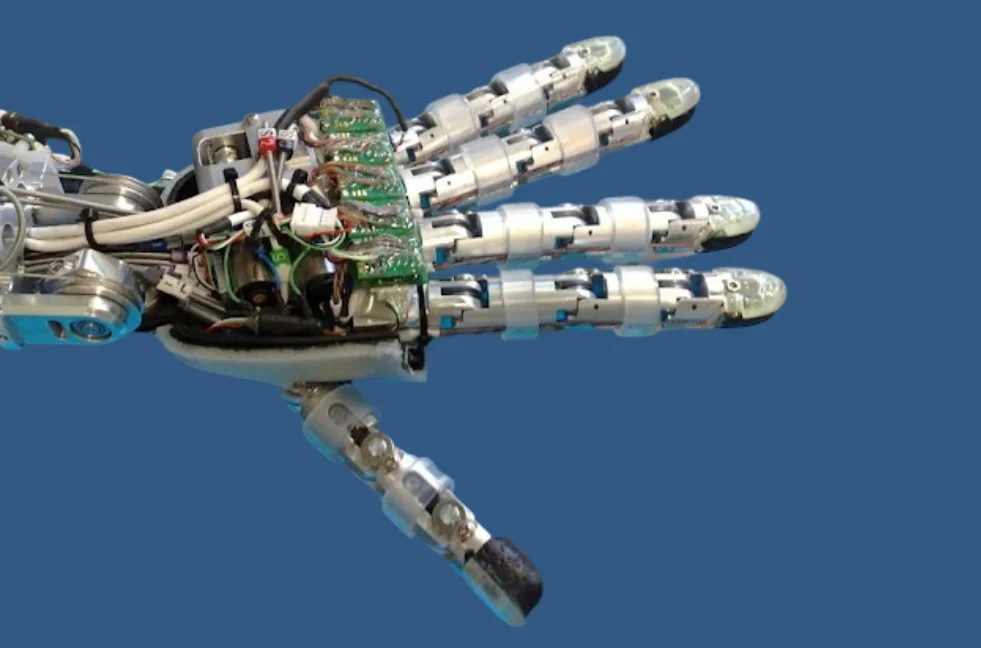
Bearings
Humanoid Wrist Articulation Bearings
18 April, 2026
9 min read
Precision bearings are the key to smooth, humanlike motion in robot wrists. Pacific International Bearing Sales (PIB) offers high-performance crossed-roller, thin-section, and miniature bearings that enable wrist joints to rotate freely while supporting multi-directional loads. These low-friction components ensure stable, quiet wrist articulation even under heavy loads.
Key Takeaways:
- Robotic wrists need bearings that handle combined radial, axial, and moment loads with high precision.
- Crossed-roller bearings are common in wrist axes, providing extreme stiffness in a compact design.
- Thin-section and miniature ball bearings save space and weight for compact wrist joints, yet still offer precise rotation.
- High-quality materials, seals, and lubrication from PIB extend bearing life in 24/7 robot operation.
- PIB’s online catalog lets engineers browse these robot-grade bearings and get expert support.
PIB’s online catalog lists a broad range of precision bearings for robotic wrists – visit pibsales.com to find parts that match your specifications.
Wrist Joint Loads and Bearing Requirements
A humanoid robot’s wrist joint must articulate like a human’s, allowing the hand to pitch, yaw, or tilt with precision. Bearings in the wrist reduce friction and carry the loads from the forearm and end effector. For example, when a robot holds a weight, the wrist bearings see radial loads (from the weight), axial thrust (along the joint axis), and bending moments (from accelerating or moving the arm). Poorly chosen bearings can introduce vibration, noise, or unpredictable torque that ruin a robot’s delicate motions. Crossed-roller and high-precision ball bearings are engineered to meet these demanding conditions. They distribute forces smoothly across the raceways so that the wrist moves steadily and quietly, mimicking human dexterity.
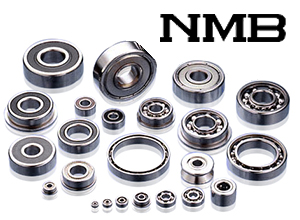
High-precision miniature ball bearings, like those supplied by Pacific International Bearing Sales, enable compact robotic wrist joints to rotate smoothly with minimal friction.
As PIB notes, selecting the right bearing is “critical in achieving low-friction performance” in any rotating joint. In robotic wrists, designers often combine bearing types: a crossed-roller bearing for the main rotary axis and miniature or thin-section ball bearings for smaller pivot or swivel functions. This mix keeps each joint compact yet strong. For instance, a robot hand or surgical tool might use a pair of tiny 8 mm ball bearings at the wrist to allow free rotation with almost no noise. These small bearings run on pre-lubricated steel balls so they last through millions of cycles.
Crossed-Roller Bearings for Multi-Axis Loads
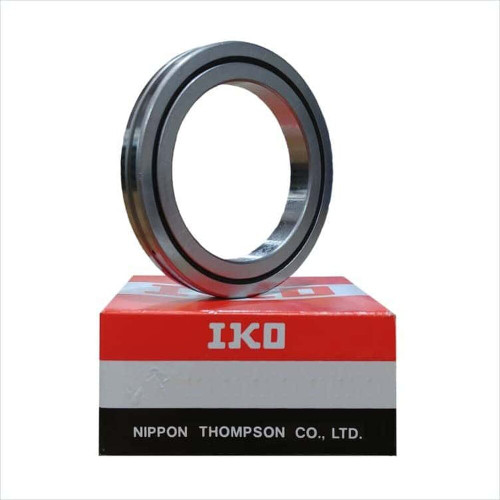
Crossed-roller bearings are especially well-suited to humanoid wrists. Inside a crossed-roller bearing, cylindrical rollers are alternated at 90°, so each roller contacts its track along a line rather than a point. This gives enormous combined load capacity and rigidity. A single crossed-roller unit can simultaneously carry axial thrust, radial force, and bending moments – exactly the complex loading a robot wrist faces. Because of this, such bearings are “a staple in robot shoulder joints, swiveling bases, [and] wrist axes”. PIB offers IKO crossed-roller bearings like the CRBH7013AUU, a slim high-rigidity model (70×100×13 mm) rated for 20.1 kN dynamic load and 27.7 kN static load.
Crossed rollers also have virtually no play and excellent repeatability. Many come preloaded (zero internal clearance) and have built-in mount holes for easy installation. In practice, using a single crossed-roller bearing in a wrist can replace what might otherwise require two ball bearings to handle thrust plus an extra bearing for the radial load. This saves space and simplifies the joint.
Thin-Section and Ball Bearings for Compact Design
When every millimeter counts, thin-section or miniature ball bearings are used in wrist linkages. Thin-section bearings have a very slim cross-section relative to their diameter. For example, a thin-section bearing with a 50 mm outside diameter might be only 5 mm thick. This lets engineers route wiring or tubes through the joint center and keeps the arm profile low. In a humanoid robot, a wrist might use 4‑point contact thin-section angular-contact bearings that handle axial loads in both directions while remaining very flat.
Miniature bearings (outside diameters under ~30 mm) are used in tiny wrist pivots or finger joints. Their small balls and tight tolerances mean even a 10 mm bearing can rotate very smoothly. Although smaller bearings carry less load, they drastically reduce weight and inertia in the moving wrist section. This lets the robot accelerate its hand quickly without excess power. PIB emphasizes that miniature ball bearings can give “big performance in a small package”, supporting precise motion in tight spaces.
For instance, a thin-section bearing with a large hollow bore lets electrical cables or fluids pass through the wrist. In surgical and service robots, keeping joints slim is crucial. As one source notes, a thin-bearing (e.g. 150 mm OD × 7 mm thick) can carry the arm load while leaving room for actuators or cabling. This design improves response speed and energy efficiency in the wrist because there is less mass to move.
Installation and Lubrication
Regardless of type, quality bearings help wrists operate quietly and last longer. Bearings for robot wrists often use stainless or chrome steel races for strength, plus hybrid designs with ceramic balls for lower friction. Proper seals or shields keep out dust and retain lubricant, which is vital in long-life service. Many robotics bearings come pre-filled with specialty grease, so maintenance can be minimized. PIB’s engineering support can guide the choice of preload, seal type, and lubrication to match each wrist’s operating conditions. By using high-grade bearings and mounting them precisely, designers avoid backlash and wobble – so the robot’s wrist behaves predictably under all conditions.
Specifications at a Glance
| Bearing Type | Example (Part) | Dimensions (ID×OD×W) | Dynamic/Static Load | Typical Uses |
| Crossed Roller | IKO CRBH7013AUU (high-rigidity type) | 70 mm × 100 mm × 13 mm | 20.1 kN / 27.7 kN | Precision rotary joints requiring high stiffness and multidirectional loads (e.g. wrist rotation axes). |
| Thin-Section Ball | (e.g., angular contact bearing) | – (varies by series) | (ranges by model) | Compact bearings for robots; slim profile saves space and weight. |
Table: Example bearing specifications for robotic wrists (loads given for dynamic/static). Each row cites a source’s example part. Crossed-roller bearings are used where multi-axis rigidity is needed; thin-section and miniature bearings are chosen for slim, lightweight joints.
Frequently Asked Questions
| Question | Answer |
| What bearing types enable smooth humanoid wrist motion? | Typically, wrists use crossed-roller bearings for high rigidity and combined load capacity, along with high-precision ball bearings (thin-section or angular-contact) for compact fit. Crossed rollers handle heavy, multi-directional loads in one unit, while miniature/thin bearings reduce space and inertia. |
| Why choose a crossed-roller bearing for a robot wrist? | Because crossed rollers uniquely support radial, axial, and moment loads in a single, thin package. This means the wrist joint stays very stiff and accurate under load, and can bear a hand’s weight and torque without separate bearings for each load type. |
| How do thin-section bearings benefit wrist design? | Thin-section bearings have a constant, slim cross-section, allowing large bore diameters without extra thickness. In a wrist joint, this saves space and weight, and often provides a hollow center for routing cables or shafts. They still handle both radial and axial loads efficiently, making them ideal when wrist space is limited. |
| Where can I find these robotic wrist bearings? | Pacific International Bearing Sales (PIB) stocks all these bearing types. You can browse PIB’s online catalog at pibsales.com to find crossed-roller, thin-section, miniature, and other precision bearings for robotic wrists. PIB’s engineers can also help select the right size, material, and preload for your application. |
Contact PIB Sales for assistance in choosing the perfect wrist bearings for your humanoid robot. Visit the PIB online catalog or give us a call at (800) 228‑8895 to get expert help with your order.