Your cart is empty
 Short Rigid Couplings
 Controlflex Couplings
 Jaw Couplings
 Oldham Couplings
 Bearing Locknuts – TCN
 Double Wide Shaft Collars
 Heavy Duty Shaft Collars
 International Series Shaft Collars
 Keyed Shaft Collars
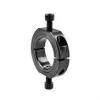 Mountable Shaft Collars
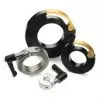 Quick Clamping Shaft Collars
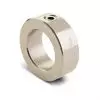 Set Screw Shaft Collars
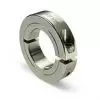 Thin Line Shaft Collars
 Threaded Shaft Collars – Pacific International Bearing Products
 Two-Piece Shaft Collars
 Friction Bearing Universal Joints
 Needle Bearing Universal Joints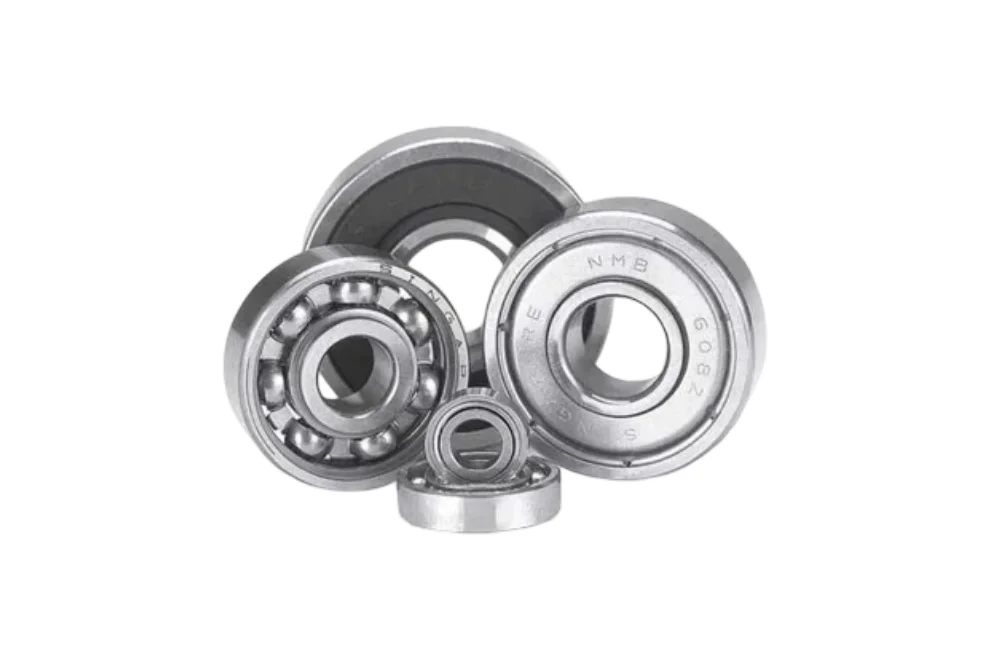
Bearings
Miniature and Thin-Section Ball Bearings for Rotating Joints and Actuators
14 January, 2026
17 min read
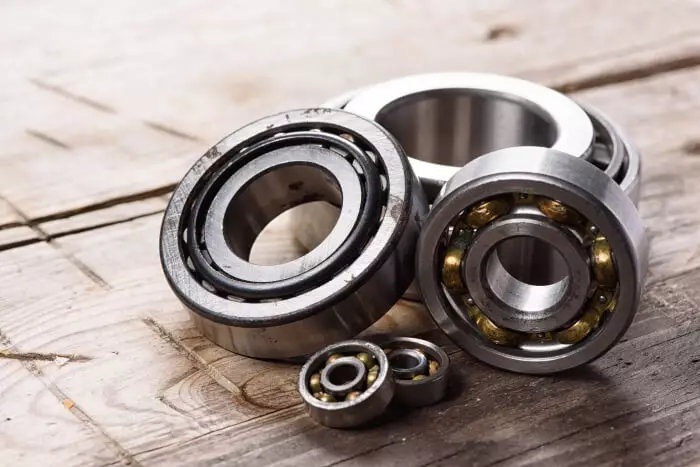
Pacific International Bearing Sales (PIB) is a leading provider of precision components that keep today’s robots and medical devices running smoothly. One critical element in achieving low-friction performance in rotating joints and actuators is the choice of the right ball bearing. In particular, miniature ball bearings and thin-section ball bearings play key roles in enabling smooth, compact, and precise motion in these applications. This article explores how each type contributes to robotics and medical device design, highlighting their differences, advantages, and selection considerations.
The Role of Precision Bearings in High-Performance Applications
In both advanced robotics and medical equipment, bearings ensure that joints rotate freely and actuators deliver motion smoothly. By minimizing friction between moving parts, high-quality ball bearings improve efficiency, accuracy, and longevity of the mechanism. Bearings also support loads and maintain alignment, which is especially important in precision assemblies like surgical robots or prosthetic limbs.
PIB specializes in bearings that meet the demanding requirements of these fields. Whether it’s a robotic arm swiveling with human-like dexterity or a medical device operating reliably inside an MRI machine, the right bearing enables smooth rotation, low wear, and consistent precision.
Miniature Ball Bearings: Smooth Motion in Compact Packages
Miniature ball bearings (often called instrument bearings) are very small bearings designed for applications where space is at a premium. They typically have outside diameters from just a few millimeters up to around 30–35 mm (about 1.4 inches). Despite their tiny size, these bearings use the same principle of rolling elements (balls) between inner and outer rings to drastically reduce friction between moving parts. This makes them indispensable for compact, precision mechanisms.
Key features of miniature bearings include:
- Available with bore diameters as small as a couple of millimeters, with outside diameters up to about 35 mm. This makes them ideal for small robots, micro-actuators, and handheld medical devices where larger bearings simply wouldn’t fit.
- Miniature bearings are manufactured to tight tolerances so that even at a small scale, they run smoothly with minimal noise and vibration. This is crucial in applications like surgical tools or laboratory instruments, where any jitter or imprecision is unacceptable.
- Most miniature bearings are made from high-grade stainless steel or chrome steel for strength and durability. Stainless steel is popular for medical and high-humidity environments due to its corrosion resistance. Some designs also offer ceramic balls or specialty alloys for even lower friction, non-magnetic properties, or higher heat resistance as required.
- These bearings can be found in open, shielded, or sealed configurations. For example, a shielded miniature bearing has metal shields to keep dust out and retain lubricant, useful in environments like cleanrooms or dusty factory floors. Flanged miniature bearings are another option, featuring a flange on the outer ring for easy mounting in precision assemblies.
Miniature bearings enable engineers to create very compact joints and actuators. For instance, in a robotic finger or a small surgical hand tool, multiple miniature bearings can support rotating shafts or linkages to give smooth, precise movement in a tight space. They contribute minimal weight and inertia, which is important in delicate or wearable systems. Their low friction helps reduce the power needed to drive joints, extending battery life for portable devices or reducing heat in high-speed dental handpieces. In short, miniature ball bearings provide big performance in a small package, making them a go-to solution for miniaturized technology.
A surgical robotic tool might use a pair of 8 mm outer-diameter miniature bearings in its wrist joint. These tiny bearings allow the tool’s joint to rotate freely and precisely, helping surgeons perform delicate maneuvers. The bearings run quietly and are pre-lubricated with a medical-grade grease, so the device operates reliably over many cycles without maintenance.
Thin-Section Ball Bearings: Maximizing Space and Weight Savings
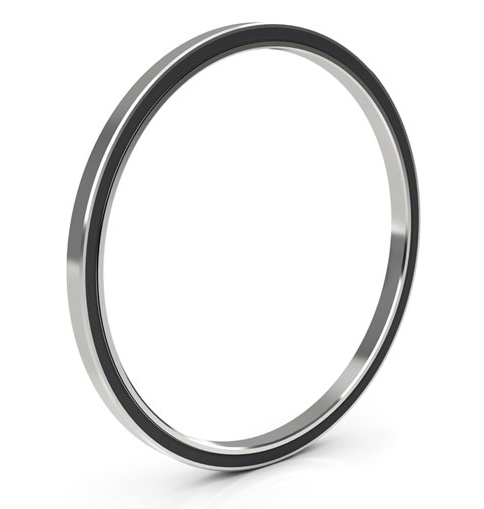
Thin-section ball bearings are a specialized type of bearing characterized by a very slim cross-section (the thickness of the bearing rings) relative to their diameter. Unlike standard bearings, thin-section bearings maintain a constant, small cross-sectional height even as their diameter increases. This design allows engineers to use bearings with relatively large bore diameters without adding bulk or weight to the assembly.
Key features of thin-section bearings include:
- These bearings often have cross-sectional thicknesses of only a few millimeters (or fractions of an inch), which remains the same for a whole series of different diameters. For example, a thin-section bearing might have a 5 mm cross-section, whether it is 50 mm in diameter or 200 mm in diameter. This constant cross-section means designers can choose a larger bearing diameter for stability or to accommodate a hollow shaft, without the bearing becoming overly thick.
- Thin-section bearings come in much larger sizes than typical miniature bearings. Diameters of 50–300 mm (and even beyond) are available in thin-section styles, all with that slim profile. This is especially useful in robotics and medical imaging equipment, where you may need a broad, stable rotational support (for example, a robot base or a CT scanner ring) but still want to conserve space and weight.
- Thin-section bearings are available in different internal geometries to handle various load conditions. Common types include radial (deep groove) for primarily radial loads, angular contact for combined axial/radial loads (often used in pairs for handling thrust in both directions), and four-point contact designs that can handle axial load in both directions plus radial load in a single bearing. The four-point thin-section bearing is particularly useful because one such bearing can often replace a two-bearing arrangement, saving even more space.
- Like miniature bearings, thin-section bearings are typically made from high-quality steel alloys (52100 chrome steel or 440C stainless steel are common). Given their use in demanding applications, they are often available with specialized coatings (for corrosion protection or dry lubrication), ceramic hybrid designs (to reduce rotating mass and increase stiffness), and integral seals or shields to keep lubrication in.
Thin-section bearings shine in applications where every millimeter and gram counts. In robotic joints, using thin-section bearings helps keep the joints slim and lightweight, which in turn improves the robot’s overall performance. A lighter joint has lower inertia, allowing the robot to accelerate and respond faster, and it reduces the power needed to move the limb. Additionally, a thin-section bearing with a large bore enables designers to route cables, tubing, or other components through the center of a rotating joint – a huge benefit in humanoid robots and surgical arms where compact integration is key.
In medical devices, thin-section bearings allow for compact yet stable rotation of large components. For example, a compact imaging machine might use a thin-section bearing to support a rotating sensor array without making the whole assembly bulky. Even in laboratory automation or biotech equipment, thin-section bearings can support spinning platforms or robot arms while occupying minimal space, which is often a design requirement.
Consider a collaborative robotic arm used in surgery. The shoulder joint of this arm may require a bearing large enough to support the arm’s load and provide stiffness for accurate movements. By selecting a thin-section ball bearing of, say, 150 mm outer diameter with a cross-section of only 7 mm, the engineers keep the joint very low-profile. The bearing is lightweight but can handle the necessary radial and axial forces. Its slim form factor also leaves room to run electrical cables through the joint and keeps the overall robot arm from becoming too bulky for the operating room.
Comparing Miniature and Thin-Section Bearings
Both miniature and thin-section ball bearings enable low-friction, precise motion, but they are optimized for different scenarios. Here’s a side-by-side comparison of their characteristics and typical specifications:
| Characteristic | Miniature Ball Bearings | Thin-Section Ball Bearings |
| Size range | ~2 mm to 35 mm outer diameter (up to ~1.4″). Bore diameters as low as 1 mm. | Much larger diameters possible: from ~20 mm up to 300 mm or more. Thin sections support large bores while staying slim. |
| Cross-section profile | Proportional to bearing size – smaller bearings have very thin rings, but cross-section grows with diameter in standard proportion. | Constant slim cross-section for a given series, regardless of diameter. For example, a series might have a 5 mm ring thickness uniform across all diameters. This yields an exceptionally thin profile for larger bearings. |
| Typical width | A few millimeters (varies by bearing series, often in the range of 1.5 mm to 10 mm width). | Narrow relative to diameter; often only 5–10 mm even for large diameters, keeping the bearing assembly compact. |
| Load capacity | Designed for light to moderate loads in small mechanisms. Despite their size, quality miniature bearings can handle high RPM and precise loads, but total load capacity is limited by their small size. | Can support substantial loads for their slimness. Thin rings mean slightly lower load capacity than a thicker conventional bearing of the same diameter, but they are engineered to efficiently handle both radial and axial loads in space-constrained designs. Often used in pairs or with preloads to increase stiffness for precision tasks. |
| Weight | Negligible weight (fractions of a gram to a few grams each). Their low mass is beneficial for reducing inertia in fast-moving small parts. | Very lightweight for the size of bearing. They provide large bearing diameters without the weight penalty of thick metal rings – ideal for keeping robotic arms or rotating platforms lighter. |
| Material options | Stainless steel or chrome steel are common; ceramic balls or specialty stainless alloys (e.g. for high corrosion resistance) are available for demanding environments. Typically come pre-lubricated with high-quality grease for life. | Similar materials (high-purity bearing steels or stainless steel). Often offered in specialized versions: e.g. thin-section bearings with corrosion-resistant coatings, food-grade lubricants for medical devices, or hybrid constructions (ceramic rolling elements) for ultra-low friction and magnetic neutrality. |
| Example applications | Small DC motors and gearboxes, robotic grippers and finger joints, prosthetic joints, dental drills, laparoscopic surgical tools, precision encoders, and any miniaturized mechanism requiring reliable rotation. | Robotic arm joints (elbows, shoulders, wrist swivels), CT/MRI scanner rotating frames, aerospace gimbals and satellites (where weight and space are critical), large medical robot bases or imaging equipment, and high-speed platforms like centrifuges or scanning stages that need a slim profile. |
In summary, miniature bearings excel at handling precision rotation in very tight spaces, while thin-section bearings excel at handling larger diameter rotation with minimal space and weight. Depending on the project, engineers might even use both: for example, a surgical robotic system could use thin-section bearings in its arm joints and larger axes, and use miniature bearings in smaller sub-assemblies like instrument drive motors or sensor gimbals.
FAQ: Bearing Selection and Design Considerations
Designers often have questions about how to choose and use miniature or thin-section bearings effectively. Below is a brief FAQ addressing common considerations such as selection, lubrication, materials, and integration into assemblies.
Q: How do I choose between using a miniature bearing or a thin-section bearing?
A: It depends on the design requirements. If your mechanism is overall very small or you need to support a small shaft with precision (for instance, a tiny motor or gear in a surgical tool), a miniature ball bearing is likely the right choice. Miniature bearings are best when the entire assembly’s scale is small. On the other hand, if you require a larger diameter rotation (say a rotating table or a robot joint) but still need to save space radially and minimize weight, a thin-section bearing is ideal. Thin-section bearings let you use a big bearing diameter (for stability or to accommodate a hollow shaft) without the bulky cross-section of a standard bearing. In some cases, you might use both types in one device for different subsystems. Consider the loads and space for each joint: use miniature bearings for tiny, high-speed shafts and thin-sections for larger, structural pivots.
Q: What factors are important in selecting the right bearing for a robotics or medical application?
A: Beyond choosing the type (miniature vs thin-section), consider load capacity, speed rating, environment, and required lifespan. Calculate the forces (radial and axial) and speed (RPM) the bearing will experience. Ensure the bearing’s dynamic load rating and fatigue life meet your needs with a comfortable safety margin. For high-speed applications, look at the bearing’s precision grade and cage design (which affect stability and noise at speed). Environmental factors are crucial: in a medical device that might undergo sterilization, stainless steel or ceramic components and a lubricant that can handle high temperatures are important. In robotics, if the joint may see dust or moisture, consider sealed or shielded bearings with appropriate grease. PIB’s catalog provides detailed specifications to help match bearings to these criteria, and consulting with bearing engineers can ensure you select a component that balances all these factors.
Q: How important is lubrication and what type is best for these bearings?
A: Lubrication is absolutely critical for ball bearings – it directly affects friction, wear, noise, and longevity. Most bearings from PIB will come pre-lubricated with a grease chosen for general-purpose performance. For many miniature and thin-section bearings, a high-quality synthetic grease is used, which offers a good balance of low friction, wide temperature range, and long life without re-lubrication. In extremely sensitive or low-torque applications (like certain scientific instruments or aerospace mechanisms), a light oil may be used instead to minimize starting and running friction. However, oil can evaporate or require periodic replenishment, whereas grease stays in place longer. The choice depends on the application: for example, in a surgical robot you might use a biocompatible grease that stays put and doesn’t need maintenance. In a cleanroom or vacuum environment, a special lubricant that doesn’t outgas is needed. Always ensure the lubricant is compatible with the bearing material (and with any cleanliness standards in medical or food-related equipment). If in doubt, consult PIB’s experts for recommendations on lubrication – using the right grease or oil will greatly extend your bearing’s performance.
Q: What materials should I consider for bearings in specialized environments?
A: The material of the bearing rings and balls can be tailored to the environment and performance needs. Stainless steel (like 440C or SV30) is often preferred for medical devices or any application where corrosion is a concern, since it resists rust and can handle sterilization chemicals. Standard chrome alloy steel (52100 bearing steel) offers excellent hardness and fatigue life for general use, especially in dry environments, and is very common in both miniature and thin-section bearings. For extremely demanding conditions, you might consider hybrid bearings – these use ceramic balls (typically silicon nitride) with steel races. Ceramic balls are lighter, harder, and generate less friction; they also won’t spark or conduct electricity, which can be valuable in MRI machines or aerospace electronics. Additionally, ceramic hybrids can operate with less lubrication and have very high wear resistance. Besides the rings and balls, think about cage (retainer) material: options include metal cages or polymer (plastic) cages. Polymer cages can reduce friction and noise further and perform well in miniatures at high speeds, but they may not handle very high temperatures. In summary, match the material to your needs: for corrosion resistance use stainless, for highest speeds or non-magnetic properties consider ceramic hybrids, and always choose high-grade materials for reliability.
Q: How do I integrate these precision bearings into my assembly correctly?
A: Proper integration is key to getting the best performance. For miniature bearings, because they are so small, ensure that housings and shafts are machined to the correct tolerances – even slight misalignment or a press fit that’s too tight can distort the tiny bearing and affect its smoothness. Many miniature bearings can be purchased with a flange or retaining groove to help secure them in place easily. For thin-section bearings, the thin rings are somewhat flexible, so careful handling and installation are important. It’s common to mount thin-section bearings in a carefully machined pocket and use a clamp or flange to hold them evenly. Avoid forcing a bearing into an out-of-round housing as this can warp the raceway (thin-section bearings are more sensitive to this due to their slimness). If your design requires ultra-high precision, you might need to preload the bearings – this means applying a slight axial load, often by pairing bearings or using springs, to eliminate any small internal play. Preloading improves stiffness and repeatability, which is beneficial in robotic arms or measurement equipment. Lastly, keep the bearings and surrounding components clean and properly lubricated during assembly. Tiny particles or a lack of grease can cause premature failure. By following manufacturer guidelines for fits and installation (PIB can provide these), you’ll ensure your miniature or thin-section bearings operate flawlessly as part of your product.
Browse the PIB Online Catalog for Bearing Options
Both miniature and thin-section ball bearings offer ingenious solutions to design challenges in robotics and medical devices. By choosing the right type and configuration, engineers can achieve low-friction, high-precision motion in even the most constrained spaces. If you’re looking to maximize performance in your project’s joints or actuators, explore the range of options available through PIB’s online catalog. Pacific International Bearing Sales offers an extensive selection of precision bearings, and our team is ready to assist with technical guidance. Explore our catalog today to find the ideal miniature or thin-section bearing for your application – and ensure your next innovative device runs smoother, lighter, and more reliably than ever.