Your cart is empty
 Short Rigid Couplings
 Controlflex Couplings
 Jaw Couplings
 Oldham Couplings
 Bearing Locknuts – TCN
 Double Wide Shaft Collars
 Heavy Duty Shaft Collars
 International Series Shaft Collars
 Keyed Shaft Collars
 Mountable Shaft Collars
 Quick Clamping Shaft Collars
 Set Screw Shaft Collars
 Thin Line Shaft Collars
 Threaded Shaft Collars – Pacific International Bearing Products
 Two-Piece Shaft Collars
 Friction Bearing Universal Joints
 Needle Bearing Universal Joints
Tutorials
Determine Shaft and Housing Fits for Bearings
02 May, 2026
14 min read
Proper installation of bearings is crucial for smooth operation and extended bearing life. A critical aspect of bearing installation is determining the appropriate shaft and housing fits. This article delves into the fundamentals of bearing and housing fits and provides a comprehensive understanding of bearing fit terminology.
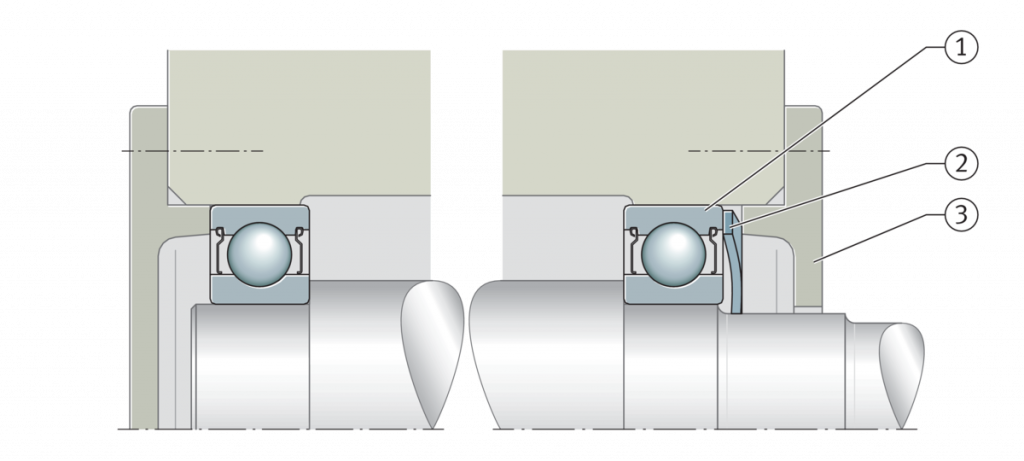
To determine shaft and housing fits for bearings, match the fit type to the load, speed, temperature, and radial internal clearance of the bearing, then verify shaft and housing tolerances against the bearing manufacturer’s fit tables.
Key Takeaways
- The right shaft and housing fit helps prevent bearing creep, vibration, heat buildup, and early failure.
- Bearing fits usually fall into three groups: clearance fit, transition fit, and interference fit.
- Interference fits change radial internal clearance, so fit selection should account for the bearing’s internal clearance values.
- Fit selection depends on operating conditions like load, speed, temperature, material properties, and application requirements.
- Manufacturer fit tables from brands like SKF and Schaeffler are useful references when calculating shaft and housing tolerances.
What Are Bearing Fits?
Bearing fits are the tightness or looseness between the bearing bore and shaft and between the bearing outside diameter and housing bore. The three basic categories are clearance fit, transition fit, and interference fit.
A proper fit prevents ring movement relative to the shaft or housing. When a ring slips on its seat, the movement is called creep. The current page correctly explains that creep can generate heat, wear particles, grease degradation, vibration, and eventual failure. \
Why it matters
A bearing fit is not just a mounting detail. It directly affects clearance, vibration, lubrication life, and the risk of premature failure.
Basics of Bearing Fits
Ball bearings are always mounted on a shaft and into a housing bore. Fit is the spatial value of tightness or looseness between the bearing bore and the shaft and the bearing outer ring and the housing. Fits are classified as Clearance Fit, Intermediate Fit, and Transition Fit.
When bearings slip, it is referred to as “Creep.” Proper fits prevent bearings from experiencing “creep” by firmly securing the inner ring and outer ring on the shaft and in the housing. Proper fits help reduce vibration during rotation. When creep happens, heat generation and wear particles are created. Excessive heat causes the degradation of grease and destruction of ball retainers. Wear particles that migrate inside the raceways cause vibration and surface degradation including seizure. Incorrect fits may cause complete failure.
In the case of Interference Fits, the interference causes a change in radial internal clearance. You need to understand what the internal clearance is for a proper interference fit calculation.
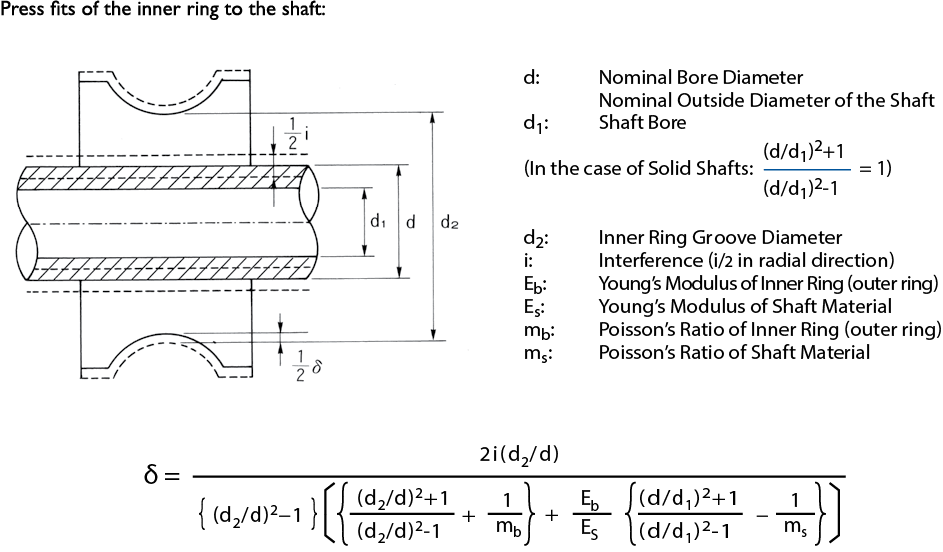
When pressing the bearing with an interference (i), the inner ring groove diameter (d2) increases by an amount (δ). This value (δ) is also equal to the decrease in radial internal clearance. You can find the calculations in any good bearing catalog to determine the proper interference fit for the bearing you are considering.
Interference Fit of the Outer Ring to the Housing
Using a press fit with an interference (I) the outer ring groove diameter D1 decreases by an amount (∆). This amount (∆) is also equal to the decrease in radial clearance. Consult with the bearing manufacturers catalog to determine the fits based on radial clearance for the bearing you are interested in.

Securing with Adhesive
When the bearing is fitted to the shaft and housing with adhesive without interference, it is necessary to select the proper clearance to enhance the effectiveness of the adhesive. Please consult with the adhesive manufacturer, as the correct clearance depends on the adhesive. The roundness of the ring raceways could be changed because of the adhesive’s curing stress.
In general, clearance fits allow for easy assembly and disassembly of bearings but may cause excessive vibration and noise due to the looseness of the fit. Interference fits provide a compressed connection reducing the risk of slippage or misalignment.
The selection of the appropriate bearing fit depends on several operating factors, including operating speed, load, and temperature. Other factors to be considered are the material properties of the bearing and the surrounding components. To determine the optimal bearing fit, you must understand the specific bearing’s radial internal clearance. Radial internal clearance is the free space between the inner and outer rings minus the ball diameter. Often internal radial clearance is called play. Bearings will have both radial and axial play to consider in mounting procedures.
Transition fits provide a compromise between clearance and interference fits. They offer a looser fit than interference fits but a tighter fit than clearance fits. A transition fit can be determined by calculating the amount of clearance or interference required based on the operating conditions and the material properties of the bearing and the surrounding components.
Determining Shaft and Housing Fits for Bearings
Shafts and housings are critical components in mechanical systems. In this context, we will discuss the factors that should be considered when selecting or designing shafts and housings, including material selection, diameter, tolerance, surface finish, and other critical factors.
Understanding Shaft and Housing Specifications
One of the most important considerations when selecting a shaft or housing is the material. In general, the material should be based on its mechanical properties. Strength, hardness, and toughness, as well as its resistance to wear and corrosion.
Another consideration when selecting a shaft or housing is the diameter, which will be based on the forces and torques that the component will experience during operation. In general, the larger the diameter, the more resistant the shaft or housing will be to bending and other types of deformation. The required diameter can be calculated using formulas such as the Euler-Bernoulli beam or the torsion equation, which considers factors such as the material properties, the length of the shaft or housing, and the loads applied.
Tolerance is another factor to consider when selecting or designing a shaft or housing. Tolerance refers to the allowable variation in the diameter, roundness, or other dimensions of the component. The tolerance required will depend on the application, with tighter tolerances typically being required for high-precision applications, such as in aerospace or medical equipment. The required tolerance can be determined by considering the required accuracy of the application and the manufacturing capabilities available.
Surface finish is another critical factor to consider, as it can affect the performance of the component, particularly in high-speed applications. The surface finish refers to the roughness or texture of the surface of the shaft or housing. A rough surface can lead to increased friction and wear, while a smooth surface can reduce friction and increase efficiency. The required surface finish will depend on the application, with higher speeds generally requiring smoother surfaces. The surface finish can be measured using techniques such as profilometry or surface roughness testers.
Calculating Bearing Tolerances
The main factors to consider when calculating bearing tolerances include the bearing type, size, and operating conditions. The following steps can be taken to calculate bearing tolerances:
- Determine the bearing type: There are many distinct types of bearings, including ball bearings, roller bearings, and plain bearings. The type of bearing will influence the required tolerances.
- Determine the bearing size: The size of the bearing will affect the required tolerances, as larger bearings typically require larger tolerances to accommodate the greater forces and loads, they will experience.
- Determine the operating conditions: The operating conditions, such as speed, temperature, and load, will affect the required tolerances. For example, higher speeds or temperatures may require tighter tolerances to maintain proper alignment and prevent damage.
- Calculate the clearance or interference fit: The clearance or interference fit between the bearing and its mating surface will affect the required tolerances. Clearance is the gap between the bearing and mating surface, while interference is when the bearing is slightly larger than the mating surface. The required clearance or interference fit can be calculated using formulas or tables provided by the bearing manufacturer.
- Calculate the shaft and housing tolerances: The shaft and housing tolerances will affect the fit of the bearing and must be calculated based on the clearance or interference fit. The tolerances can be calculated using formulas or tables provided by the bearing manufacturer.
- Verify the tolerances: Once the tolerances have been calculated, they should be verified using measuring tools such as micrometers or gauges to ensure that they are within the required range.
Most manufacturers like SKF and FAG Schaeffler provide fit tables for housings and shafts. Connect to Schaeffler for deep groove ball bearing and mounted housings selection assistance below.
- Deep groove ball bearing mounting assistance
- Housing selection assistant
- Review bearing selection criteria
How Do You Select Shaft and Housing Fits?
Select shaft and housing fits by matching the seat tolerance to the load direction, load magnitude, speed, temperature conditions, and bearing internal clearance. SKF and Schaeffler both describe fit selection as an operating-condition decision, not a one-size-fits-all tolerance choice.
Main factors to check
- Load direction. The ring under rotating load usually needs the tighter fit to prevent creep. SKF explicitly notes that rotating inner ring loads can loosen the fit if interference is insufficient.
- Load magnitude and shock. Heavier loads and vibration generally require tighter fits.
- Temperature difference between shaft, bearing, and housing. Temperature changes can alter the effective fit during operation. SKF highlights temperature differences as a fit-selection factor.
- Bearing type and size. Different bearing families and sizes use different fit guidance. SKF says resultant fits depend on bearing tolerances, seat tolerances, and ISO tolerance classes.
- Initial radial internal clearance. The initial clearance must be large enough that the required operating clearance remains after mounting effects reduce it.
Why it matters
This section answers the main query directly: you do not start with a tolerance code. You start with the operating conditions, then select the fit from manufacturer guidance.
Frequently Asked Questions About Shaft and Housing Fits for Bearings
What happens if a bearing fit is too loose?
A loose fit can let the bearing slip on the shaft or in the housing, which is called creep. That movement can create vibration, heat, wear particles, grease breakdown, and eventually bearing failure.
What is the difference between a clearance fit and an interference fit?
A clearance fit leaves space between the bearing and the mating surface, which makes assembly easier. An interference fit creates a tighter press fit, which helps reduce slippage and misalignment but also affects radial internal clearance.
How do you choose the right shaft and housing fit for a bearing?
Start with the bearing type, size, load, speed, temperature, and material conditions. Then check the bearing’s radial internal clearance and use the manufacturer’s fit tables or formulas to calculate the needed shaft and housing tolerances.
Why does radial internal clearance matter when selecting a fit?
Radial internal clearance affects how the bearing performs once mounted. If the fit is too tight, the clearance can decrease too much and cause excess heat, friction, or premature wear.
Where can you verify bearing fit recommendations?
Manufacturer catalogs and fit tables are the best place to verify recommendations. This article already points readers to Schaeffler resources for mounting assistance, housing selection, and bearing selection criteria.
Conclusion
Determining the right shaft and housing fits for bearings is essential for optimal bearing performance and long life. By understanding the basics of bearing fits, calculating bearing tolerances, and selecting the right fit based on the bearing type and application, you can ensure that your bearings will operate smoothly and reliably. Use the expert tips outlined in this article to help you make the best choices for your machines.
Still have a question or need to discuss something? Contact us to get help.