Your cart is empty
 Short Rigid Couplings
 Controlflex Couplings
 Jaw Couplings
 Oldham Couplings
 Bearing Locknuts – TCN
 Double Wide Shaft Collars
 Heavy Duty Shaft Collars
 International Series Shaft Collars
 Keyed Shaft Collars
 Mountable Shaft Collars
 Quick Clamping Shaft Collars
 Set Screw Shaft Collars
 Thin Line Shaft Collars
 Threaded Shaft Collars – Pacific International Bearing Products
 Two-Piece Shaft Collars
 Friction Bearing Universal Joints
 Needle Bearing Universal Joints
Bearings
eVTOL Bearings Used in Power Generators
04 November, 2026
20 min read
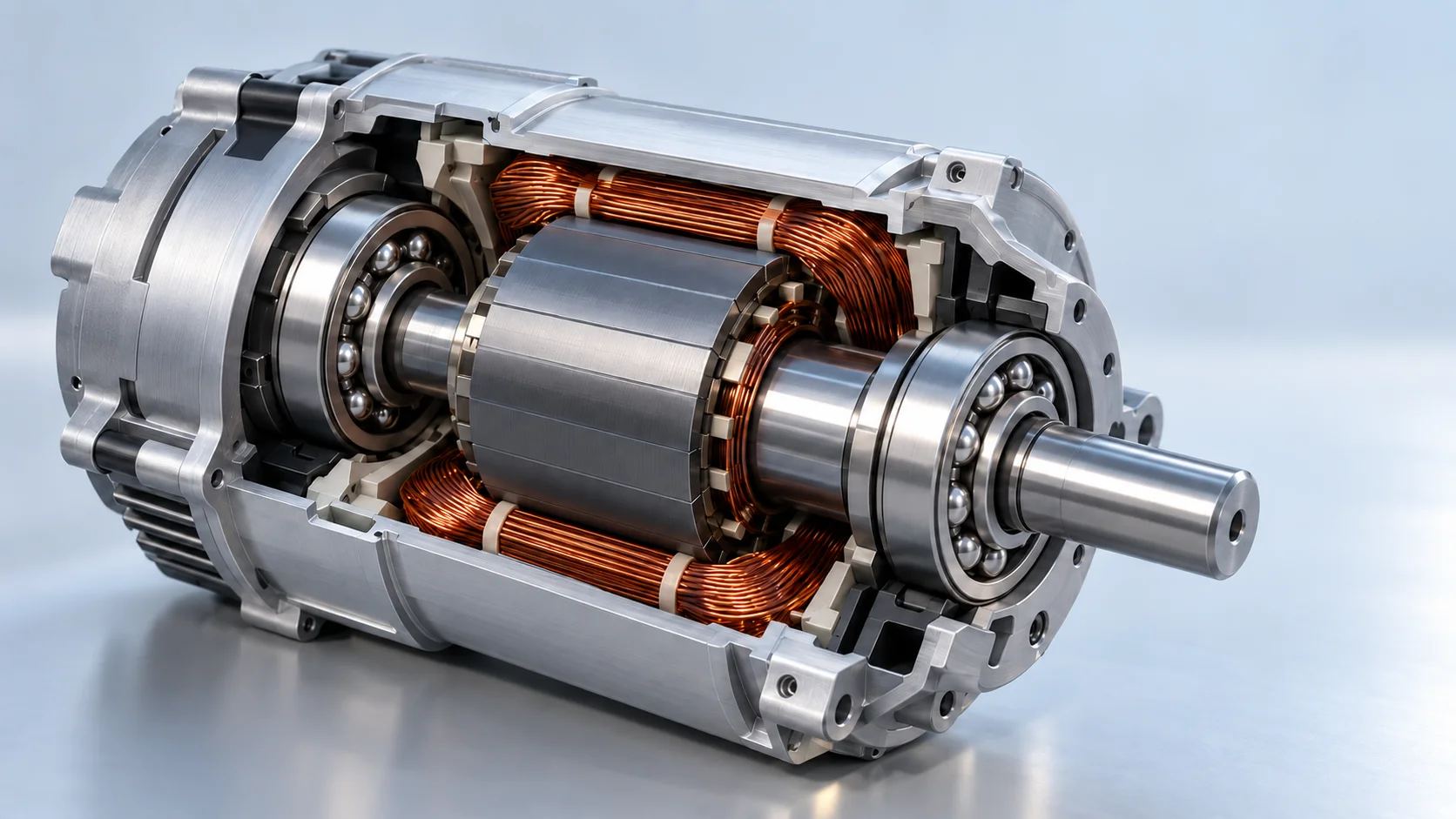
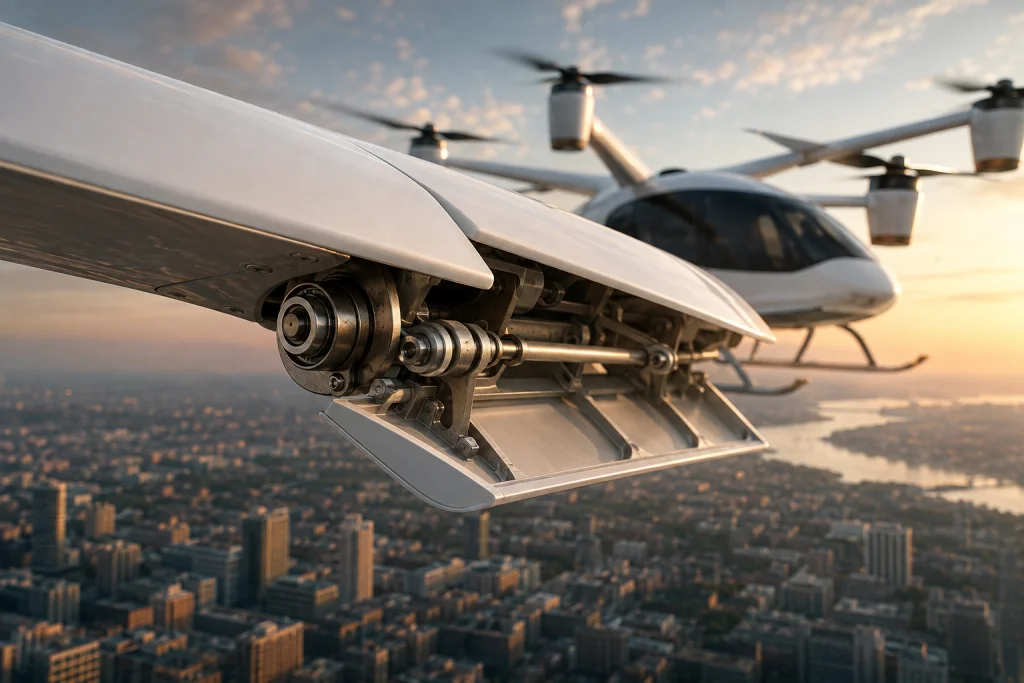
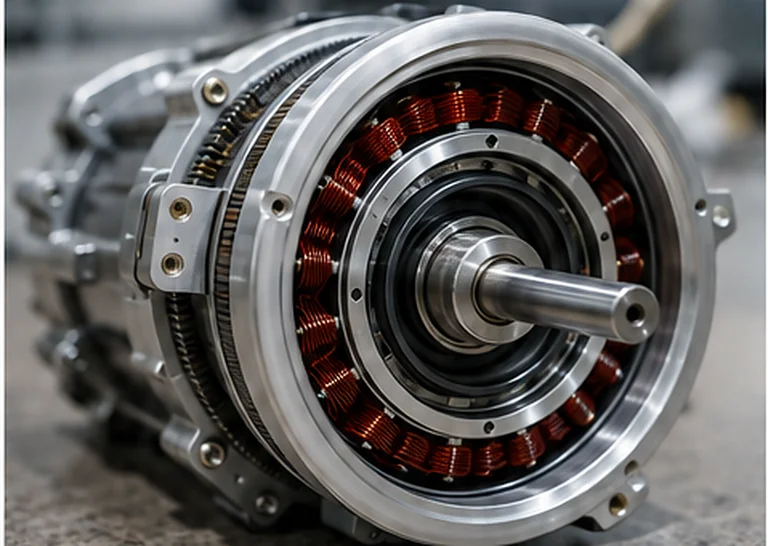
Not every eVTOL aircraft carries an onboard power generator. Fully battery-electric designs draw propulsion power directly from batteries, while some hybrid-electric architectures use an engine- or turbine-driven generator to produce electrical power in flight. In those hybrid systems, the generator bearings sit in a demanding part of the aircraft: high shaft speed, tight weight limits, thermal gradients, vibration, and a strong need to keep friction and heat under control.
Pacific International Bearing Sales (PIB) works with bearing applications where the correct answer depends on the complete rotating system, not simply bore size and outside diameter. In an eVTOL generator, the bearing arrangement has to locate the rotor accurately, carry the expected radial and axial loads, control shaft motion through temperature changes, support the selected lubrication method, and avoid failure modes that can turn a small bearing problem into a power-system problem.
The practical goal is straightforward: keep the rotor running true, keep bearing temperature predictable, maintain the intended air gap and shaft position, and make the bearing system reliable enough for the aircraft’s actual duty cycle.
Key Takeaways
- eVTOL generator bearings are relevant mainly to hybrid-electric or range-extender architectures; a fully battery-electric aircraft may not use an onboard power generator at all.
- High-speed generator designs place strong emphasis on low heat generation, rotor control, lubrication delivery, thermal growth, and bearing stiffness.
- Angular-contact ball bearings, deep-groove ball bearings, cylindrical roller bearings, hybrid ceramic bearings, and electrically insulated variants can all be relevant, but they solve different problems.
- Electrical current through a bearing can damage raceways and lubricant. Hybrid ceramic or coated insulated bearings can help interrupt that current path when the electrical design requires it.
- The wrong preload, fit, lubricant quantity, or bearing arrangement can raise torque and temperature even when the nominal bearing load rating looks adequate.
What Bearings Are Used in eVTOL Power Generators?
For high-speed eVTOL power generators, bearing selection usually centers on precision ball-bearing arrangements that can control radial and axial loads at speed, often with engineered preload and oil lubrication. Hybrid ceramic rolling elements may be considered when speed, heat generation, or electrical insulation are important. Other generator architectures may use deep-groove or cylindrical roller bearings where the load path, speed, and thermal-growth strategy support them.
What a Power Generator Means in an eVTOL
In a hybrid-electric eVTOL, a mechanical prime mover can drive a generator that supplies electrical power to propulsion motors, charges or supports the battery system, or does both depending on the architecture. The prime mover may be a gas turbine or another engine type. Some designs integrate the generator closely with the turbine or engine; others use a coupled shaft or gearbox. The bearing duty changes with that architecture.
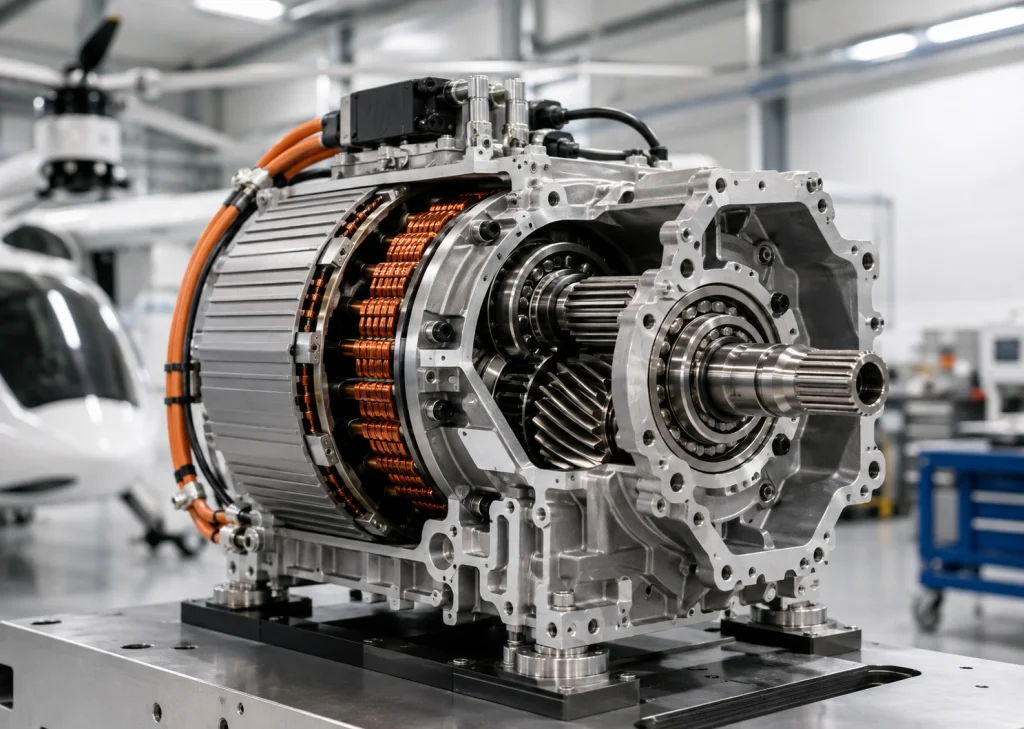
This distinction matters because a generator rotor is not the same bearing application as a lift-motor rotor, tilt mechanism, or flight-control actuator. A high-speed turbogenerator can push bearing speed and lubrication demands much harder than a lower-speed accessory generator. The bearing arrangement has to be designed around the generator shaft, rotor mass, electromagnetic air gap, thermal behavior, and drive system as a complete package.
What Generator Bearings Have to Handle
The generator bearing set has two jobs at the same time: carry mechanical load and preserve rotor geometry. That second job is easy to underestimate. If shaft motion becomes excessive, rotor-to-stator clearance can change, vibration can increase, and the generator can run hotter or less smoothly even before the bearing reaches a conventional fatigue limit.
Common design pressures include high rotational speed, radial load from rotor mass and imbalance, axial load from the drive arrangement, thermal expansion, transient loads during start and shutdown, aircraft vibration, and limited space for lubrication hardware. In inverter-connected electrical machines, shaft voltage and bearing-current risk can also become part of the bearing decision.
| Generator condition | What it does to the bearing system | Selection priority |
| High shaft speed | Raises centrifugal effects, lubricant shear, and heat generation | Low-friction geometry, suitable cage and materials, controlled lubrication |
| Combined radial and axial load | Changes contact loading and rotor location | Contact angle, bearing arrangement, preload or clearance |
| Thermal growth | Changes fits, internal clearance, and shaft position | Hot-condition clearance, floating/locating strategy, housing stiffness |
| Vibration and transients | Adds dynamic loading during starts, stops, and aircraft operation | Stable rotor support, robust fits, fatigue and cage margin |
| Electrical shaft voltage | Can drive discharge current through rolling contacts | Hybrid ceramic or insulated bearing strategy when required |
| Weight and packaging limits | Restricts bearing size and lubrication hardware | High power density without sacrificing stiffness or cooling |
Bearing Types Commonly Considered for eVTOL Generators
There is no single “eVTOL generator bearing.” The right bearing type depends on generator speed, shaft diameter, rotor mass, axial load, desired stiffness, lubrication system, and whether one bearing must locate the shaft while another allows thermal growth.
Angular-contact ball bearings
Angular-contact ball bearings are a strong option when the generator needs high-speed capability together with controlled axial location. A pair can support radial and axial load while providing a defined level of stiffness. Arrangement and preload matter: too little control can allow shaft movement, while excessive preload can increase friction, heat, and sensitivity to thermal expansion.
In very high-speed applications, reduced rolling-element mass can become valuable because centrifugal loading rises with speed. This is one reason hybrid ceramic angular-contact bearings are often considered in high-speed rotating equipment.
Deep-groove ball bearings
Deep-groove ball bearings work well in many electric machines because they are compact, efficient, and can carry radial load plus a useful amount of axial load in both directions. They may fit lower- or moderate-speed generator architectures where the shaft-location and thrust requirements do not justify an angular-contact arrangement. They should not be treated as a default choice for every high-speed turbogenerator simply because they are common in industrial motors.
Cylindrical roller bearings
Cylindrical roller bearings provide high radial stiffness and load capacity. Certain designs allow axial displacement between the rings, which can be useful at the non-locating end of a shaft where thermal growth must be accommodated. Their suitability depends strongly on speed, lubrication, cage design, and the generator’s load path. They are a system-level option, not an automatic replacement for ball bearings in high-speed machines.
Hybrid ceramic bearings
Hybrid bearings use steel rings with ceramic rolling elements, typically silicon nitride. Their lower rolling-element density reduces centrifugal forces at high speed, while the ceramic elements also provide electrical insulation between the shaft and housing through the bearing. Those properties can be useful in compact generators where speed and electrical-current risk are both important.
Hybrid construction does not remove the need to evaluate preload, lubrication, contact stress, thermal behavior, and rotor dynamics. It changes the bearing’s operating characteristics; it does not make the rest of the design less important.
Electrically insulated bearing options
If generator shaft voltage can create current through the bearings, an insulated bearing arrangement may be needed. Ceramic rolling elements are one approach. Another is an insulating coating on a bearing ring. The correct choice depends on the electrical circuit, switching frequency, shaft grounding strategy, bearing size, mechanical loads, and the voltage that must be interrupted.
| Bearing option | Where it can fit | What can go wrong when mismatched | What improves with the right choice |
| Angular-contact ball bearing | High-speed rotor support needing axial location and stiffness | Heat from excessive preload; poor axial control if arrangement is too soft | Stable shaft position, combined-load support, predictable running behavior |
| Deep-groove ball bearing | Compact generator with primarily radial load and moderate thrust demand | Insufficient axial stiffness or poor thermal fit at higher duty | Simple, efficient support where the load path suits the bearing |
| Cylindrical roller bearing | Radially loaded support or non-locating position, architecture dependent | Excess drag, poor axial strategy, speed or cage limitations | High radial stiffness and controlled thermal displacement when properly applied |
| Hybrid ceramic ball bearing | High-speed or electrically sensitive generator position | Cost added without solving a defined speed/electrical problem; wrong preload still overheats | Lower rolling-element inertia and electrical isolation through the bearing |
| Coated insulated bearing | Generator position requiring current interruption | Coating damage or insufficient insulation if installation/electrical duty is not considered | Reduced risk of current passing through rolling contacts |
What the Wrong Bearing Looks Like in Service
A generator bearing problem usually shows up as a system problem first. Temperature begins to climb, vibration changes, rotor noise increases, lubricant condition deteriorates, or the machine needs more torque to maintain speed. If electrical current is involved, the raceways can develop electrical erosion patterns and the lubricant can be damaged even when the mechanical load is not unusually high.
A bearing can also be perfectly good on paper and still run poorly after installation. A housing fit that removes too much internal clearance, excessive preload, a distorted mounting face, or an oil feed that floods the bearing can all raise heat. At the other extreme, too much clearance or weak shaft support can allow rotor motion that hurts running accuracy.
With the correct bearing arrangement, fits, and lubrication, the changes are practical rather than dramatic: shaft motion is controlled, temperature is more stable, friction stays predictable, lubrication does its job without excessive churning, and inspection data becomes easier to interpret. That is the kind of improvement that supports uptime and repeatable generator performance.
| Problem | Typical effect in the generator | Better design response |
| Too much preload | Higher friction and heat; reduced thermal margin | Set preload from speed, load, stiffness, and hot-condition behavior |
| Too little shaft control | Rotor movement, vibration, changing air gap | Use an arrangement with adequate axial/radial stiffness |
| Poor lubrication delivery | Starvation or churning; heat and wear | Meter the correct lubricant to the contact and provide a clear exit path |
| Unmanaged thermal growth | Clearance loss, preload increase, or axial binding | Use fits and locating/floating strategy that work at operating temperature |
| Bearing current | Electrical erosion and lubricant degradation | Control shaft voltage/current path; use insulated or hybrid bearings where required |
| Weak contamination control | Debris-driven surface damage and shortened lubricant life | Match filtration, seals, and handling cleanliness to the bearing system |
High Speed Changes the Bearing Conversation
High-speed generator design is not simply a matter of checking a catalog limiting speed. As shaft speed rises, rolling-element centrifugal force, cage behavior, lubricant shear, heat generation, and rotor dynamics all become more important. Bearing pitch diameter also matters, which is why high-speed bearing work often uses a speed factor based on bearing size and rotational speed rather than rpm alone.
The bearing arrangement also contributes to rotor critical-speed behavior. Shaft diameter, bearing span, bearing stiffness, rotor mass, housing stiffness, and preload all interact. A bearing with more static load capacity is not automatically the better high-speed choice if it increases friction, adds mass, or changes rotor dynamics in the wrong direction.
Lubrication Has to Cool Without Becoming a Loss
Lubrication in a high-speed eVTOL generator has two jobs: protect the rolling contacts and help carry heat away. Supplying more oil is not always better. Too much oil can increase churning losses and temperature, while too little can starve the contacts. The delivery method therefore has to put the right amount of lubricant where the bearing needs it and allow the oil to leave without pooling around the rolling elements.
High-speed rotating equipment can use jet, under-race, oil-air, or other metered oil-delivery approaches depending on the architecture. eVTOL packaging makes the choice more sensitive because pumps, lines, filters, oil tanks, and heat exchangers all add mass and volume. The bearing and lubrication circuit should be developed together, not selected independently.
Grease can still be appropriate in generator designs where speed, temperature, relubrication strategy, and desired life support it. The point is not that one lubricant type is universally better. It is that the lubricant, fill quantity, delivery method, and heat path have to match the actual generator duty.
Electrical Erosion Is a Bearing Issue and a System Issue
A generator can develop voltage between the shaft and housing. If that voltage discharges through a rolling bearing, the contact can experience microscopic arcing. Repeated discharge can damage raceways and rolling elements and can accelerate lubricant degradation. The resulting surface patterns may resemble fluting or pitting as damage progresses.
The bearing is only one part of the electrical circuit. Grounding, inverter or converter behavior, common-mode voltage, machine geometry, insulation, and cable routing all influence the current path. Hybrid ceramic or coated insulated bearings can be effective tools, but they should be chosen as part of the generator’s electrical-current mitigation strategy rather than as a mechanical afterthought.
Thermal Growth, Fits, and Preload Must Be Checked Together
Generator shafts, housings, bearing rings, and rotors do not all reach the same temperature at the same time. Those temperature differences change interference fits and internal clearance. In a preloaded angular-contact set, they can also change the actual preload seen in operation.
That is why cold assembly dimensions are only the starting point. The design should be checked at representative operating temperatures and transient conditions. A locating bearing must hold the rotor where it belongs; a non-locating bearing or other thermal-growth provision must let the shaft expand without forcing unwanted axial load back into the bearing set.
Cleanliness and Contamination Control Still Matter
A generator may live inside an enclosed nacelle or power unit, but that does not make contamination irrelevant. Machining debris, assembly contamination, degraded lubricant, wear particles, and external ingress can all damage high-precision rolling contacts. The smaller the contact area and the higher the speed, the less tolerance the bearing has for poor cleanliness.
For oil-lubricated systems, filtration and oil cleanliness should be considered part of bearing life. For grease-lubricated designs, seal selection and assembly handling become more important because there may be no continuous oil circuit to remove contaminants. Sealing should protect the bearing without adding more drag than the application can tolerate.
A Practical Selection Process for eVTOL Generator Bearings
For a new generator or a redesign, PIB recommends starting with the rotating-system requirements rather than a part number. A useful review includes:
1. Define the generator architecture. Is it an integrated turbogenerator, an engine-driven generator, a geared unit, or another hybrid power source? Identify which bearings belong to the generator rotor and which belong to the prime mover or gearbox.
2. Map the real loads. Document radial, axial, moment, imbalance, transient, and any gear or coupling loads at each bearing position. Include the effect of rotor weight and shaft geometry.
3. Define the full speed profile. Use steady speed, acceleration, start/stop events, overspeed conditions, and the bearing size-speed factor. High-speed duty should be evaluated with lubrication and cage design at the same time.
4. Set the rotor-control targets. Establish allowable shaft displacement, stiffness, runout, preload or clearance, and how the bearing arrangement supports the generator air gap.
5. Build the thermal model around the bearings. Estimate shaft, ring, housing, and lubricant temperatures so fits and preload are checked in the hot condition, not only at assembly.
6. Choose the lubrication strategy. Define oil or grease type, delivery quantity, scavenge or drain path, filtration, cooling, and maintenance access.
7. Evaluate electrical-current risk. If the generator architecture can produce bearing current, determine whether grounding, coated insulation, hybrid bearings, or a combination is appropriate.
8. Validate the installed system. Measure temperature, torque, vibration, shaft behavior, lubricant condition, and electrical effects under representative speed, load, and thermal conditions before freezing the production configuration.
Frequently Asked Questions
Do all eVTOL aircraft use power generators?
No. Fully battery-electric eVTOLs can operate without an onboard mechanical power generator. Generator bearings become relevant in hybrid-electric, range-extender, or other architectures that mechanically generate electrical power in flight.
What bearing type is best for a high-speed eVTOL generator?
There is no universal best type. High-speed angular-contact ball bearings are common candidates when axial location, stiffness, and speed capability are important. Hybrid ceramic versions may be considered for lower rolling-element mass and electrical insulation. The final choice depends on speed, load, rotor dynamics, temperature, lubrication, and shaft-current risk.
Why are hybrid ceramic bearings useful in generators?
The ceramic rolling elements are electrically insulating and substantially lighter than steel rolling elements. Those properties can help where bearing-current damage and high-speed centrifugal effects are concerns. They still require correct fits, preload, lubrication, and load analysis.
Can electrical current really damage a generator bearing?
Yes. If shaft voltage discharges through the rolling contact, electrical erosion can damage the raceways, rolling elements, and lubricant. Insulated or hybrid bearings can be part of the mitigation strategy, but the complete grounding and electrical system should be evaluated.
Is oil lubrication always required?
No. Very high-speed generator bearings often use engineered oil delivery because lubrication and cooling have to be tightly controlled. Other generator designs can use grease when speed, temperature, life, and maintenance requirements support it.
Why does preload matter so much in a generator?
Preload can improve shaft location and stiffness, but it also increases internal load and friction. Too much preload can raise temperature and reduce thermal margin; too little can allow unwanted shaft movement. The correct value is application-dependent and should be checked at operating temperature.
What information does PIB need to help select generator bearings?
Useful inputs include shaft and housing dimensions, bearing span, speed profile, radial and axial loads, rotor mass, allowable shaft movement, temperature estimates, lubrication method, desired preload or clearance, electrical-current risk, vibration environment, and maintenance targets.
Final Thoughts
Bearings in an eVTOL power generator are small components inside a system that is very sensitive to heat, shaft motion, and efficiency. The right selection starts with the generator architecture, then works through speed, load, rotor stiffness, thermal growth, lubrication, and electrical-current risk. When those details are treated as one system, the bearing arrangement is easier to keep cool, stable, and predictable over the intended service interval.
PIB can help compare bearing arrangements for high-speed generator rotors, hybrid-electric power units, and related aerospace rotating equipment. The most useful starting point is a clear load path, speed profile, shaft layout, temperature estimate, and lubrication strategy so the bearing can be selected around the machine rather than forced into it afterward.
Call us (800) 228-8895, email us [email protected], visit us www.pibsales.com.