Your cart is empty
 Short Rigid Couplings
 Controlflex Couplings
 Jaw Couplings
 Oldham Couplings
 Bearing Locknuts – TCN
 Double Wide Shaft Collars
 Heavy Duty Shaft Collars
 International Series Shaft Collars
 Keyed Shaft Collars
 Mountable Shaft Collars
 Quick Clamping Shaft Collars
 Set Screw Shaft Collars
 Thin Line Shaft Collars
 Threaded Shaft Collars – Pacific International Bearing Products
 Two-Piece Shaft Collars
 Friction Bearing Universal Joints
 Needle Bearing Universal Joints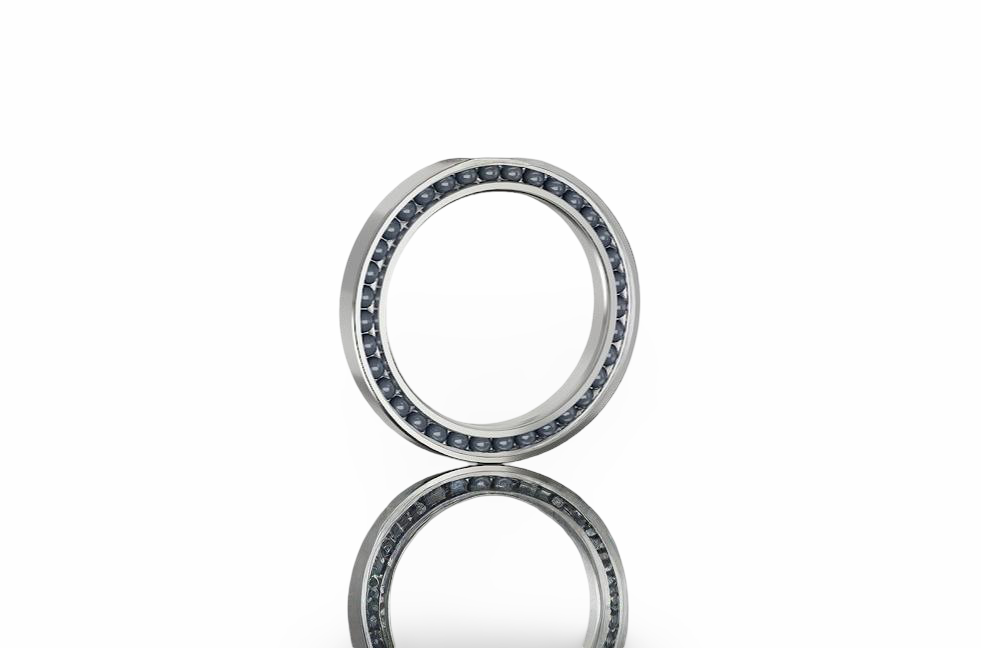
Bearings
WIB-SA Thin-Section Ball Bearings
12 January, 2026
16 min read
Designing high-performance joints for robots and prosthetic devices requires components that deliver power and precision without adding bulk. WIB Thin section bearings offer an ideal solution for actuating joints like elbows, knees, and wrists – providing strong, smooth motion in compact spaces. This article is about WIB thin-section bearings and how they enhance performance in real-world applications, especially robotics and medical prosthetics.
Types and Specifications of WIB Thin Section Bearings
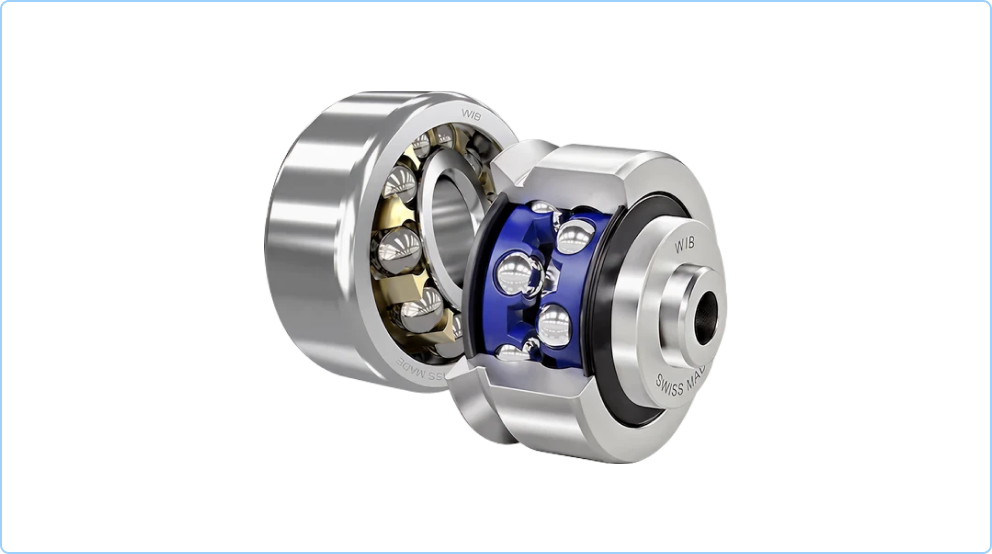
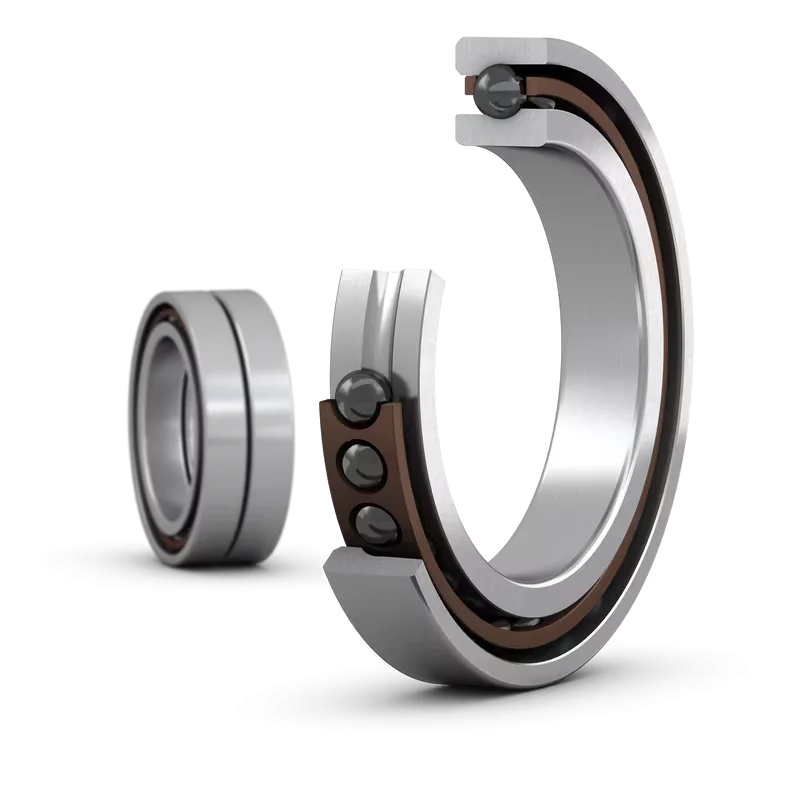
WIB thin-section bearings are available in a range of configurations to best handle different load conditions and design constraints. The most common design is the single-row deep groove (radial) thin-section bearing, which supports primarily radial loads (with moderate axial load capacity) and is often chosen for its simplicity and efficiency in tight spaces. For applications with higher axial or combined loads, angular contact thin section bearings can be provided – these have raceway geometry designed to support significant axial thrust in one direction (or in pairs for dual directions) alongside radial loads. WIB can also engineer four-point contact thin-section bearings (often called X-type) for situations requiring a single slim bearing to manage radial, axial, and moment loads simultaneously; this is especially useful in robotics and turntable mechanisms where complex loading occurs, but space for multiple bearings is limited.
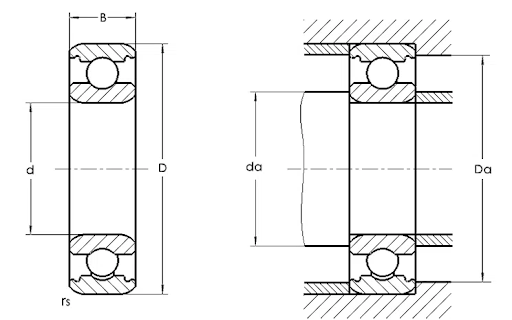
Because WIB is highly customer-focused, they can deliver whichever bearing type (radial, angular, four-point contact) and configuration best fits your project. They offer both metric and inch series thin-section bearings, covering a broad range of sizes. For example, bore diameters can range from just a few millimeters in small instrumentation bearings to several inches in larger robotic or aerospace bearings, all with correspondingly small cross-sectional widths. The table below highlights a few example WIB thin section bearings and their key specifications to illustrate the range of sizes and capacities available:
| Bearing Designation | Dimensions (Bore × O.D. × Width) | Dynamic Load (kN) | Static Load (kN) |
| 638/4 (Deep groove) | 4 mm × 9 mm × 4 mm | 0.64 kN | 0.23 kN |
| 619/8 (Deep groove) | 8 mm × 19 mm × 6 mm | 2.46 kN | 1.05 kN |
| 61804 (Deep groove) | 20 mm × 32 mm × 7 mm | 3.10 kN | 1.90 kN |
Table: Examples of WIB thin-section ball bearings with their dimensions and load ratings.
These examples demonstrate how even the smaller bearings (for instance, a 4 mm bore unit) can support loads over 0.6 kN despite weighing only around a gram, while larger thin sections (~20 mm bore) handle several kilonewtons of load. In all cases, the cross-section of the bearing is kept very small relative to its diameter. This slim profile is what allows designers to reduce space and weight in their assemblies. Whether you need a tiny bearing for a miniature robotic hinge or a larger thin-ring bearing for a gimbal in an aerospace system, WIB’s product range (and custom design capability) has you covered.
Key Advantages of WIB Thin Section Bearings
WIB thin-section ball bearings offer several important advantages for high-performance applications:
- Space and weight savings: The foremost benefit is the ability to save space and minimize weight. Thin-section bearings have a much smaller cross-section than standard bearings of the same diameter. This means you can use a larger bore diameter (to pass cables, shafts, or other components) or simply reduce the overall footprint of your design. Lighter bearings also reduce the mass of moving parts, which can improve efficiency in systems like robotic arms or UAVs.
- High load capacity for size: Despite their slim build, thin-section bearings are engineered to carry impressive loads relative to their size. Through careful internal geometry and material selection, WIB’s thin-section designs maintain high load capacities (both radial and axial) and resist deformation. Their high stiffness ensures stability and precise operation even under significant force. For example, in semiconductor manufacturing equipment or medical scanners, these bearings provide rock-solid support with minimal deflection, which is critical for maintaining accuracy.
- Precision and smooth operation: Manufactured to exacting tolerances (WIB can meet various precision grades, up to ABEC-7 or equivalent for extreme accuracy), these bearings deliver smooth rotation with minimal friction and runout. Low friction not only means quieter, more efficient operation, but also less wear over time. The precision of WIB’s manufacturing process and quality control (including multi-layered inspections) guarantees consistent performance, which is vital in applications like imaging devices or aerospace sensors where any vibration or irregularity can cause problems.
- Versatility in design: Thin-section bearings from WIB are highly versatile. They can be configured as needed – open bearings for lowest friction, or with integrated seals/shields to keep lubricants in and contaminants out. Special low-noise designs, high-temperature lubricants, or vacuum-compatible greases can be applied for niche environments. Furthermore, because thin-section bearings can be made in radial, angular, or four-point contact styles, a designer has the flexibility to address different load scenarios while still using a space-saving form factor. Instead of employing multiple bearings to handle complex loads, a single four-point contact thin-section bearing, for instance, can often do the job, simplifying the design.
- Durability and specialized materials: WIB’s use of advanced materials and treatments results in bearings built to last. Chrome alloy steel rings provide a strong foundation, while stainless steel options offer corrosion resistance for harsh or moisture-prone conditions. For ultra-demanding cases, ceramic balls (silicon nitride) can greatly reduce wear and friction, and they are non-magnetic for sensitive equipment. WIB also offers coatings (like thin dense chrome or other proprietary surface treatments) that further enhance durability and lifespan. These choices ensure that even in challenging environments – whether a cleanroom, a vacuum of space, or a high-heat setting – the bearings maintain their performance over a long service life.
In summary, WIB thin-section ball bearings enable engineers to achieve compact, lightweight designs without trade-offs in load-bearing capability or precision. They encapsulate the best of Swiss bearing craftsmanship: each unit is robust, finely tuned, and reliable. These advantages translate to higher performance and efficiency in the end products, from smoother-running robots to more compact aerospace instruments.
Applications of Thin Section Bearings
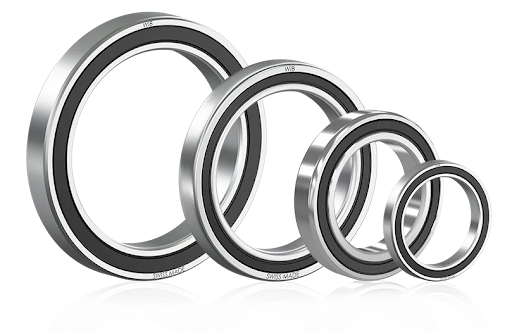
Thin-section ball bearings play vital roles across numerous high-tech and demanding industries. Their ability to provide robust performance in a compact, lightweight package makes them indispensable wherever space and weight are limited.
Notable application areas include:
- Aerospace and space systems: Satellite mechanisms, drones, and aircraft components, where minimizing weight is critical.
- Robotics and automation: Robotic arms, automation equipment, and motion control systems that require compact, precise bearings for smooth, multi-axis movement.
- Medical equipment: Imaging machines, surgical robots, and laboratory devices that need high precision in small form factors (often with special materials for cleanliness or non-magnetic properties).
- High-speed tooling & machinery: Machine tools, CNC spindles, and precision instruments where thin bearings reduce footprint and inertia while maintaining stiffness.
- Electric motors & actuators: Compact motors, stepper drives, and gearboxes benefit from thin-section bearings to keep size and weight low without sacrificing load capacity.
- Packaging & semiconductor equipment: Pick-and-place machines, indexing tables, and other equipment that combine speed with space-efficient designs using slim bearings.
In each of these industries, thin-section bearings enable innovative designs by conserving space and reducing mass. Engineers can integrate these slim-profile bearings into mechanisms that would be impossible or impractical with standard bearing sizes. Despite their slender build, WIB thin-section bearings still handle substantial loads and deliver the accuracy needed for precision-dependent applications.
Selecting the Right Thin Section Bearing with PIB Sales
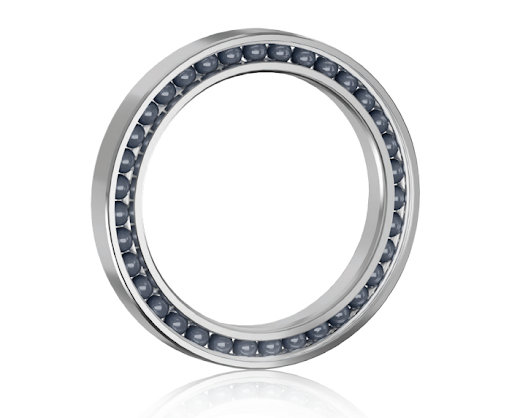
Choosing the ideal thin-section bearing for a specific application can be a complex task – there are many variables to consider, including size, cross-section series, material, and contact type (radial vs. angular vs. four-point). Ensuring you pick a bearing that meets your load requirements, fits within your space constraints, and operates reliably under your environmental conditions is critical. This is where PIB’s expertise comes into play. As a trusted distributor of WIB bearings, PIB offers knowledgeable guidance to help you navigate the selection process.
When working with PIB, you benefit from both a broad product catalog and personalized engineering support. For example, if your design primarily experiences radial loads and space is very tight, PIB might recommend a deep-groove radial thin-section bearing from WIB’s standard series to maximize capacity in the smallest envelope. If your application involves significant axial loads – say in a vertical axis or a pivot – an angular contact thin section bearing or a matched pair could be the better solution for maintaining precision under combined loads. In cases of complex, multi-directional forces (such as a robotic joint or a positioning table), PIB can advise on using a four-point contact thin-section bearing, which can handle radial, axial, and moment loads simultaneously, potentially reducing the need for multiple bearings and simplifying your design.
Beyond load and size considerations, PIB will help factor in other details: Do you need a stainless steel bearing for corrosion resistance (for instance, in a medical or food-grade environment)? Is a sealed bearing preferable to keep dust and debris out (for industrial automation or outdoor equipment)? What clearance or preload is optimal given your assembly and thermal expansion conditions? Our team will address these questions, ensuring you get a bearing that not only fits but also performs optimally over time.
Explore the PIB online catalog of WIB thin-section bearings to see available sizes and options. Each listing includes detailed specifications to assist your decision. You can filter by dimensions, material, or other attributes to quickly find candidates that meet your needs. When you’re ready, you can conveniently request a quote or purchase through our online system. If you have any doubts or require a custom solution beyond the standard offerings, don’t hesitate to contact PIB for support. We liaise directly with WIB in Switzerland for any special requirements, so you’ll receive authentic, high-performance bearings tailored to your project.
At Pacific International Bearing Sales, we are committed to helping you find the perfect thin-section bearing solution. With WIB’s Swiss-made precision bearings and PIB’s dedicated customer support, you can design with confidence knowing your application is equipped with the best in space-saving, high-precision bearing technology.
FAQ
Q: What are thin-section ball bearings?
A: Thin-section ball bearings are specialty bearings with a very small cross-sectional profile relative to their diameter. In other words, they are slim bearings (often called slimline or thin-ring bearings) designed to save space and weight. Despite their thin profile, they can support significant loads and provide precise, smooth rotation. Thin-section bearings enable more compact and lightweight designs in equipment where standard bearings would be too bulky.
Q: Why would I choose a thin-section bearing over a standard bearing?
A: The primary reason to choose a thin-section bearing is to save space and reduce weight in your design. These bearings allow for a smaller, lighter assembly, which is crucial in many high-tech applications (for example, drones, satellites, portable medical devices, or compact robots). Thin-section bearings still offer excellent load capacity and stiffness for their size, so you don’t have to sacrifice performance to get a smaller form factor. They are ideal when design envelopes are tight or when excess weight could impair functionality or efficiency.
Q: What makes WIB thin-section bearings special?
A: WIB thin-section bearings stand out due to Swiss precision manufacturing and customization. WIB SA has a long history of engineering high-performance bearings, and they apply very strict quality controls to every product. Their thin-section bearings are made with premium materials and advanced techniques (like specialized heat treatments and precision grinding) to ensure accuracy and longevity. Moreover, WIB can customize bearings to customer needs more than many standard off-the-shelf suppliers. Whether you need a particular material (stainless steel or ceramic), a non-standard size, a special seal, or a certain internal clearance, WIB can accommodate those requirements. When you get a WIB bearing through PIB, you’re getting a product that’s been optimized for your specific application, not just a generic part.
Q: In what industries or machines are thin-section bearings commonly used?
A: Thin-section bearings are used across a variety of industries, especially in situations where equipment must be lightweight, compact, or precise. Common examples include: Aerospace and defense (for satellites, aircraft instruments, gimbals), robotics and automation (robot joints, collaborative robots, factory automation systems), medical devices (scanners, surgical robots, prosthetic mechanisms), semiconductor manufacturing (wafer handling equipment, precision stages), optical systems (telescopes, cameras with gimbal mounts), and electric motors or gearboxes (where a slim bearing can allow for a smaller motor footprint). They are also found in specialized machinery like packaging equipment, drones, laboratory instruments, and even high-performance sporting equipment. Essentially, any application that benefits from reducing bulk and weight while maintaining bearing performance is a good candidate for thin-section bearings.
Q: How do I select the correct thin-section bearing for my project?
A: Selecting the right thin section bearing involves considering several factors: the load conditions (magnitude and direction of forces the bearing must handle), the size constraints (available diameter and width for the bearing), the operating environment (temperature extremes, presence of dust or moisture, vacuum, etc.), and any special requirements (such as corrosion resistance, low magnetic permeability, or noise limitations). Start by determining the required bore diameter and cross-section that fit your design. Then, consider the type of bearing contact that suits your loads: a radial (deep groove) bearing if mainly radial loads, an angular contact bearing if you have a significant axial load in one direction, or a four-point contact if you need to handle axial loads in both directions or moments. Next, choose the material – stainless steel if corrosion is a concern or if the bearing might need to operate without rust in humid conditions, or even a hybrid with ceramic balls for high-speed or specialty applications. Decide if you need seals or shields (sealed bearings are great for dirty or greased environments since they keep contaminants out and lubricant in). Finally, check the bearing’s load ratings (dynamic and static) to ensure they exceed the maximum forces in your application for an adequate safety margin.
PIB is here to help. Go to [email protected]. Our sales staff can guide you through the catalog or even discuss your application details to recommend a suitable part. You can use our online catalog filters to narrow down candidates by size, series, material, etc. Once you identify a potential bearing, review its specifications (load ratings, speed ratings, etc.) to confirm it meets your needs. And of course, you can always reach out to Pacific International Bearing Sales for personalized assistance – we’ll make sure you get the right WIB thin-section bearing that gives your project the perfect balance of compactness and performance.