Your cart is empty
 Short Rigid Couplings
 Controlflex Couplings
 Jaw Couplings
 Oldham Couplings
 Bearing Locknuts – TCN
 Double Wide Shaft Collars
 Heavy Duty Shaft Collars
 International Series Shaft Collars
 Keyed Shaft Collars
 Mountable Shaft Collars
 Quick Clamping Shaft Collars
 Set Screw Shaft Collars
 Thin Line Shaft Collars
 Threaded Shaft Collars – Pacific International Bearing Products
 Two-Piece Shaft Collars
 Friction Bearing Universal Joints
 Needle Bearing Universal Joints
Robotics
Humanoid Finger Joint Bearings
14 May, 2026
12 min read
Humanoid finger joint bearings are usually miniature deep-groove ball bearings sized for extremely tight envelopes, low friction, repeatable oscillating motion, and combined radial plus light axial loading. Pacific International Bearing Sales supports this with miniature options in multiple materials, precision grades, and closure styles, plus engineering help when a standard part is not enough.
Key Takeaways
- Most true finger knuckles belong in the miniature-bearing category, where compact deep-groove ball bearings handle the space, friction, and light combined-load demands far better than larger rotary-bearing formats.
- Open, shielded, and sealed versions are not always interchangeable. The right choice depends on how much contamination protection the joint needs and how much extra drag the actuator can tolerate. Also note that an open bearing may have a smaller cross section which can be advantageous for space savings.
- PTFE-lined spherical plain bearings make sense when a joint or linkage oscillates, sees angular misalignment, or needs maintenance-free behavior more than it needs free continuous rolling motion.
- PIB’s catalog gives designers a practical path from miniature ball bearings to thin-section, spherical plain, crossed roller, and flexible bearings, with engineering support and custom-design help when a standard catalog part is not the full answer.
Why the Joint Feels Right or Wrong
A humanoid finger joint has a simple job on paper and a hard job in practice. It has to stay compact, move quietly, minimize friction, hold alignment, and survive repeated grasp cycles without developing looseness or rough spots. When the bearing specifications are not perfect, the hand feels sticky, sloppy, or noisy. When it is right, the bearing almost disappears and the finger simply tracks the motion it was designed to make.
That is why miniature deep-groove ball bearings show up so often in robotic fingers. Finger joints are tight on space, and they usually see radial load first, with smaller axial loads appearing as the finger is pressed or pulled along its axis. Miniature radial ball bearing designs are a natural fit because they support axial loads in both directions in addition to radial loads, and PIB’s own robotics content points directly to miniature ball bearings as the go-to hardware for compact finger knuckles.
The Bearing Types that Actually Make Sense in Fingers
The fastest way to make a robotic hand harder than it needs to be is to assume every joint wants the same bearing. It does not. A distal knuckle, a thumb base, an off-axis linkage, and a strainwave-driven actuator module are different mechanical problems, so they deserve different bearing types. PIB’s current catalog spans the full menu needed for that kind of design work: miniature ball bearings, spherical plain bearings, thin-section bearings, crossed roller bearings, and flexible bearings.
| Finger design problem | Bearing style that usually fits best | Why it works | Typical place in a humanoid hand |
| Very small enclosed knuckle pivot | Miniature deep-groove ball bearing | Compact, low friction, supports radial plus light axial load | DIP and PIP style joints, compact proximal joints |
| Clean joint with very tight torque budget | Open miniature deep-groove bearing | Lowest drag when the joint is well enclosed | Internal fingers with clean housing and controlled lubrication |
| Joint exposed to dust or contamination | Shielded or sealed miniature bearing | Keeps debris out and lubricant in | Service robots, exposed hands, less protected joint modules |
| Oscillating linkage with angular misalignment | PTFE-lined spherical plain bearing | Handles misalignment and back-and-forth motion without the same lubrication concerns as a ball bearing | Link attachments, off-axis pivots, actuator linkages |
| Larger-diameter compact pivot | Thin-section bearing | Gives more diameter support without a bulky cross-section | Thumb base, palm pivots, compact articulated modules |
| Compact strainwave actuator package | Flexible bearing | Supports wave-generator function in strainwave drives | Inside the actuator package, not in the knuckle itself |
| Precision rotary joint with higher combined load and moment demand | Crossed roller bearing | Handles radial, thrust, and moment loads at once with high rigidity | Usually wrist, palm, or larger rotary structures rather than true finger knuckles |
The categories above line up with the way these products are described across the PIB catalog: miniature bearings for tight spaces and low-friction motion, spherical plain bearings for pivoting high-load applications with misalignment, thin-section bearings for saving space and weight, flexible bearings for strainwave assemblies, and crossed rollers for compact but highly rigid rotary load cases.
A quick size check makes the selection logic even clearer. PIB’s miniature category currently filters down to 1.5 mm bore sizes and up through 10 mm, while the crossed-roller category starts at 10 mm bores and scales upward from there. Thin-section bearings are defined by their large diameter relative to a slim cross-section. In other words, crossed rollers and many thin-section solutions naturally live closer to thumb bases, palm pivots, or wrists, while true finger knuckles usually stay in the miniature type.
If the hand uses a miniature strainwave reducer, there is another distinction that matters: the flexible bearing belongs on the wave generator and supports the drive’s wave motion. It is part of the actuator architecture, not a replacement for the actual phalanx pivot bearing. That distinction saves a lot of confusion during early design reviews.
Specification Snapshot for Miniature Finger-Joint Candidates
When the joint is truly small, the right answer is a well-chosen miniature deep-groove bearing with the right bore, width, material, and closure. Below is a reference chart with miniature-bearing data that lines up well with the size range commonly discussed for compact robotic fingers.
| Reference part | Bearing type | Ring material | Closure | ID | OD | Width | Dynamic load Cr | Static load Cor |
| DDR-620ZZ | Deep-groove ball bearing | Stainless steel | Shielded | 2.0 mm | 6.0 mm | 3.0 mm | 330 N | 99 N |
| DDL-730ZZ | Deep-groove ball bearing | Stainless steel | Shielded | 3.0 mm | 7.0 mm | 3.0 mm | 384 N | 129 N |
| DDL-840ZZ | Deep-groove ball bearing | Stainless steel | Shielded | 4.0 mm | 8.0 mm | 3.0 mm | 391 N | 140 N |
| DDL-950ZZ | Deep-groove ball bearing | Stainless steel | Shielded | 5.0 mm | 9.0 mm | 3.0 mm | 495 N | 207 N |
| DDL-1280ZZ | Deep-groove ball bearing | Stainless steel | Shielded | 8.0 mm | 12.0 mm | 3.5 mm | 506 N | 249 N |
Even inside a tiny physical envelope, load capacity rises quickly as the bearing size steps up. That is why a distal joint and a proximal joint do not always use the same part number. In many hands, the bearing type stays the same while the size steps up as the joint moves closer to the palm and sees more load.
Design Details that Decide Real-World Performance
The first detail that changes everything is closure style. Shielded bearings are a strong fit for enclosed finger mechanisms because they keep dust out without adding much drag, while sealed versions improve contamination resistance but add some friction. Open bearings can still be the best option when the joint is well enclosed and the design is chasing the lowest possible running torque.
The second detail is motion type. Many robotic joints do not spin endlessly; they oscillate back and forth. PIB’s robotics guidance highlights exactly that point and notes that lubrication has to survive repeated back-and-forth motion without drying out. When the mechanism also carries angular misalignment, a PTFE-lined spherical plain bearing can be the smarter answer because it is built for pivoting and misalignment rather than free continuous rolling.
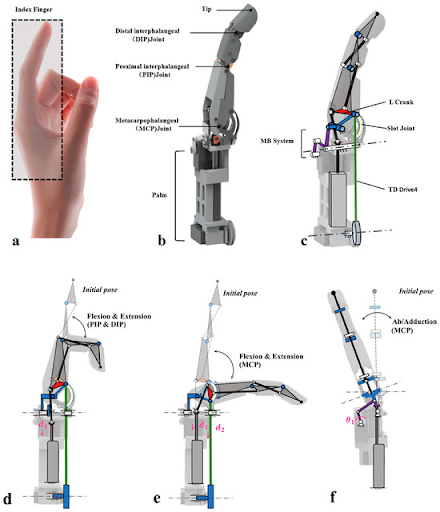
The third detail : If the joint problem is actually a larger-diameter pivot, a thin-section bearing may be a better solution than a standard radial bearing because it saves space and weight while keeping the profile slim. If the problem is really inside a strainwave actuator, a flexible bearing may be the correct part. But if the problem is a true finger knuckle with just a few millimeters to work with, a miniature deep-groove bearing is usually the answer.
This is also where engineering support matters. Support does not stop at what appears in the standard catalog: special dimensions, loads, speeds, lubricant decisions, and environmental conditions can all be discussed, and custom design help is available when the application is demanding enough to need it. That is especially useful in humanoid hands, where the bearing choice is usually tied to the actuator, housing stiffness, contamination risk, and assembly method all at once.
FAQ
What bearing type is used most often in a humanoid finger joint?
In most true finger knuckles, the starting point is a miniature deep-groove ball bearing. It fits very small housings, supports radial load plus light axial load, and keeps friction low enough for repeatable finger motion. That is why PIB’s robotics consistently points miniature bearings toward finger-joint duty.
Should a humanoid finger use an open, shielded, or sealed bearing?
Use the environment to decide. Open bearings make sense when the joint is well enclosed and low drag matters most. Shielded bearings are often the sweet spot for enclosed fingers because they add protection with little friction penalty. Sealed bearings give more contamination resistance, but they also may add drag depending upon the amount of inner ring contact.
When is a spherical plain bearing a better choice than a miniature ball bearing?
When the mechanism is really a pivoting linkage rather than a clean rolling knuckle. If the joint oscillates, moves slightly off-angle, or needs misalignment capability without constant lubrication attention, a PTFE-lined spherical plain bearing can be specified..
Are crossed roller bearings better because they are stiffer?
Not automatically. Crossed rollers are excellent bearings, but they are built for compact high-rigidity rotary joints that carry radial, thrust, and moment loads together. PIB’s current crossed-roller category starts at larger bore sizes than the miniature type, which is why they usually make more sense in wrist, palm, or larger thumb structures than in tiny finger knuckles.
Can PIB help if the joint needs a special size, lubricant, or nonstandard configuration?
Yes. PIB’s site specifically calls out engineering support, custom design assistance, and the ability to discuss special dimensions, loads, speeds, and operating environments. It also notes a worldwide sourcing network for hard-to-find bearings, which is useful when a humanoid-hand design is close to standard but not quite catalog-clean.
Find the Right Bearing in the PIB Sales Online Catalog
PIB’s online catalog already gives designers lots of information for miniature ball bearings, spherical plain bearings, thin-section bearings, crossed roller bearings, flexible bearings, and more. Users can narrow by bore, width, material, precision, and closure type. If the exact answer is not obvious, PIB also offers engineering support, custom-design help, and hard-to-find sourcing through its broader supply network. PIB represents NMB as its primary miniature bearing supplier for Humanoid Robotic finger joint applications. PIB has stock.
Visit the PIB online catalog or give us a call at (800) 228-8895 to get expert help with your order.