Your cart is empty
 Short Rigid Couplings
 Controlflex Couplings
 Jaw Couplings
 Oldham Couplings
 Bearing Locknuts – TCN
 Double Wide Shaft Collars
 Heavy Duty Shaft Collars
 International Series Shaft Collars
 Keyed Shaft Collars
 Mountable Shaft Collars
 Quick Clamping Shaft Collars
 Set Screw Shaft Collars
 Thin Line Shaft Collars
 Threaded Shaft Collars – Pacific International Bearing Products
 Two-Piece Shaft Collars
 Friction Bearing Universal Joints
 Needle Bearing Universal Joints

Robotics
Purpose-Driven Humanoids: Why Advanced Motion Components Matter
06 June, 2025
22 min read
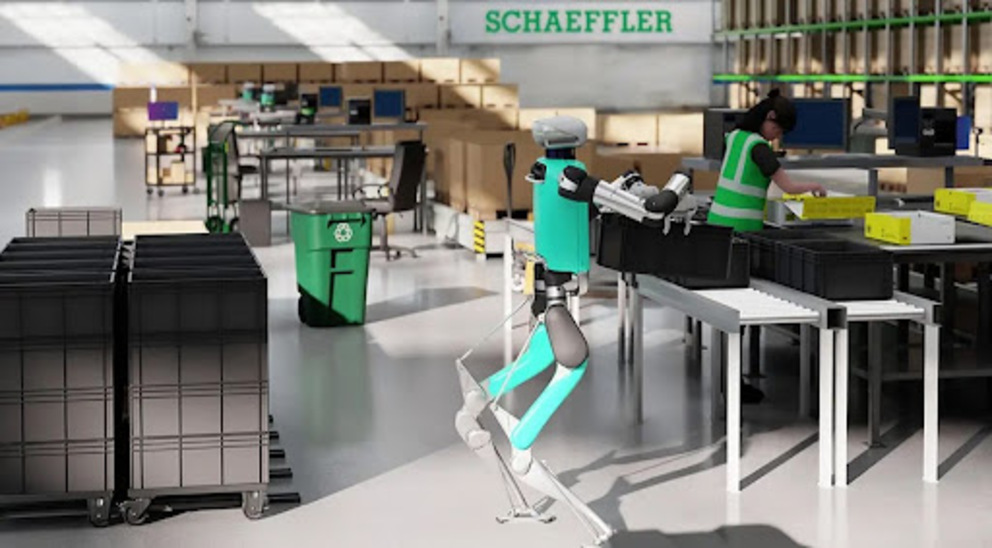
Humanoid robots are breaking new ground in industries from manufacturing to healthcare, taking on tasks that once seemed impossible. In humanoid robotics, motion components such as high-precision linear guides and advanced bearings play a critical role in replicating human-like movements reliably. The growing adoption of humanoid robots “would not be possible without advanced motion components that allow them to perform tasks by replicating human motion”.These components provide the precision, durability, and integration capabilities needed for robots to achieve smooth, human-like motion and operate in real-world environments. This article explores how cutting-edge linear guides, crossed roller bearings, and other rotary motion components empower humanoid robots – and why partnering with experts at Pacific International Bearing Sales Inc. can make all the difference in designing a high-performance humanoid.
Key Takeaways
- Humanoid robots need different motion components for different kinds of movement. High-rigidity rotary joints, compact linear axes, and articulating linkages do not place the same demands on a bearing or guide.
- Crossed roller bearings are a strong fit for compact rotary joints because one bearing can support radial, axial, and moment loads while maintaining high rigidity.
- Miniature linear guides are better suited to short, controlled linear travel such as grippers, finger mechanisms, and compact sliding axes.
- Spherical plain bearings and rod ends are useful where a linkage needs to tolerate angular misalignment or oscillating motion, while cam followers work well when a mechanism needs rolling contact against a track or cam.
- Clearance, preload, mounting stiffness, lubrication, and contamination protection can affect positioning and friction just as much as the nominal bearing type.
- The best component is the one matched to the actual motion path, load direction, stiffness requirement, environment, and maintenance strategy of the joint.
Humanoid Tasks Demand Precision and Stability
Humanoid robots perform various movements that mimic human motion. Each type of motion – whether a major joint rotation or a fine linear slide – requires components optimized for that task. Below, we examine a few key motion elements in humanoids and the motion components best suited for each:
Hip, Shoulder, Elbow, or Wrist Joints – Crossed Roller Bearings
There may be no more important component in humanoid robot joints than the crossed roller bearing (CRB). These bearings consist of cylindrical rollers arranged in alternating orientations (each roller is crossed at 90° relative to the next) between an inner and outer ring. This unique geometry means a single compact bearing can simultaneously support radial loads, axial loads (thrust in both directions), and moment (tilting) loads. The result is exceptional stability and rotational accuracy in a small package – exactly what high-torque humanoid joints need.
For example, in a robot’s hip or knee actuator, a crossed roller bearing handles the complex loads when the leg swings and supports weight. Because the rollers make line contact with the raceways (rather than point contact as in ball bearings), deformation under load is minimized. This gives CRBs very high rigidity and minimal play, ensuring precise, smooth joint motion even under heavy loads. A typical full-size humanoid robot might use 14–20 crossed roller bearings in its various joints (hips, shoulders, elbows, wrists, etc.) to achieve human-like articulation.
To illustrate the range of crossed roller bearings available, Table 1 compares a few IKO CRB bearings. Notably, the IKO CRBH series (High Rigidity Type Crossed Roller Bearings) provides slim bearings that are easy to integrate into joint designs. For instance, IKO CRBH208AUU is a high-rigidity crossed roller bearing with a 20 mm bore and only 8 mm width – ideal for a compact wrist or elbow joint. Larger sizes in the CRBH series can handle even higher loads for use in major axes like hips or shoulders.
| Part Number (IKO CRBH Series) | Inner Diameter × Outer Diameter × Width (mm) | Dynamic Load Rating (N) | Static Load Rating (N) | Typical Application in Humanoid Robot |
|---|---|---|---|---|
| CRBH208AUU (High Rigidity) | 20 × 36 × 8 mm | 2,910 N | 2,430 N | Compact joints (wrist, small elbow) – slim profile fits tight spaces while supporting multi-axis loads. |
| CRBH4010AUU (High Rigidity) | 40 × 65 × 10 mm | 8,610 N | 10,600 N | Medium joints (elbow, knee) – high load capacity and rigidity for mid-sized actuators. |
| CRBH7013AUU (High Rigidity) | 70 × 100 × 13 mm | 20,100 N | 27,700 N | Major joints (hip, shoulder) – handles heavy combined loads with excellent accuracy and stiffness. |
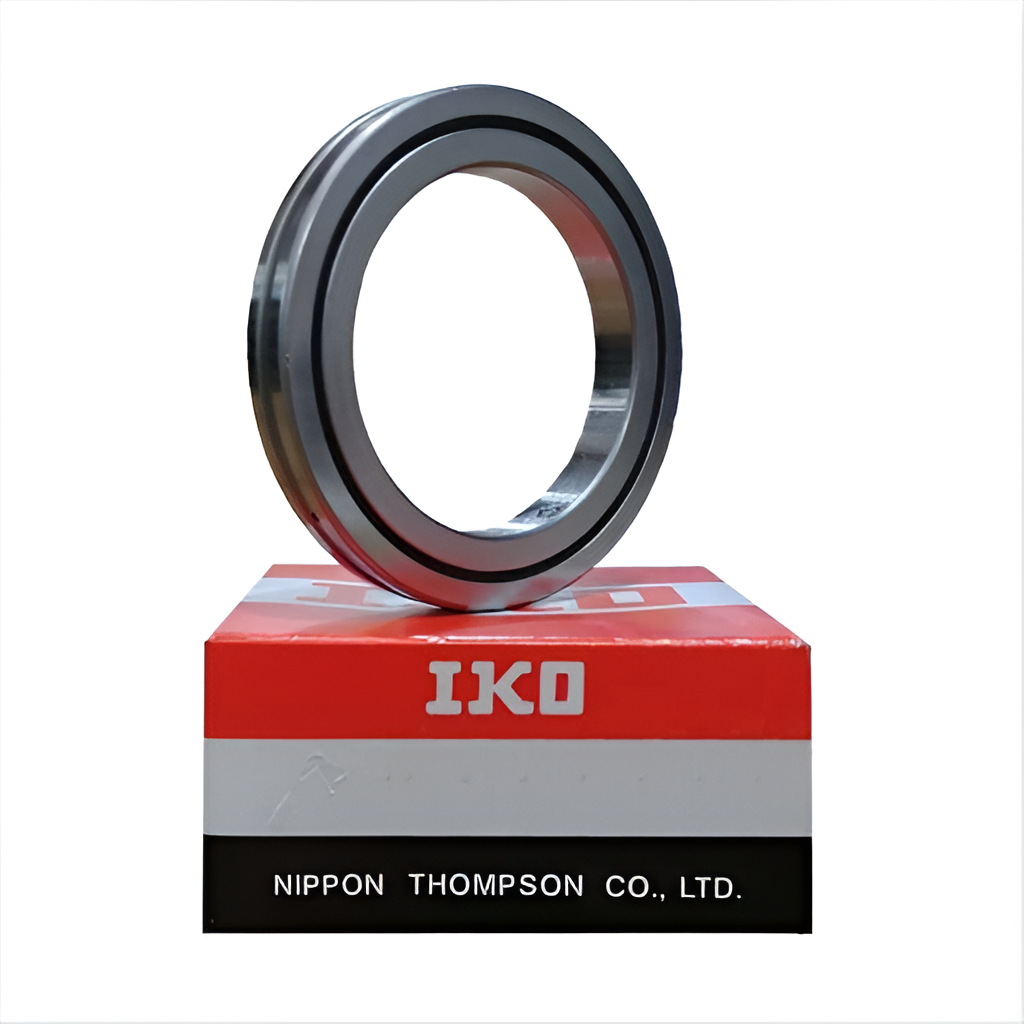
Crossed roller bearings like the above combine high load capacity, precision, and rigidity. Using these IKO crossed roller bearings in humanoid joint actuators ensures smooth rotation with minimal deflection, which is critical for balance and fine motion control. Figure: An IKO crossed roller bearing (CRBH series) provides a compact rotational joint that can support radial, axial, and moment loads simultaneously. Its robust construction is well-suited for humanoid robot hip and shoulder joints.
Why Backlash and Joint Stiffness Matter in Humanoid Actuators
A precise encoder cannot fully compensate for a joint that moves before the load follows. Internal clearance, bearing deflection, housing flexibility, and compliance in the surrounding actuator all contribute to lost motion. In a humanoid shoulder, hip, knee, or wrist, that can show up as small positioning errors, oscillation during direction changes, or a joint that feels less controlled under load.
Crossed roller bearings are useful in these joints because their geometry provides high rigidity in a compact envelope. Where the bearing design allows it, reduced clearance or a controlled preload can further limit play and improve rotational accuracy. The tradeoff is that more preload also increases rolling resistance and internal loading, so “more preload” is not automatically better.
Mounting stiffness matters too. A high-precision bearing installed in a flexible or distorted housing cannot deliver the same joint behavior it shows in a catalog. The bearing, housing, shaft, fasteners, and actuator structure need to be treated as one stiffness stack when the goal is predictable motion under changing load.
Linear Motion in Grippers and Limbs – Miniature Linear Guides
Not all movements in a humanoid are rotary; many are linear motions, such as the opening and closing of fingers or extending a limb. For controlled linear motion, miniature linear guides (also called linear motion rolling guides or slide rails) are ideal. These guides use circulating ball bearings or rollers running in tracks to allow smooth, precise sliding movement with minimal friction.
A common example in humanoids is the finger mechanism in robotic hands or grippers. Each “finger” often uses a tiny linear guide to slide segments, mimicking the way our fingers extend and curl. These linear guides must be extremely compact yet provide high precision and sufficient load capacity to grip objects firmly without backlash. They also need to operate smoothly to achieve the delicate touch required for handling fragile objects.
IKO’s Linear Way L and Linear Way ML series guides are well-suited here. The IKO LWL series carriages, for instance, come in very small sizes. One such model is IKO LWL9B, a miniature linear guide block that runs on a 9 mm wide rail. Despite its small size, the LWL9 B uses two rows of steel balls in four-point contact with the rail, giving it stability and accuracy under load. For slightly larger linear motions – say a sliding mechanism in an arm or the neck – a bigger model like LWL12B or LWL15B can be used, which provides higher load ratings and rigidity while still being compact. Notably, IKO’s ML Series miniature guides include built-in C-Lube lubrication technology and come in some of the industry’s smallest sizes, with track rail widths as small as 1 mm, enabling incredibly tiny linear slides for micro-motion in humanoids.
In addition to size options, linear guides can be chosen in standard or long-block versions. Longer blocks or dual-carriage arrangements increase stiffness for applications like a humanoid’s leg extension or torso slider, where a longer stroke and higher moment capacity might be needed. Linear guides can even be mounted vertically in a robot’s neck joint to allow the head to raise, lower, or tilt – useful for a humanoid to “look” above obstacles.
Linear Guide Model (IKO) | Rail Width × Height (mm) | Dynamic Load Rating (N) | Static Load Rating (N) | Medium sliders (e.g., wrist extension, neck tilt) – higher load miniature guide for slightly larger actuators. |
|---|---|---|---|---|
| LWL9B (Linear Way L) | 9 mm × 6 mm rail cross-section, 10 mm block height | 1,810 N | 2,760 N | Small sliders (e.g. finger mechanisms, small grippers) – ultra-compact guide for precise finger motion. |
| LWL12B (Linear Way L) | 12 mm × 8 mm rail cross-section, 13 mm block height | 3,330 N | 4,290 N | Medium sliders (e.g. wrist extension, neck tilt) – higher load miniature guide for slightly larger actuators. |
| LWL15B (Linear Way L) | 15 mm × 10 mm rail cross-section, 16 mm block height | 4,980 N | 6,490 N | Larger linear motion (e.g. arm extension, torso lift) – robust miniature guide for heavy-duty precision slides. |
Miniature linear guides offer smooth, controlled linear motion in a very compact form factor. The above IKO guides cover a range from tiny (9 mm width) to larger miniatures (15 mm width), accommodating different force requirements. Using linear guides for humanoid robots ensures that sliding joints like grippers operate with high accuracy and repeatability.
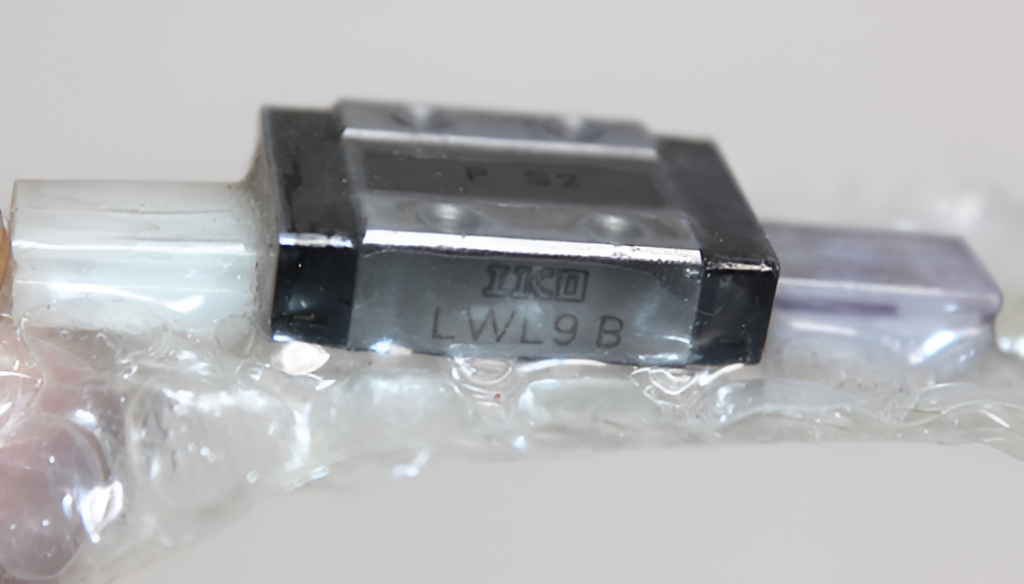
An IKO LWL9B miniature linear guide block (shown on its rail) is one example of a tiny linear motion component that can be used in humanoid robot fingers or other small linear axes. Despite its size, it can carry significant loads with precision.
How Preload Changes a Miniature Linear Guide
Miniature linear guides are available with different internal clearances and preload levels. A light preload can reduce free movement between the carriage and rail and increase stiffness, which helps when a finger, gripper, neck slide, or compact actuator has to reverse direction without a noticeable dead zone.
The same preload also raises motion resistance. In a small mechanism, that matters because the actuator has limited torque and every source of friction contributes to heat and power demand. A heavily preloaded guide may feel rigid on the bench but can make a lightly loaded axis harder to drive than necessary.
Block length, number of carriages, rail spacing, and mounting accuracy should therefore be considered together with preload. The objective is not simply to eliminate all clearance; it is to reach the stiffness and repeatability the mechanism needs while keeping travel smooth and predictable over the full stroke.
Limb Pivot Stabilization – Spherical Plain Bearings and Cam Followers
In addition to the main joint bearings and linear slides, humanoid designs often require stabilizing links or pivots that allow limited rotation with high load support. For instance, many humanoid robots have a supporting link or rod behind the ankle or between other linkages – sometimes called a “dog-bone” linkage – to maintain structure and balance. These pivots must allow a certain range of angular motion (to accommodate misalignment or shock) while carrying the weight of the robot.
For such applications, spherical plain bearings are commonly used. A spherical plain bearing (also known as bushings or a rod-end when in a housing) features a spherical inner ring that can swivel inside a cylindrical outer ring. This design permits angular misalignment between connected parts. In a humanoid’s foot, for example, a spherical bearing at the joint where a stabilizer rod meets the foot allows the foot to tilt and rotate slightly relative to the leg, similar to how our ankles flex, without binding. Spherical plain bearings are made of robust metal-on-metal or metal-on-PTFE combinations and can support very high radial and axial loads. They are ideal for heavy static or oscillatory loads and shock absorption in pivots, albeit they operate with sliding friction (no rolling elements).
Another type of rotary bearing useful in certain humanoid linkages is the cam follower (also known as a roller follower). Cam followers are essentially heavy-duty needle roller bearings integrated into a stud or yoke that can be easily mounted to machine parts. The IKO CFE series cam followers, for example, have an eccentric stud, meaning the stud’s mounting collar is offset – this allows adjustment of the position of the roller relative to the track or cam it contacts. In humanoid robots, cam followers might be used in mechanisms that convert rotary motion to linear motion or in joints that require a rolling contact to reduce friction. For instance, a cam follower could serve as a rolling pivot at a knee or elbow linkage where a lever slides over it, or as part of a suspension or balancing mechanism in the foot. The model IKO CFE10-1UUR is a metric eccentric cam follower with a 10 mm stud diameter (M10 thread) and a 26 mm outer roller diameter. It features built-in seals (designation “UU”) and a crowned outer ring (“R” for reducing edge stress) – well-suited for handling intermittent rotation or oscillation under load. Cam followers provide lower friction than plain bushings because of the rolling needle elements, though they constrain motion to one axis (they don’t allow the multi-directional tilt that spherical bearings do).
To compare these stabilization components, Table 3 gives some specifications. Note the difference in load capacities: spherical plain bearings can support extremely high static loads due to their large contact area, whereas cam followers support high dynamic loads and offer smoother rolling motion for continuous operation.
Component Type & Example | Key Dimensions | Dynamic Load Capacity (N) | Static Load Capacity (N) | Typical Use in Humanoid Robots |
|---|---|---|---|---|
| Spherical Plain Bearing (e.g. IKO GE10 or rod-end PHS10, 10 mm bore) | 10 mm bore, steel-on-steel spherical joint | ~9,000 N (dynamic)¹ | ~50,000 N (static)¹ | Misalignment joints and link rods (e.g., ankle linkage, hip stabilization rod) – allow angular tilt and rotation under very heavy loads (excellent for absorbing shocks and maintaining alignment). |
| Cam Follower Bearing (IKO CFE10-1UUR, eccentric stud type) | 26 mm roller OD on 10 mm stud (M10×1.25 thread) | 5,430 N (dynamic) | 6,890 N (static) | Rolling pivot or track follower (e.g., knee lever roller, adjustable support joint) – provides a low-friction rotation point for one-axis motion, with a stud for easy mounting in compact mechanisms. |
Note: Spherical plain bearing load ratings are very high in static scenarios (supporting weight with limited motion). The approximate values above illustrate a typical 10 mm bore spherical joint’s capacity. In practice, dynamic oscillating loads for spherical bearings are limited by lubrication and wear considerations. Always consult detailed catalogs for precise values.
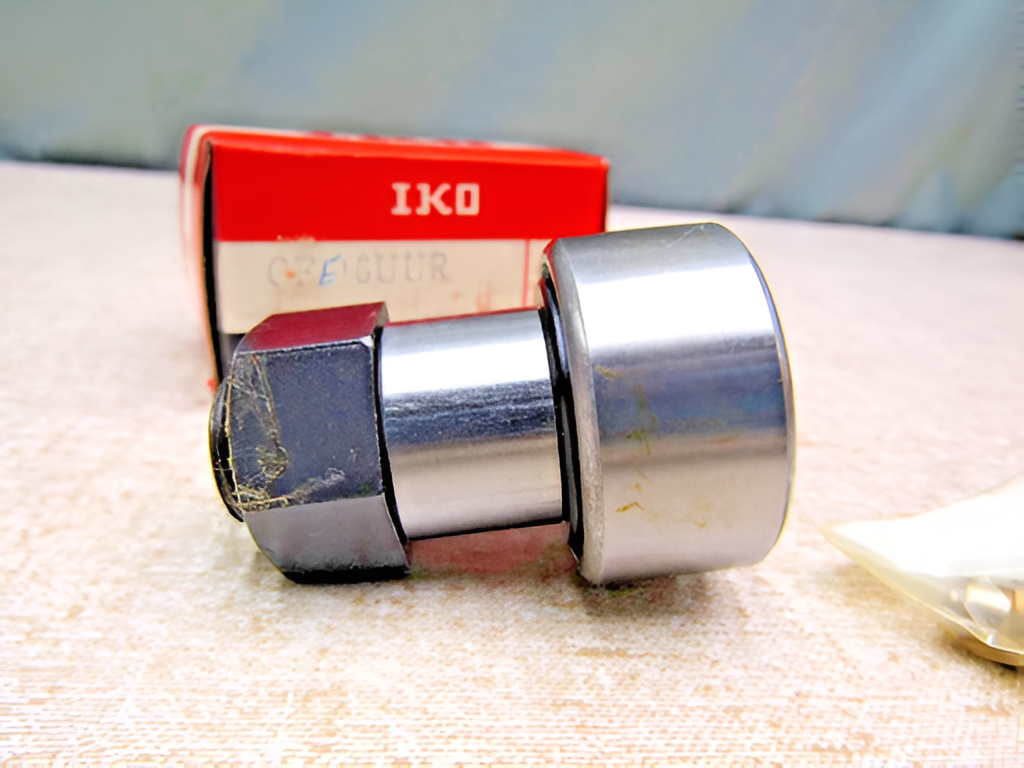
An IKO eccentric cam follower (CFE series) provides a robust rotary bearing with an integrated stud. Cam followers like this can serve as adjustable pivot points or rolling supports in humanoid linkages, complementing spherical plain bearings in applications where rotation is primarily in one plane.
How to Match the Motion Component to the Joint
The motion path should be the first filter in component selection. A humanoid robot may use several bearing and guide families in the same limb because each joint is doing a different mechanical job.
- For a compact rotary joint that must resist radial, axial, and overturning loads, start with a high-rigidity rotary bearing arrangement such as a crossed roller bearing.
- For short, precise linear travel, a miniature linear guide is usually a more direct solution than trying to convert a rotary bearing into a sliding mechanism.
- For an oscillating linkage that must tolerate angular misalignment, a spherical plain bearing or rod end can be more appropriate than a precision rolling bearing.
- For a lever, cam, or track where one surface needs to roll against another, a cam follower provides a compact rolling contact with a mounting stud or yoke.
After the motion type is clear, the next checks are load direction, peak load, stiffness, speed, allowable friction, mounting space, contamination exposure, lubrication, and service access. That sequence keeps the selection tied to what the joint actually does rather than to a preferred component family.
Understand the Operating Environment and Requirements
While selecting the right bearing or guide is essential, it’s equally important to consider the robot’s operating conditions early in the design. Humanoids may be deployed in environments too hazardous or demanding for humans, such as disaster areas, outdoors in varying weather, or in industrial settings with dust or chemicals. Each motion component should be chosen not only for load and size specs but also for its durability in the expected environment:
- Temperature and humidity: If the humanoid will face extreme cold or heat, or high humidity, components like linear guides and bearings might need special materials or lubricants. For example, stainless steel linear rails resist corrosion, and high-temperature grease can keep a joint bearing running smoothly in heat.
- Contamination exposure: Dust, sand, or debris can impair moving parts. Sealed bearings (e.g., the “UU” double seals on IKO CRBH208AUU or CFE10-1UUR) and wipers or covers on linear guides are critical for keeping abrasives out. In very dirty environments, spherical bushings might be chosen over rolling bearings since they have no small moving elements to jam (though they might wear faster without lubrication).
- Maintenance access: Some components come in maintenance-free versions (like IKO’s C-Lube linear guides that automatically lubricate the rolling elements). In a humanoid that is expected to operate for long periods without human intervention, such self-lubricating or sealed-for-life options are highly beneficial.
- Shock and impact: Humanoids that walk or carry loads experience shock loads (for instance, foot impact on the ground). Using high-capacity bearings (as shown in the tables above) with some safety margin helps ensure longevity. Spherical joints and cam followers can also be selected in heavy-duty versions to withstand intermittent shock forces.
Because there are many such considerations, it pays to collaborate with motion component experts during the design phase. Pacific International Bearing works closely with manufacturers like IKO International to help robot designers optimize component selection and protective features for the intended environment. Whether it’s choosing a high-rigidity crossed roller bearing for a shoulder joint, a miniature linear guide for a finger, or a durable cam follower for an ankle linkage, making the right choice early can dramatically improve your humanoid robot’s performance and reliability.
Frequently Asked Questions
What bearings are commonly used in humanoid robot joints?
Crossed roller bearings are commonly considered for compact, high-rigidity rotary joints such as shoulders, hips, knees, elbows, and wrists. Other locations may use miniature ball bearings, spherical plain bearings, rod ends, cam followers, or linear guides depending on whether the motion is rotary, oscillating, or linear.
Why are crossed roller bearings useful in humanoid robots?
A crossed roller bearing can support radial, axial, and moment loads in one compact bearing while maintaining high rigidity. That combination is useful in robot joints where space is limited but the actuator still has to control position under complex loading.
Do humanoid robots use linear guides?
Yes. Linear guides can be used wherever the mechanism needs controlled straight-line travel, including grippers, finger mechanisms, compact slides, neck motion, or other translating axes. The required guide size, carriage length, preload, and accuracy depend on load, stroke, stiffness, and packaging.
When is a spherical plain bearing a better choice than a rolling bearing?
A spherical plain bearing is a good candidate when a linkage needs angular misalignment capability, oscillating motion, or high load support without continuous high-speed rotation. It trades the low rolling friction of a ball or roller bearing for a sliding interface that can accommodate articulation more naturally.
How do preload and clearance affect humanoid joint performance?
Clearance can introduce free movement before the joint load follows the actuator, while preload can reduce that play and increase stiffness. Too much preload, however, increases friction and internal loading. The correct setting depends on the required accuracy, torque, speed, temperature, and structural stiffness of the joint.
What should be checked before selecting a motion component for a humanoid robot?
Start with the required motion: rotary, linear, oscillating, or rolling contact. Then check load direction and magnitude, stiffness, speed, space, mounting accuracy, allowable friction, shock, contamination, lubrication, and maintenance access. The surrounding structure matters because even a high-precision component cannot compensate for a weak or distorted mounting interface.
Please contact us at [email protected] or call us at 1-800-228-8895.