Your cart is empty
 Short Rigid Couplings
 Controlflex Couplings
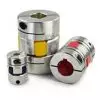 Jaw Couplings
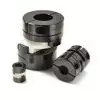 Oldham Couplings
 Bearing Locknuts – TCN
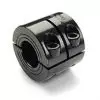 Double Wide Shaft Collars
 Heavy Duty Shaft Collars
 International Series Shaft Collars
 Keyed Shaft Collars
 Mountable Shaft Collars
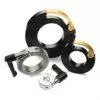 Quick Clamping Shaft Collars
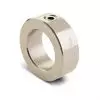 Set Screw Shaft Collars
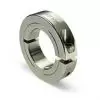 Thin Line Shaft Collars
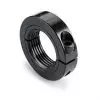 Threaded Shaft Collars – Pacific International Bearing Products
 Two-Piece Shaft Collars
 Friction Bearing Universal Joints
 Needle Bearing Universal Joints
Bearings
Types of Bearings Used in Drones & UAVs – What They Actually Do
06 November, 2026
23 min read
A practical guide to matching bearing design to propulsion, payload, actuation, landing gear, and auxiliary systems.
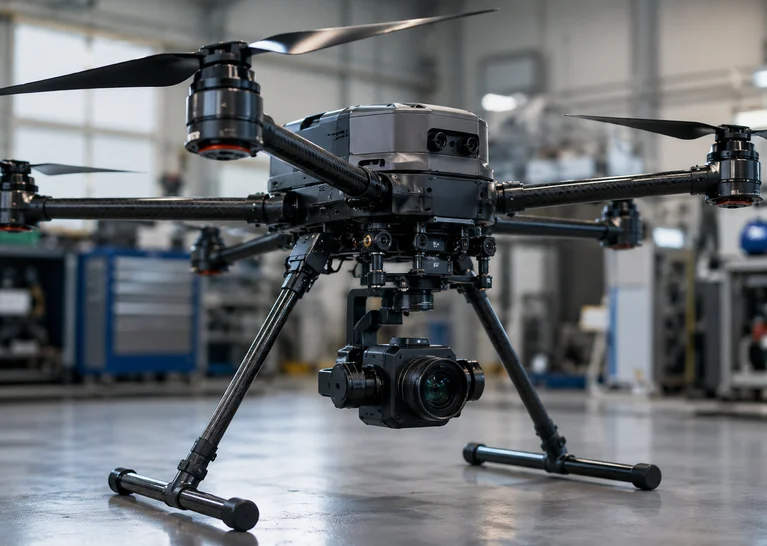
A drone does not have one “drone bearing.” It has a collection of rotating and oscillating joints, and each one asks the bearing to do something different. A propulsion motor needs low-friction shaft support at high speed. A camera gimbal needs low torque and repeatable positioning. A retract actuator or landing-gear link may barely rotate at all, but it still has to carry shock, misalignment, and reversing load without developing play.
That distinction matters because bearings that look interchangeable on a drawing can behave very differently in service. Pacific International Bearing Sales works with engineers and maintenance teams that need the bearing arrangement to match the real load path, speed, available space, environment, and service interval. PIB focuses on what the bearing has to do in the assembly first, then on size and part-number matching.
This article breaks down the bearing types most commonly considered in drones and UAVs, where they fit, what they actually contribute, and what tends to happen when the wrong design is used.
Key Takeaways
Miniature deep groove ball bearings are the default choice for many electric motor shafts because they combine high-speed capability, low friction, compact size, and support for radial load plus moderate axial load in both directions.
Angular contact bearings are used when axial load, stiffness, or controlled preload matters more than the simplicity of a deep groove bearing.
Thin-section, four-point contact, and crossed roller bearings are most useful in large-diameter, space-limited payload or pointing axes where stiffness and moment-load control matter.
Needle roller, cylindrical roller, tapered roller, spherical plain, and rod-end bearings belong in higher-load gearboxes, pivots, links, and landing-gear mechanisms – not automatically in high-speed propeller motors.
Hybrid ceramic is a material/configuration option, not a separate load geometry. It can help in selected high-speed or electrically sensitive motor positions, but it does not replace correct fits, lubrication, preload, or load analysis.
The right bearing improves motion quality because it controls shaft position, friction, runout, clearance, and load transfer. The wrong one shows up as heat, noise, vibration, end play, binding, position drift, or repeated maintenance.
Where Bearings Actually Work in a Drone or UAV
The most useful way to understand drone bearings is to map them to the assembly they support. The same bearing family can work well in one node and be a poor choice in another because the speed, load direction, motion amplitude, and stiffness target are completely different.
| UAV location | What the bearing actually does | Typical bearing families |
| Propulsion motor | Keeps the rotor shaft centered at speed, carries radial magnetic/propeller loads, accepts the required axial load, and limits runout that would otherwise create vibration and heat. | Miniature deep groove; angular contact in higher-thrust or stiffness-critical arrangements; hybrid variants where justified |
| Propeller or rotor support | Supports the rotating hub or shaft and controls axial/radial position under thrust, maneuver, and gyroscopic loading. | Deep groove, angular contact, cylindrical/tapered roller on larger systems |
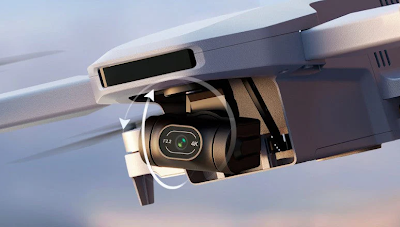
| Camera or sensor gimbal | Supports low-torque rotation while controlling radial, axial, and moment loads so the payload can point and return repeatably. | Miniature ball, thin-section, angular contact pairs, four-point contact, crossed roller |
| Tilt or transition mechanism | Carries actuator and aerodynamic loads through a joint while maintaining stiffness and alignment during limited-angle movement. | Angular contact, thin-section, crossed roller, spherical plain/rod ends in linkages |
| Gearbox or reduction stage | Supports gears and shafts, controls mesh alignment, and carries the radial and axial forces generated by the gear geometry. | Deep groove, angular contact, cylindrical roller, needle roller, tapered roller |
| Landing gear / wheel / link | Supports wheel rotation or low-speed articulation and accommodates impact, oscillation, and possible misalignment. | Deep groove wheel bearings, needle roller, spherical plain, rod ends |
| Cooling fan, pump, auxiliary drive | Provides compact low-friction shaft support so thermal-management or fluid systems run without adding unnecessary power loss. | Miniature deep groove, specialty sealed ball bearings |
Bearing Types and Material Options for Drones and UAVs
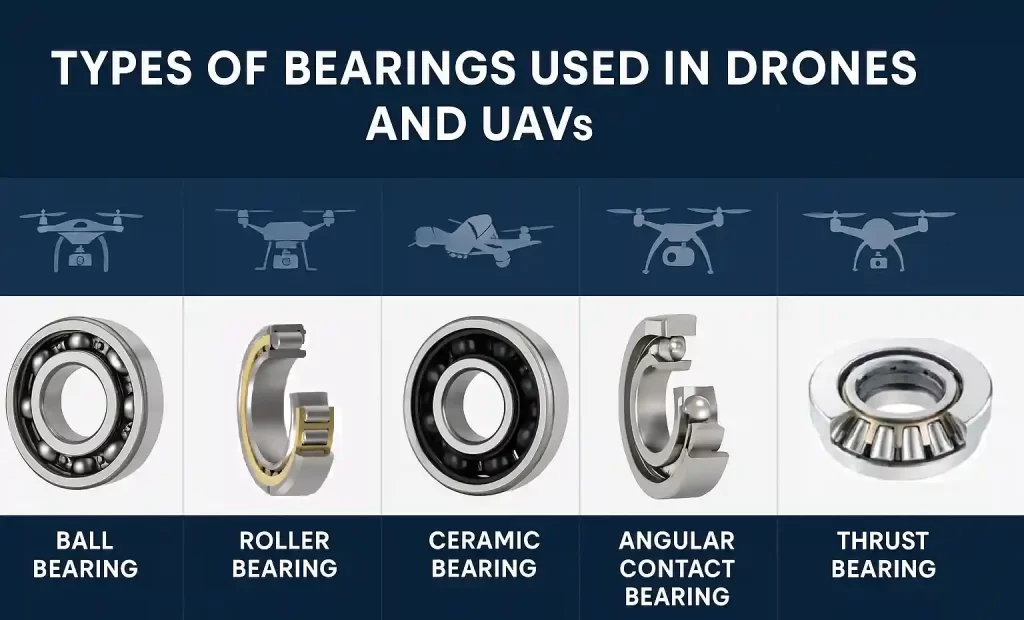
1. Miniature Deep Groove Ball Bearings: The Workhorse of Drone Motors
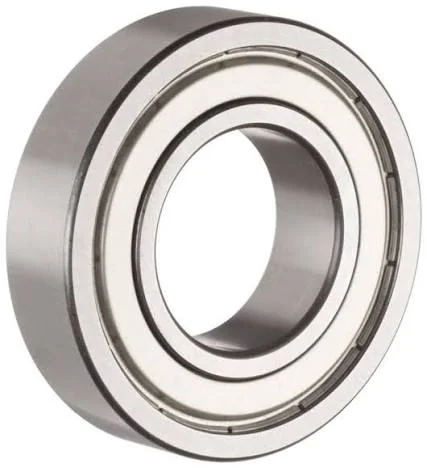
Single-row deep groove ball bearings are common in small electric machines because they are simple, compact, low-friction, and capable of high rotational speed. Their groove geometry lets them carry radial load and a useful amount of axial load in either direction, which makes them a practical fit for many brushless motor shafts and small auxiliary drives.
In a propulsion motor, the bearing is not there to create thrust or absorb vibration. Its job is to locate the rotor shaft, keep the air gap and propeller axis stable, and allow rotation with predictable torque. If the bearing develops excess internal clearance, raceway damage, contamination, or poor lubrication, the motor can show higher noise, rising temperature, shaft wobble, or vibration that the flight-control system then has to work around.
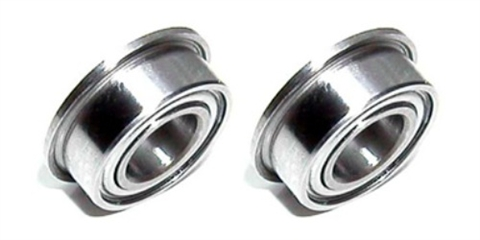
Sealed or shielded versions are often attractive for outdoor UAVs because they help retain lubricant and limit contamination. The tradeoff is that sealing adds torque and heat compared with an open bearing, so the seal type has to match the speed and contamination risk rather than being treated as a free upgrade.
2. Angular Contact Ball Bearings: When Axial Load and Stiffness Matter
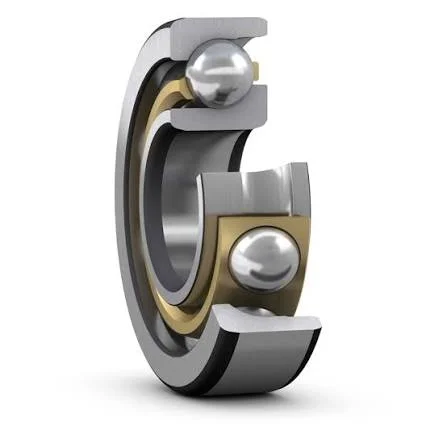
Angular contact ball bearings carry combined radial and axial load through a defined contact angle. A single bearing is directional for axial load, so UAV arrangements that need thrust capacity in both directions commonly use a pair. The pair can also be preloaded to reduce end play and increase stiffness.
That makes angular contact bearings useful in larger rotor supports, thrust-heavy drive arrangements, gearboxes, and precision payload axes. They are not automatically better than deep groove bearings. They require correct orientation, fits, preload, and thermal allowance. Excess preload raises friction and temperature; too little preload or an unsuitable arrangement allows axial movement and can reduce pointing accuracy or gear alignment.
3. Thin-Section Bearings: Large Bore Without a Large Envelope
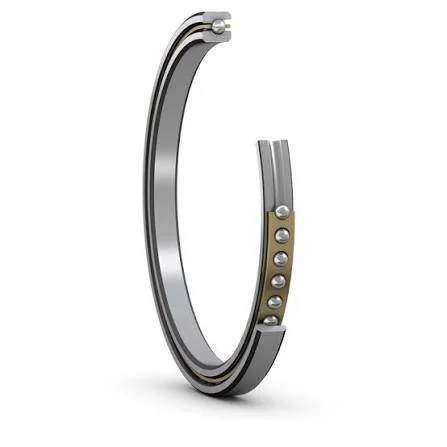
Thin-section bearings keep the radial cross-section small even as bore diameter increases. That geometry is useful in gimbals, sensor turrets, antenna drives, folding mechanisms, and other UAV assemblies that need a relatively large clear aperture or joint diameter without the weight and radial thickness of a conventional bearing.
Their value is packaging, not magic load capacity. The thin rings are more sensitive to housing distortion, shaft or housing roundness, and installation fits. A bearing that runs smoothly on a bench can develop torque variation after it is clamped into a distorted lightweight housing. Good thin-section design therefore includes the surrounding structure, not just the bearing catalog rating.
4. Four-Point Contact and Crossed Roller Bearings: Compact Moment-Load Control
Some payload turrets and pointing axes need one compact support to resist radial load, axial load, and overturning moment. Four-point contact ball bearings and crossed roller bearings are two ways to solve that problem. A four-point contact bearing uses a raceway geometry that can carry axial load in both directions and moment load in a single bearing position. Crossed roller bearings alternate roller orientation so one bearing can support multi-directional load with high rigidity.
These designs make sense when stiffness and position control are more important than very high rotational speed. They are common candidates for pan-tilt, radar, EO/IR, LiDAR, and other stabilized payload axes. The wrong preload or mounting distortion can increase torque and create stick-slip, which shows up directly as poor pointing smoothness.
5. Needle Roller and Cylindrical Roller Bearings: High Radial Capacity in the Right Place
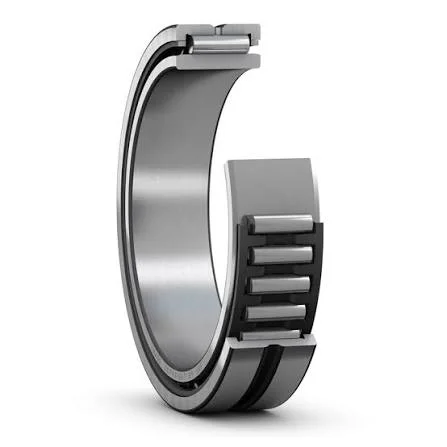
Roller bearings carry load through line contact rather than point contact. Needle roller bearings use long, small-diameter rollers and are especially useful when radial space is limited but the joint needs substantial radial capacity. Cylindrical roller bearings provide high radial capacity and can be used in larger gearboxes, rotor supports, or drive systems where the load and stiffness justify the added mass and packaging.
These are not the first choice for a small high-speed outrunner motor. Their strengths show up in compact pivots, reduction stages, and higher-load UAV hardware. They also demand suitable raceway hardness, alignment, lubrication, and retention. A drawn-cup needle bearing running directly on a shaft, for example, depends on the shaft surface acting as part of the bearing system.
6. Tapered Roller Bearings: Combined Load for Heavier UAV Drivetrains
Tapered roller bearings are built to carry radial and axial load together and can provide high stiffness when used in opposed arrangements. In drones and UAVs, they are more relevant to larger gearboxes, wheel hubs, rotor supports, or heavy mechanical transmissions than to small multirotor motors.
Their penalty is size, mass, and the need to set end play or preload correctly. Where the load case justifies them, tapered rollers can keep shafts and gears stable under combined load. Where it does not, they can add more friction, weight, and assembly complexity than the system needs.
7. Spherical Plain Bearings and Rod Ends: For Oscillation and Misalignment
Spherical plain bearings and rod ends solve a different problem from motor bearings. They are intended for joints that oscillate, articulate, or need to tolerate angular misalignment while carrying load. Typical UAV uses include landing-gear links, actuator linkages, tilt mechanisms, control surfaces on fixed-wing UAVs, and other joints where the motion is limited rather than continuous high-speed rotation.
Self-lubricating lined versions can reduce routine lubrication where access is difficult, but the allowable wear, shock load, oscillation angle, temperature, contamination, and liner system still have to match the application. The key benefit is controlled articulation without forcing a linkage to bend or side-load another component.
8. Thrust Bearings: Useful, but Usually Part of a Bearing Arrangement
Thrust ball or roller bearings are designed primarily for axial load. They can appear in specialized vertical shafts, geared mechanisms, or actuator stacks, but they do not normally replace the radial-support bearing in a motor. Most UAV shafts need both radial location and axial control, so a dedicated thrust bearing is typically combined with another bearing type or replaced by an angular contact arrangement when packaging allows.
9. Hybrid Ceramic Bearings: A Material Choice, Not a Different Load Geometry
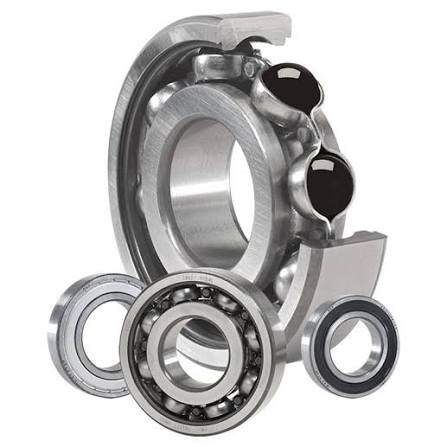
Hybrid bearings use steel rings with ceramic rolling elements, typically silicon nitride. The ceramic balls are lighter and electrically insulating compared with steel balls, and they can reduce rolling-element centrifugal effects at high speed. Those properties can be useful in selected high-speed electric machines or where electrical discharge through a bearing is a concern.
A hybrid bearing does not fix an overloaded, misaligned, poorly lubricated, or incorrectly preloaded arrangement. In many drones, a well-selected all-steel miniature bearing is the better cost and performance choice. Hybrid construction earns its place when the operating conditions create a real benefit, not simply because the aircraft is high performance.
What the Wrong Bearing Looks Like – and What Changes with the Right One
| Mismatch | What happens in service | What improves with the correct choice |
| Too little axial capacity | Shaft end play grows, rotor or gear position shifts, and contact patterns become less stable. | An angular contact or properly arranged bearing set controls axial position and stiffness. |
| Too much preload | Torque and temperature rise; lubricant life can fall and the motor or gimbal draws more power. | Correct preload removes unwanted play without creating unnecessary friction. |
| Bearing too lightly sealed for environment | Dust, spray, or debris reaches the raceways and produces noise, wear, and roughness. | Appropriate seals/shields and lubricant keep the bearing cleaner for the intended service interval. |
| Bearing too heavily sealed for speed | Seal drag adds heat and power loss, especially in small high-speed motors. | A lower-torque closure or open/shielded arrangement balances speed with contamination protection. |
| Thin-section bearing mounted in a distorted housing | Running torque varies around the rotation and pointing motion can become sticky or inconsistent. | Stiffer, rounder mounting features preserve raceway geometry and smooth torque. |
| Rigid rolling bearing used where joint misalignment is unavoidable | Edge loading, binding, or side load is pushed into the linkage and adjacent structure. | A spherical plain bearing or rod end accommodates angular movement while carrying the joint load. |
| General-purpose bearing used in a shock-loaded high-capacity pivot | Raceway indentation, clearance growth, and early play appear even though average speed is low. | A bearing family sized for static/shock load handles the real duty instead of the average motion. |
How to Select Bearings for a Drone or UAV
Bearing selection should start with the node in the aircraft, not with a favorite bearing family. The same UAV may need a high-speed miniature bearing in the motor, a preloaded thin-section bearing in the payload turret, a needle bearing in a compact pivot, and a lined spherical plain bearing in an actuator link.
| Selection factor | Questions to answer | Why it changes the bearing choice |
| Load direction and magnitude | How much radial, axial, and moment load is present? Is the peak load a landing shock, maneuver load, gear mesh force, or continuous thrust? | Determines bearing geometry, arrangement, size, and whether static capacity is as important as fatigue life. |
| Speed and duty cycle | Is the motion continuous high-speed rotation, slow positioning, short oscillation, or infrequent deployment? | Changes lubrication, cage, closure, heat generation, and whether rolling or plain bearing designs make sense. |
| Stiffness and runout | How much shaft movement, tilt, end play, or pointing error can the system tolerate? | Drives precision class, preload, bearing spacing, housing stiffness, and choice between single vs paired arrangements. |
| Space and weight | What bore is required, and how much radial/axial envelope is available? | May favor miniature, thin-section, needle, or integrated designs, but the surrounding structure must still be stiff enough. |
| Environment | Will the bearing see dust, spray, humidity, fertilizer, salt, fuel, or wide temperature changes? | Determines materials, corrosion protection, seals/shields, grease, and maintenance interval. |
| Fits and thermal behavior | Which ring rotates? What are the shaft/housing materials and temperatures? | Incorrect fits can create creep, unwanted preload, looseness, or ring distortion as the assembly heats and cools. |
| Maintenance strategy | Can the bearing be relubricated or replaced easily, or must it operate sealed for the service interval? | Changes lubricant quantity, closure type, liner selection, and the value of maintenance-free designs. |
Precision, Clearance, and Preload Matter More Than the Label on the Box
Two bearings with the same nominal dimensions can produce very different results when internal clearance, runout, lubricant, seal torque, and fit are different. This is especially visible in drone motors and payload gimbals because the mechanisms are small and the control system can expose tiny changes in vibration or friction.
Internal clearance must leave room for the actual shaft and housing fits plus thermal expansion. A tight fit can reduce the installed clearance. If the inner ring runs hotter than the outer ring, the operating clearance can shrink further. In a high-speed motor, that can turn a bearing that felt fine at room temperature into a hot, high-torque bearing in flight.
Preload is useful when a gimbal or angular contact pair needs stiffness and zero perceptible end play, but preload should be treated as an engineered value. More preload is not more precision. Once preload exceeds what the application needs, it mainly adds friction, heat, and sensitivity to tolerance stack-up.
Seals, Lubrication, and Contamination Control
Outdoor drones live in dust, moisture, grass debris, spray, and sometimes corrosive chemicals. Bearing protection therefore has to be chosen with the operating environment in mind. Contact seals provide better exclusion but create more drag. Shields create less torque but are not intended to provide the same barrier. Open bearings offer the lowest closure drag but depend on a clean surrounding enclosure and a deliberate lubrication strategy.
Grease selection affects starting torque, high-speed temperature, noise, corrosion protection, and service life. Filling a small high-speed bearing with more grease than it needs can increase churning and heat. Underfilling or using an incompatible lubricant can leave the contacts poorly protected. For UAVs, the best lubrication strategy is the one matched to bearing speed, temperature, closure type, orientation, and required maintenance interval.
Frequently Asked Questions
What bearing type is most common in drone motors?
Miniature single-row deep groove ball bearings are common because they are compact, low friction, capable of high speed, and can support radial load plus moderate axial load in both directions. The exact bearing size, clearance, closure, and lubricant depend on the motor design.
Are angular contact bearings better for drones?
Only when the application needs their axial capacity, stiffness, or preload capability. A well-selected deep groove bearing is usually simpler for a small motor. Angular contact bearings become valuable when combined load and axial position control justify the more demanding arrangement.
Why are thin-section bearings used in gimbals?
They provide a large bore or support diameter with a small radial cross-section, which saves space and weight around cameras, sensors, wiring, or optical apertures. Their thin rings make housing stiffness and mounting accuracy especially important.
Do ceramic bearings make a drone fly longer?
Not automatically. Hybrid ceramic bearings can reduce rolling-element mass and have useful high-speed and electrical properties, but the real system benefit depends on speed, load, lubrication, motor design, and the rest of the bearing arrangement.
What bearings are used in UAV landing gear and actuator links?
Wheel hubs can use conventional ball bearings, while pivots and linkages may use needle roller, spherical plain, or rod-end bearings depending on load, oscillation, misalignment, and maintenance requirements.
What causes a drone bearing to fail early?
Common causes include contamination, incorrect fit, unsuitable clearance or preload, inadequate or excessive lubrication, overload or shock, misalignment, housing distortion, corrosion, and operating above the bearing or lubricant speed/temperature capability.
Should every drone bearing be sealed?
No. Seals improve contamination exclusion and lubricant retention, but they also add friction. High-speed enclosed motor positions may use shields or lower-torque closures, while exposed low-speed joints may need stronger sealing. The environment and speed decide the tradeoff.
What information does PIB need to help identify a UAV bearing?
Useful inputs include the bearing location, shaft and housing dimensions, radial/axial/moment loads, speed or oscillation rate, expected shock load, operating temperature, environment, target life, lubrication plan, allowable runout or play, and any weight or envelope limits.
Final Thoughts
The useful question is not “Which bearing is best for drones?” It is “What does this bearing have to control in this specific UAV joint?” High-speed motor shafts need low friction and stable rotor location. Gimbals need low torque, stiffness, and repeatable position. Gearboxes need shaft and gear alignment under combined load. Landing-gear and actuator links need shock capacity, articulation, and tolerance for misalignment. Once the job is clear, the bearing type usually becomes much easier to choose.
PIB can help compare standard and specialty bearing options for UAV propulsion, payload, actuation, landing gear, and auxiliary systems. A practical selection review starts with the real loads, motion, environment, fits, and maintenance target so the bearing solves the mechanism problem instead of simply fitting the drawing.
Call us (800) 228-8895, email us [email protected], visit us www.pibsales.com.
1
/
1