Your cart is empty
 Short Rigid Couplings
 Controlflex Couplings
 Jaw Couplings
 Oldham Couplings
 Bearing Locknuts – TCN
 Double Wide Shaft Collars
 Heavy Duty Shaft Collars
 International Series Shaft Collars
 Keyed Shaft Collars
 Mountable Shaft Collars
 Quick Clamping Shaft Collars
 Set Screw Shaft Collars
 Thin Line Shaft Collars
 Threaded Shaft Collars – Pacific International Bearing Products
 Two-Piece Shaft Collars
 Friction Bearing Universal Joints
 Needle Bearing Universal Joints
Bearings
Bearings Used in Drone Docking Stations
16 November, 2026
21 min read
Depending on its design, a drone docking station may use bearings in the roof or lid, a movable landing platform, a centering mechanism, or a battery exchange system. Unlike high-speed propulsion bearings, dock bearings often spend long periods standing still outdoors. Then they must move under load on command, perhaps after a cold night or days of wind and rain. A bearing, lubricant, closure, and mounting arrangement matched to that duty helps each mechanism move repeatably. If the arrangement is wrong, rising actuator current, slower cycles, or inconsistent positioning may be early signs. Left unresolved, a mechanical fault can prevent the next launch.
A docking station, often called a drone-in-a-box, turns a drone into a remote tool. It shelters the aircraft and, depending on the design, charges or swaps its battery before a scheduled launch to inspect power lines, substations, solar sites, pipelines, mines, and industrial plants. Many of these sites are far from the nearest technician, so a sticking mechanism is not a minor inconvenience. It can mean a missed inspection window and a service visit for a part that costs far less than the trip.
The product lines involved, including linear guides, screw-drive support bearings, spherical plain bearings, thin-section bearings, and miniature ball bearings, are available from Pacific International Bearing Sales (PIB). The sections below follow a dock through one mission cycle, because each stage loads the bearings differently and tends to fail in its own way.
Why Do Bearings in a Drone Dock Work Differently from Bearings in the Drone?
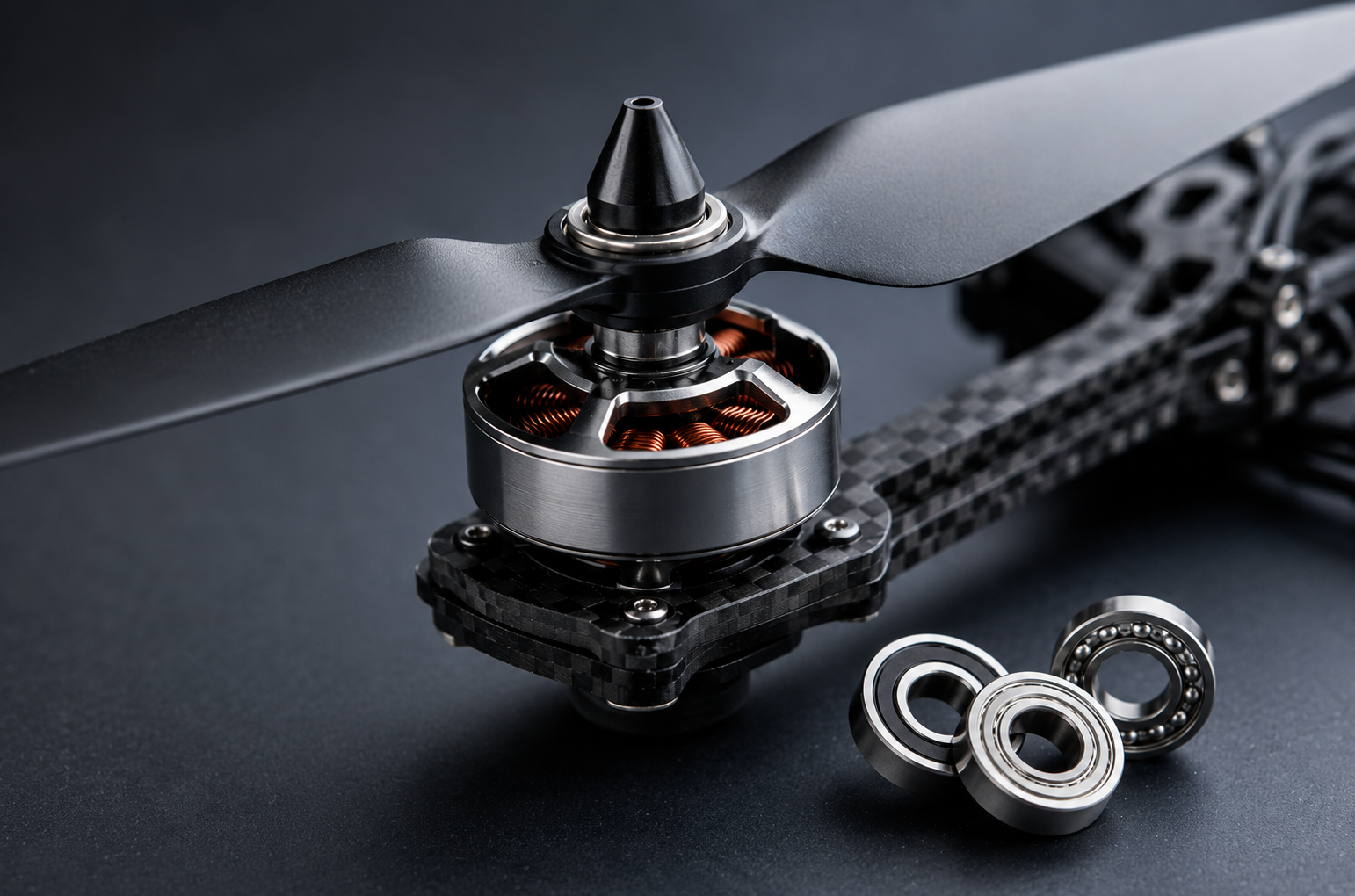
Dock bearings generally move slowly and intermittently through short strokes or partial rotations, while propulsion-motor bearings run at high speed during flight. In a propulsion motor, the priorities are low drag at speed, runout, balance, and rotor stability, as covered in Drone Motor Bearings. The other on-board positions are reviewed in bearings in drones and UAVs. In a dock, the priorities change: breakaway torque after standstill, resistance to corrosion and contamination while idle, tolerance for frame distortion, and repeatable positioning at the end of each stroke.
That shift changes several familiar choices. A contacting seal that would cost too much drag in a small motor is often acceptable on a hinge that moves a few times a day. A grease chosen for continuous high-speed rotation may be the wrong grease for a bearing that oscillates through a small angle and then stands still for hours. And a bearing with adequate load capacity on paper can still bind if the enclosure frame twists when the dock is mounted on an uneven surface.
The bearing also cannot be judged apart from the mechanism. Shaft and housing fits, guide parallelism, actuator stiffness, and the structure of the enclosure decide how each bearing is actually loaded as installed.
Standby: What Happens to Dock Bearings While Nothing Moves?
Standby is where many dock bearing problems begin, even though nothing is moving. The enclosure heats in the sun and cools at night. In a ventilated or imperfectly sealed enclosure, temperature changes can draw in humid air. Moisture may then condense on cold bearing rings, guide rails, and shaft seats. Repeated exposure can corrode unprotected steel and compromise lubrication.
At sites exposed to vibration, stationary rolling bearings can experience small movements at the raceway contacts. Wind on the enclosure, nearby machinery, or traffic may contribute. With little rotation to redistribute lubricant, this can cause standstill wear known as false brinelling, while micromovement at the shaft or housing fit can cause fretting at the seats. The risk depends on vibration, load, fit, and lubrication. Damage may later appear as roughness, noise, or uneven torque at specific positions.
Grease ages during standby as well. High enclosure temperatures can accelerate grease aging, while small movements may not redistribute lubricant across the contact. The practical measures that reduce standby damage include:
- Closures chosen for the real exposure, with contacting seals wherever the motion and the actuator can accept the added torque.
- Corrosion-resistant bearing materials or protected rings where condensation is expected, with load capacity confirmed for the chosen material.
- A lubricant selected for slow, oscillating duty across the site temperature range, not only for continuous rotation; the grease selection guide explains the properties that matter.
- Bearing seats and shaft and housing fits that prevent ring movement under vibration.
- Isolation of the enclosure from site vibration where the installation allows it.
- Control logic that exercises mechanisms during long idle periods, where the dock design permits.
Opening the Dock Roof: Hinge and Slide Bearings Under Wind, Ice, and Frame Distortion
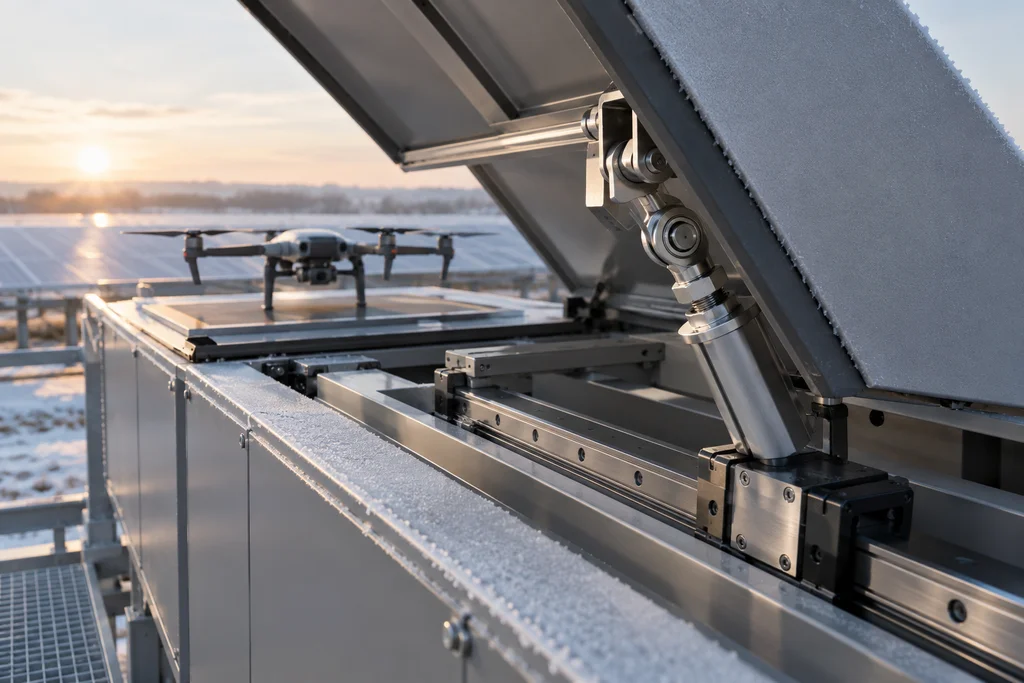
The roof or lid can place a high breakaway demand on its drive because a large panel must start moving from standstill under weather loads. Depending on the design, the dock may use pivoting lids, sliding panels, or both. A pivoting lid may connect to a linear actuator through clevises or rod ends, with spherical plain bearings or rod ends where angular misalignment must be accommodated. Sliding panels may ride on linear guides and carriages.
Breakaway torque at low temperature
Cold grease stiffens, elastomer seals harden, and ice on exposed weather seals adds resistance. The actuator has to overcome the combined breakaway torque of every bearing, seal, and guide in the mechanism, plus the weight of the panel and any snow or ice on it. If the margin is thin, the lid may stall on the first attempt or open only partway, and the drone cannot launch. The factors affecting friction torque all apply here, but the worst case is the coldest morning, not the running condition. Trending actuator start current over the season can provide a useful early warning on a remote dock.
Misalignment and frame distortion
An enclosure can distort when mounted on an uneven base or as its frame changes temperature. Where rigid ball bearings are held in fixed housings, frame twist can misalign the lid pivots and raise torque. Spherical plain bearings and rod ends accommodate angular misalignment at actuator and pivot points, which keeps the load path through the bearing rather than across its edge.
The opposite extreme is also a problem. Play at the hinge shows up as lid rattle in wind and as inconsistent seal compression when the lid closes, which allows water and dust into the enclosure. Free play should be checked as installed, because it accumulates across clevis pins, rod ends, and actuator mounts.
Sliding roofs and guide parallelism
A sliding roof depends on two rails staying parallel as installed and across the temperature range. If the rails are mounted to a surface that is not flat, or if the frame and rails expand at different rates, carriages can bind near one end of the stroke. Wipers and end seals on the carriages help keep grit and ice out of the rolling path. The mounting principles used for profile rail guidance systems largely apply here, and linear guides and carriages should be selected for the moment loads created by a wide, wind-loaded panel.
Wind matters in the open position too. An open lid acts like a sail, and gusts load the pivots, guides, and actuator in directions the closed position never sees. That load case should be reviewed for the pivot bearings and guide carriages, not only the weight of the panel.
Raising the Landing Platform: Screw Support and Guide Bearings Under Off-Center Loads
Where a dock has a movable platform, its bearings must keep the pad level under loads that may be off-center. Some docks raise the landing platform toward the opening for launch and lower it for storage, using a lead screw or ball screw together with linear guides or round shafts and linear bearings.
The screw needs a fixed-end support that holds its axial position under load in both directions. This is where axial angular contact bearings for screw drives or a matched angular contact pair are commonly used. The opposite end is carried by a floating support bearing, or left unsupported on short screws, so that thermal growth is accommodated. The support arrangement, preload, and fits should be confirmed for the screw size, the stroke, and the enclosure temperature range.
The drone does not always land in the center. An off-center landing, or a drone that tips slightly before centering, places a moment load on the platform that travels into the guides as a tilting load. If the guides are too closely spaced or the carriages have too little moment capacity, the platform can cock, the screw sees side load, and the lift may lag or bind on one side.
Two patterns show up when the arrangement is wrong. Too much clearance in the guides or screw support lets the platform settle or rock, which disturbs leveling and the stop position at the top of the stroke. Too much preload, or a second guide that is not parallel to the first, raises drive torque and actuator current. A typical sign is a platform that runs smoothly empty and stalls only with the drone on it. When the arrangement is right, the platform reaches the same height every cycle and the drone sits level for centering. Lift current stays consistent, and wear is shared across the guides rather than concentrated at one carriage.
Centering the Drone on the Pad: Where Repeatability Is Decided
In docks with active centering, the mechanism moves the drone toward a repeatable reference position so charging contacts or battery exchange tools can engage. Push bars, arms, or rollers may run on small linear guides, linear ball bearings on round shafts, or pivots with miniature bearings.
Centering strokes are short and repeated. A short stroke does not move the rolling elements far enough to spread lubricant along the rail, so wear can concentrate in a narrow band. The bars also meet the drone with some impact, and the guides take a sudden load at the end of travel.
When centering repeatability degrades, the dock may still open and close normally. One possible symptom appears downstream: charging contacts may not seat reliably, or battery exchange may need extra attempts. Because the fault surfaces downstream, centering bearings are easy to overlook. Checking guide play and carriage condition belongs in the troubleshooting sequence for charging faults, alongside contact wear and contamination. Before the design is released, the centering mechanism should be checked for:
- Carriage preload or fit class chosen for positioning repeatability, not only for load.
- Seals and wipers suited to the dust and debris carried in by the drone and its downwash.
- An end-of-travel load path into hard stops rather than through the rolling elements.
- A lubrication approach that suits short-stroke duty.
Battery Exchange: Bearing Loads and Positioning Accuracy
In docks equipped for battery exchange, positioning requirements and loads depend on battery mass, magazine geometry, and gripping force. Some systems use a gantry with linear axes, others a rotating magazine or a compact arm. A rotary magazine may use thin-section bearings because they support a large bore in a shallow cross-section, leaving room for wiring and battery slots inside the rotating structure. Their stiffness depends heavily on the housing and shaft around them, so the surrounding structure should keep the rings round as installed.
Selection should account for battery mass, moment loading, runout, radial and axial free play, and behavior over many short moves. Too much clearance may let a magazine shift under gripping force and misalign the battery with the drone’s receptacle. Excessive preload or seal drag raises drive torque and may cause positioning errors if a stepper or servo has little torque in reserve.
Cleanliness is a design input. Dust carried in by the drone can reach the exchange mechanism, depending on the enclosure layout. Closures, guide wipers, and the position of the mechanism relative to debris paths all affect how long the system stays repeatable.
Bearing Priorities Across the Dock Mission Cycle
The stages present in a given dock load bearings differently, so one specification rarely suits every mechanism. The last column can serve as a checklist for a design review or a supplier conversation.
| Mission-cycle stage | Motion and load | What may limit the mechanism | What to confirm |
| Standby | No motion; site vibration, day-night temperature swings, condensation | Standstill damage, fretting on seats, grease separation, corrosion | Closure type, lubricant behavior at storage temperature, corrosion protection of rings and seats |
| Roof opening | Slow oscillation or short linear stroke; panel weight, snow, ice, wind; frame twist | Breakaway torque, edge loading from misalignment | Combined torque at the coldest site condition, misalignment capability, actuator margin |
| Platform lift | Short vertical stroke; drone weight plus off-center landing moment | Screw support stiffness, guide moment capacity, binding between guides | Screw support arrangement, guide spacing, parallelism as installed |
| Centering | Repeated short strokes with impact at end of travel | Positioning repeatability, localized wear, contamination on rails | Carriage preload or fit class, wipers, load path into hard stops |
| Battery exchange | Precise, repeated positioning; battery mass, gripping force, and moment load vary | Runout, free play, load capacity, drive torque reserve, debris | Clearance or preload of rotary bearings, guide accuracy, location relative to debris |
| Roof closing | Closing against seal compression; latching | Hinge play, load at end of travel | Free play across pivots and rod ends, seal compression load path |
Seals, Materials, and Grease for an Enclosure That Stays Outdoors
Because dock mechanisms move slowly, they can usually accept more sealing than high-speed drone components.
Closures
Contacting seals give stronger exclusion of water and fine dust than shields. At low speed, seal friction generates little heat, so the main cost is breakaway torque, especially when the seal lip is cold. For linear guides, end seals and wipers are the equivalent decision, and lead screws exposed near the landing opening may also need covers or bellows.
Materials
Stainless steel bearings improve corrosion resistance where condensation, coastal air, or agricultural chemicals are expected. Their load capacity can differ from chrome steel bearings of the same size, so the substitution should be confirmed rather than assumed. The seats matter as much as the bearing. An aluminum housing bore expands more than a steel outer ring as temperature rises, potentially reducing an interference fit; at lower temperatures, that fit may tighten. Check the intended operating fit across the site’s temperature range.
Grease
The lubricant needs acceptable torque at low temperature, oxidation resistance at the highest enclosure temperature, resistance to water, and suitability for oscillating motion. It also has to be compatible with the seals and any polymer cages. As with drone motor bearings, factory-lubricated bearings should normally stay on their specified grease unless the mechanism has been designed around a different lubrication process. An uncontrolled grease change in the field can raise breakaway torque more than it improves protection.
Designing Dock Mechanisms for Remote Maintenance
A dock bearing should be chosen with the service visit in mind, because the cost of reaching a remote site often exceeds the cost of the component. The decisions that make remote maintenance practical are made at the design stage:
- Choose between sealed-for-life bearings and relubrication points deliberately, and make any relubrication point. reachable without dismantling the mechanism.
- Group bearings into subassemblies that a technician can replace as a unit on site.
- Base inspection intervals on cycle count and site conditions rather than calendar time alone.
- Use actuator current, cycle time, and stop-position data to flag changes in mechanism performance; investigate bearings alongside other possible causes.
- Record each replacement so that repeated failures at one position are investigated rather than repeated.
- Specify replacement bearings by closure, clearance, lubricant, material, and precision, not only by bore, outside diameter, and width.
Drone Docking Station Bearing FAQs
Can the same miniature bearings used in drone motors be used in dock mechanisms?
Not based on size alone. Propulsion-motor bearings are selected for high-speed operation and may use shields or seals with a specified lubricant. Dock mechanisms move slowly, stand still for long periods, and may need different contamination protection, grease, or corrosion resistance. Check the actual load, closure, lubricant, and material before using the same bearing in a dock.
Why does a dock lid or platform stick after a cold night?
Possible causes include stiffened grease, hardened or iced weather seals, and fit changes caused by different rates of thermal contraction. These effects can raise the force needed to start the mechanism, leaving less actuator margin than a room-temperature test suggested. Checking torque at the lowest expected temperature is the most direct way to confirm the design.
Are plain bearings or rolling bearings better for dock hinges?
It depends on the motion and the load. Spherical plain bearings and rod ends accommodate misalignment and suit slow oscillation with shock from wind, while rolling bearings offer lower and more consistent running torque where the mechanism needs precise, low-effort motion. Many docks use both: spherical plain bearings at actuator connections and rolling bearings or guides where positioning matters.
Should dock bearings be sealed even if it raises actuator torque?
Often, if the exposure warrants it and the added torque fits within the actuator margin at the coldest condition. At low speed, seal drag is more likely to affect breakaway force than heat. A protected enclosure may need a different closure choice from a mechanism exposed directly to water and fine dust.
Do linear guides in a dock need wipers or bellows?
Yes, where dust, sand, ice, or debris carried by the drone can reach the rails. End seals and wipers protect the rolling path at the carriage, and covers or bellows protect exposed screws and rails near the landing opening. The added resistance should be included in the drive sizing.
Can worn centering or platform bearings cause charging faults?
Yes. If guide play or platform tilt allows the drone to settle in a slightly different position each cycle, charging contacts and battery exchange tools may not engage consistently. The dock can still open and close normally, so the fault often looks electrical. Checking mechanical repeatability should be part of diagnosing intermittent charging problems.
Do dock mechanism bearings need preload?
It depends on the position. Screw supports and positioning guides may need controlled preload or limited clearance to hold position under reversing loads. Lid pivots and actuator connections usually do not, but their free play should still be limited and checked as installed. Too much preload anywhere in the dock raises breakaway torque, which is often the limiting factor at low temperature.
Final Thoughts
The main engineering decision in a drone docking station is to select bearings for how they behave after standstill and at the end of each stroke, rather than for speed. Each mechanism, from the roof to the battery exchange, has its own load case, and the bearing performs only as well as the fits, guide alignment, closures, and lubricant around it. Checking those conditions against the site reduces the risk of a cold-start stall or an unscheduled service visit.
For a new dock design or a recurring field problem, useful starting data includes the site temperature range and exposure, cycles per day, stroke lengths and pivot angles, and drone weight with its typical landing offset. Add the wind exposure of the open lid, the actuator force or torque margin, how the enclosure is mounted, and how each mechanism is reached for service. PIB can help review that information for bearing type, arrangement, clearance, preload, closure, and lubricant for each position in the dock.
Call us (800) 228-8895, email us [email protected], visit us www.pibsales.com.